
Forex is traded by banks and dealers, investment funds, companies, central banks and governments, and retail traders like you. Most of the volume passes through large banks, and many participants trade because they must, not to make a profit. Knowing who trades forex helps you understand why price moves, why news matters and why some chart tricks do not work.
Who trades forex? The main players
When you place a trade, it can feel as if you are alone with the price. In reality you are one of many players in the largest financial market in the world, and most of them have different goals from yours.
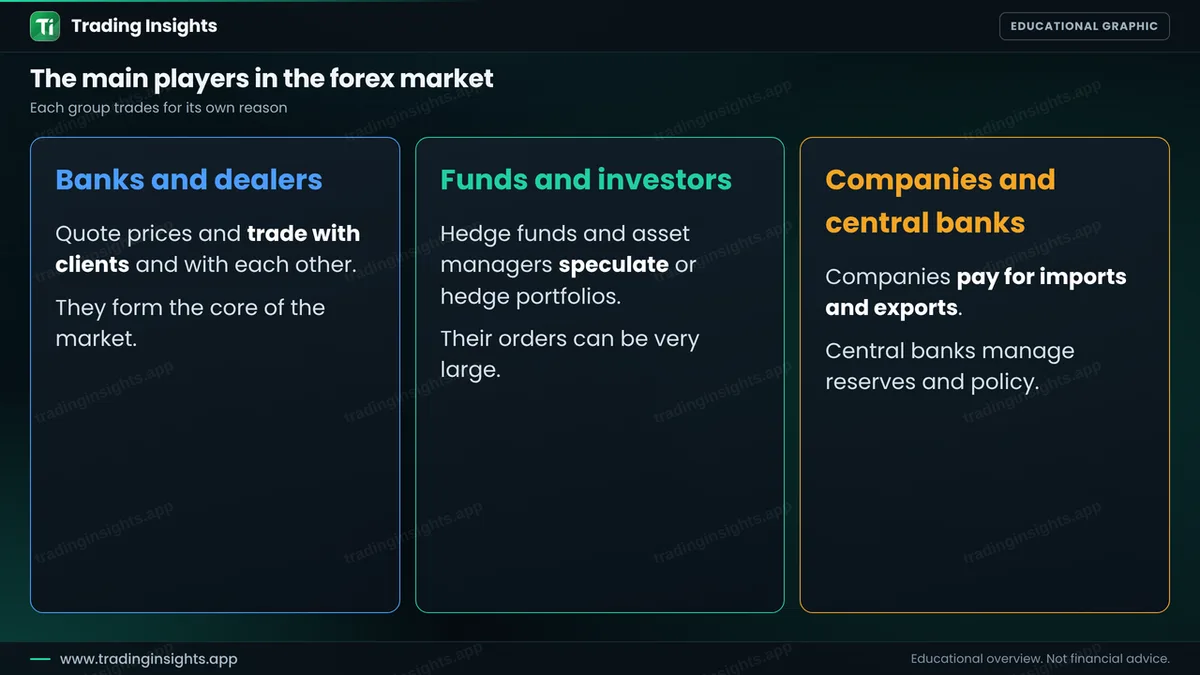
- Banks and dealers. Large banks sit at the centre of the market. They quote prices to clients and to each other, and they manage their own risk. Most of the volume passes through them.
- Funds and investors. Hedge funds, asset managers and pension funds trade to make a profit, or to hedge the currency risk of their investments. Their orders can be very large.
- Companies. A business that buys goods abroad, or earns money in another currency, needs to exchange money. These trades are not speculation. They are part of everyday business.
- Central banks and governments. They manage reserves and carry out monetary policy. Their decisions can move prices sharply. See interest rates and forex.
- Retail traders. Individuals who trade through a broker, like most readers of this site.
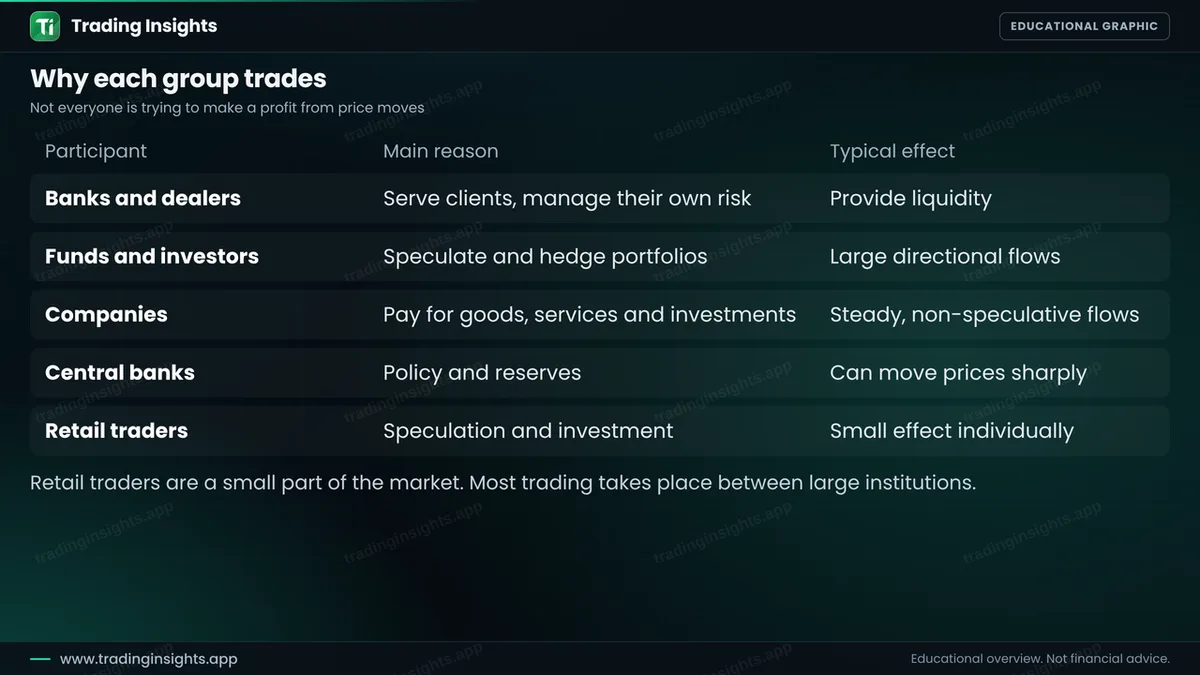
Why each group trades
This is the most important point: many players trade because they must. A company that needs euros to pay a supplier will buy them at whatever the price is. A fund that needs to hedge will do it on a schedule. These flows create the movement that technical traders try to read.
The retail share of the total is small, and most of the trading takes place between large institutions, mostly through banks. Because there is no single exchange, prices can differ slightly between providers. See forex broker types for how your broker connects to this market.
How the market is layered
The market has several layers, and your order sits near the bottom of them.
- Banks trade with each other in the interbank market, which sets the base prices.
- Brokers connect retail traders to liquidity providers, often through banks. The spread you pay is part of this chain. See bid and ask prices.
- Different instruments, such as spot, forwards and futures, are used by different players. See spot forex, CFDs and futures.
Each layer adds its own pricing and costs. That is why two brokers can show slightly different quotes at the same moment, and why your cost is never exactly the "market price".
What this means for you
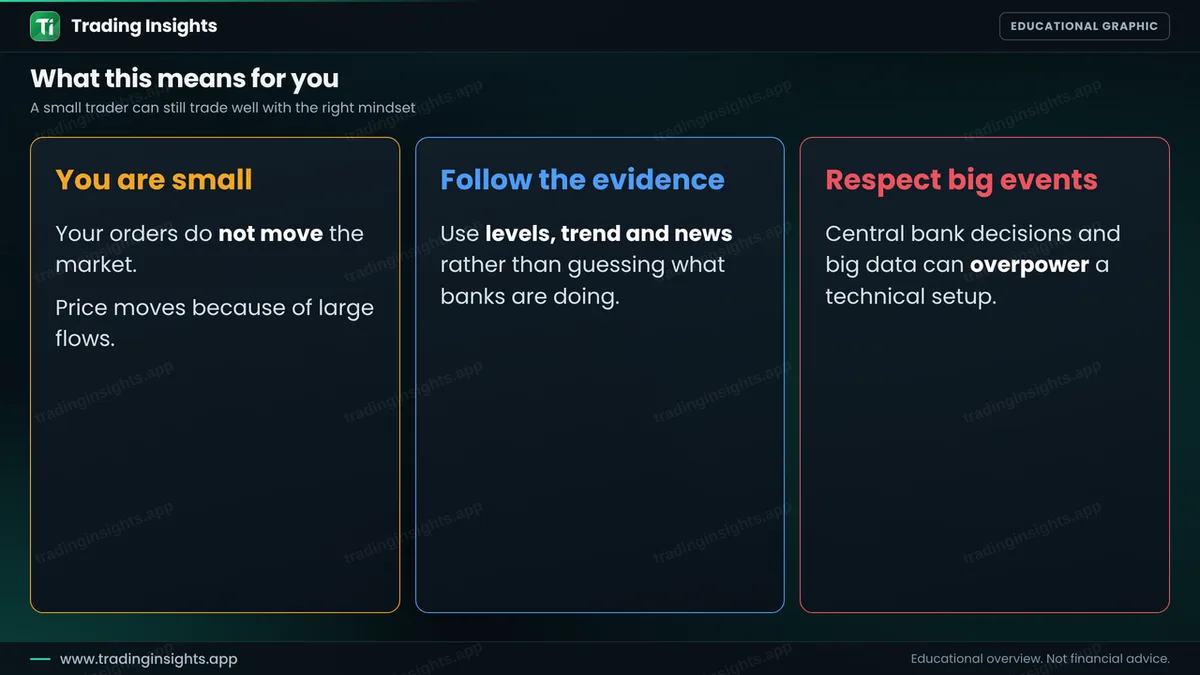
- You are small. Your orders do not move the market, so you do not need to fight it. You only need to read it and join it at good places.
- Use evidence, not stories. Many beginners believe that "banks are hunting my stop". Sometimes price does sweep obvious levels, see liquidity sweeps, but you can only use what the chart shows. Do not build your plan on guessing what a bank is doing.
- Respect big events. A central bank decision or a major data release can overpower any chart pattern. See trading forex news.
- Know the times. Different players are active at different hours. See forex trading sessions.
- Manage risk. Because you cannot control the large flows, your protection is your stop and your size. See how to calculate position size.
Illustrative example: your trade next to a company's payment
This is an illustrative example with made-up numbers. A company has to pay a supplier 5,000,000 euros next week and exchanges dollars for euros. It does not care whether the price is 20 pips better or worse, because the payment is due.
A retail trader sees a EUR/USD buy setup, enters at 1.0820 and puts the stop at 1.0795 (25 pips). With a $10,000 account risking 1% ($100), the position size is $100 / (25 pips x $10 per pip per lot) = 0.40 lot, which is 40,000 euros. A win of 50 pips pays about $200, and a loss costs about $100.
The company's order is about 125 times larger than the trader's (5,000,000 / 40,000). The trader's order is a tiny part of the flow, so the plan should not depend on moving or beating it. It should depend on a clear level, a stop and a size that keeps the loss small.
Common mistakes
- Believing you can see what "smart money" is doing from a chart alone. A chart shows prices, not the identity of the buyer. Trade what you can see, such as levels, trend and news.
- Assuming every large move is caused by speculators. Many moves come from payments, hedges and policy. Do not invent a story for each candle.
- Trading a technical setup into a major announcement. A central bank decision can overpower the pattern. Check the calendar and stand aside or reduce the size.
- Blaming the market, or the banks, for a plan that had no stop. You cannot control large flows. You can control your stop and your size, so fix those first.
Frequently asked questions
Who are the biggest players in forex?
Large banks and dealers handle most of the volume, together with investment funds, companies and central banks. Each one trades for its own reasons, such as profit, hedging or paying for goods.
What share of the forex market is retail?
It is a small share. Most of the trading takes place between large institutions. The exact figure varies by source and by period, so treat any single number with care.
Do banks trade against retail traders?
Banks trade with brokers and each other. What happens to your order depends on your broker. See the broker types article for the models.
Why does it matter who trades?
Because different players have different reasons to trade, and their large flows and the timing of their activity create the moves you see on the chart. Knowing this keeps your expectations realistic.
Your next step
Open a glossary page for "liquidity" and "interbank market", then look at one pair across the Asian, London and New York hours of a single day. Note when the candles are largest. This links the idea of who is active to what you see on the screen.
This is education, not financial advice. Trading carries risk, and no method guarantees results. The charts are illustrative and not real market data.


