
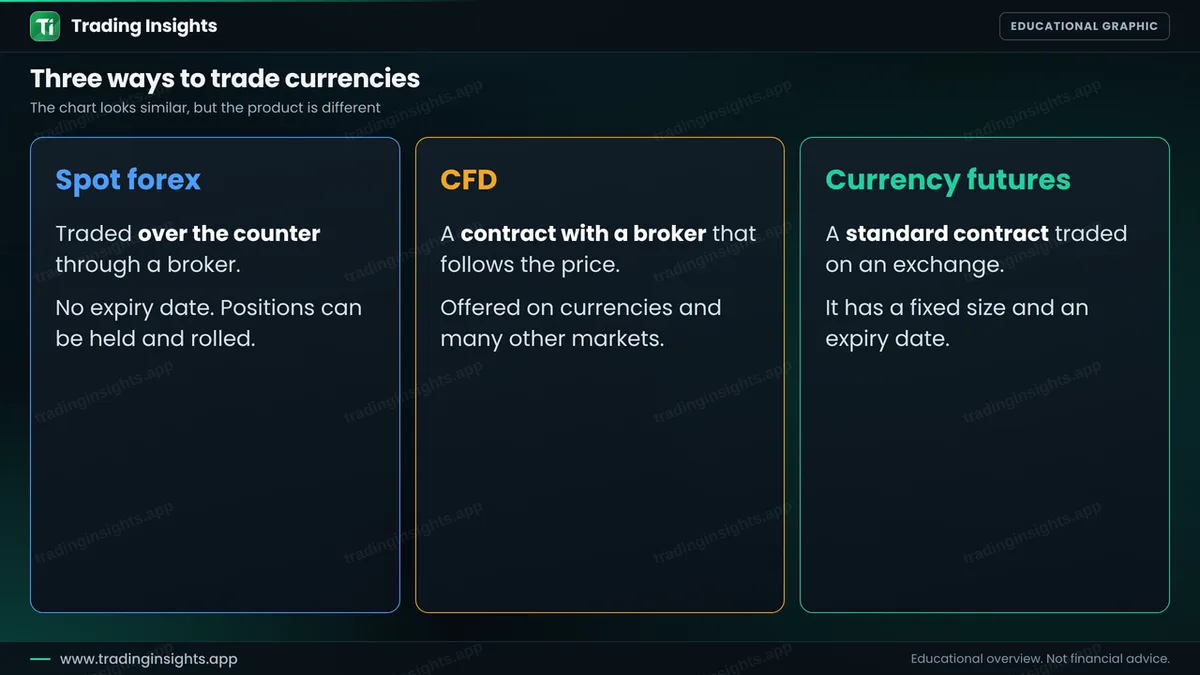
Spot forex, CFDs and currency futures all let you trade the same pair, such as EUR/USD, but they are different products. Spot forex is traded over the counter through a broker, a CFD is a contract with a broker that follows the price, and a currency future is a standard contract traded on an exchange with an expiry date. Which products are available to you depends on your country and your broker, so knowing which one you are really trading matters.
Spot forex vs CFD vs futures: the three products
- Spot forex. A trade to exchange one currency for another at the current price, usually through a broker in the over-the-counter market. There is no central exchange. A retail trader normally does not take delivery of the currency. Positions are rolled forward, which creates swap. See forex swap and rollover.
- CFD (contract for difference). A contract between you and a broker to exchange the difference between the opening and closing price. CFDs exist on currencies and on many other markets. Many retail forex accounts are, in legal terms, CFDs.
- Currency futures. A standardised contract traded on an exchange. It has a fixed contract size and an expiry date, and it is cleared through a central clearing house.
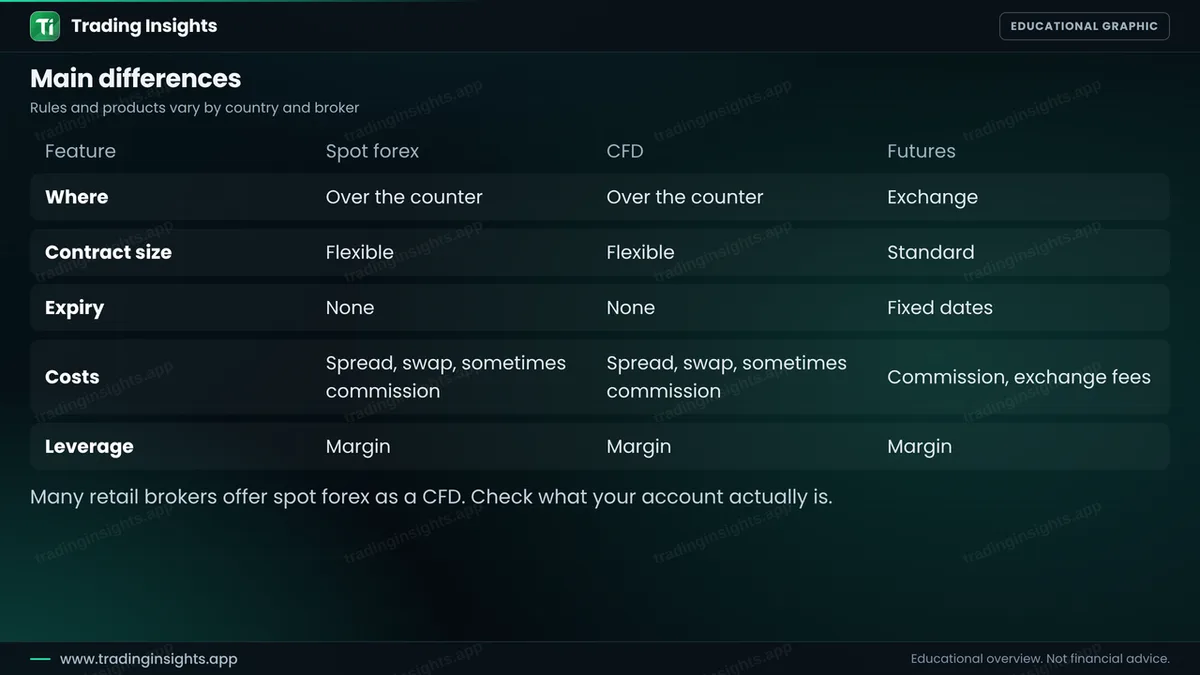
Main differences
Spot forex and CFDs are alike for most traders: you trade with a broker, the position size is flexible, there is no expiry, and you pay the spread, sometimes a commission, and swap for holding overnight. See forex trading costs.
Futures are traded on an exchange with standard contract sizes, which are often larger than the small lots many retail traders use, and they have expiry dates. Costs usually come as commission and exchange fees, and the quoted price is visible in a central order book. All three use margin, so all three involve leverage.
Illustrative example: sizing the same idea in two products
This is an illustrative example, not a real trade. A trader wants to buy EUR/USD with a 20-pip stop on a $10,000 account, risking 1% ($100).
In spot forex or a CFD, the position size is $100 / (20 pips x $10 per pip per lot) = 0.50 lot. A 40-pip target pays about $200, and a loss costs about $100.
A standard euro futures contract is commonly 125,000 euros, which is worth about $12.50 per pip. One contract with a 20-pip stop risks 20 x $12.50 = $250, or 2.5% of the account. Contracts cannot usually be split, so the trader either accepts that risk, widens the account, or looks for a smaller contract if the exchange offers one. Check the contract specifications with your broker, because sizes and tick values vary.
The same idea has the same chart but a different risk step. That is why contract size matters for small accounts.
Which is better?
None is better for everyone. Spot forex and CFDs are flexible and widely available, with small position sizes that suit small accounts. Futures offer a regulated exchange, transparent prices and standard terms, but the contracts are larger, and they expire.
What matters more is how the broker handles your orders, how it is regulated, and how clear the costs are. See forex broker types and how to check if a broker is regulated.
What to check before you choose
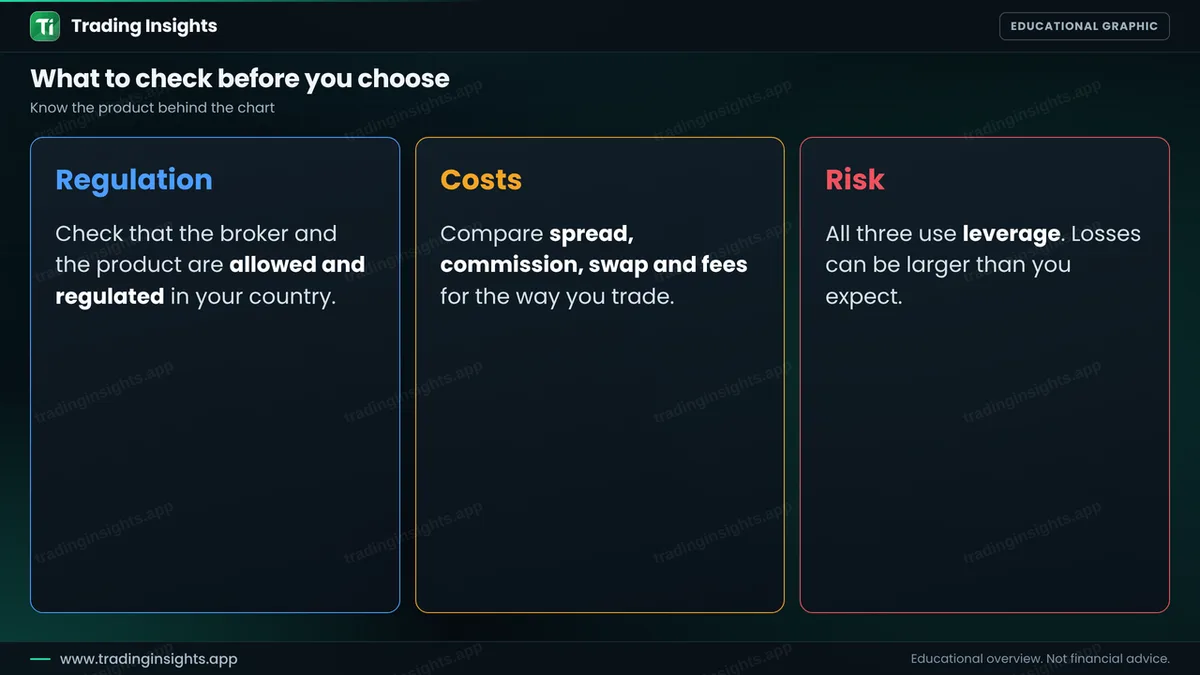
- Regulation. Check that the broker and the product are allowed and regulated where you live. Rules for retail clients differ between countries, and some products may be restricted.
- Costs. Compare the total cost for the way you trade: spread, commission, swap and other fees. See bid and ask prices.
- Contract size. Check that you can size positions to your risk. See how to calculate position size and the position size calculator.
- Leverage and margin. Know the margin rules and what happens if the account falls. See margin call and stop out.
- Expiry and rollover. For futures, know when the contract ends and how to roll it.
Costs compared
Costs look different in each product, so compare the total, not one number.
| Spot forex | CFD | Futures | |
|---|---|---|---|
| Where it trades | Over the counter | With your broker | On an exchange |
| Expiry | None | Usually none | Fixed date |
| Typical costs | Spread, swap, sometimes commission | Spread, swap, sometimes commission | Commission and exchange fees |
This is a general guide. Brokers differ, so read the fee schedule for your account.
A note on risk
- Leveraged products can lose money quickly. A small price move can create a large loss compared with your deposit.
- Learn on a demo account first. See demo account vs live account.
- Keep the risk per trade small, and always use a stop.
Common mistakes
- Not knowing which product the account really is. The rules and protections differ. Read your account terms.
- Comparing only the spread. Swap and commission can matter more for your style. Compare total cost.
- Using a futures contract that is too large for the account. One contract can risk more than you planned. Check the tick value before you trade.
- Assuming all three products have the same rules in every country. Availability and rules vary. Check your local regulator.
Frequently asked questions
Is spot forex the same as a CFD?
For many retail traders, they work in a similar way, and many forex accounts are offered as CFDs. The legal structure and the rules depend on the broker and the country.
What is a currency future?
It is a standardised contract to exchange currencies at a set price on a future date, traded on an exchange with fixed contract sizes.
Which product has lower costs?
It depends on the broker, the pair and how you trade. Compare the total costs, including spread, commission, swap and fees.
Are all three products leveraged?
Yes. All three use margin, so losses and gains are larger than the deposit would suggest, and risk management is needed.
Your next step
Open your account terms and find out which product you actually trade, then list its spread, commission, swap and contract size. That one page tells you the real cost of your next trade.
This is education, not financial advice. Trading carries risk, and leveraged products can lose more quickly than many expect. The charts are illustrative and not real market data.


