
The three common forex broker types are market maker, STP and ECN, and the difference is how the broker handles your order and how it earns money. A market maker quotes its own prices and often takes the other side of your trade, an STP broker passes your order to liquidity providers, and an ECN broker connects you to a pool of participants and charges a commission. None is automatically best, so this article explains each in simple language and what to ask before you choose where to trade.
Market maker, STP and ECN brokers
These models are simplified. Many brokers use a mix, and the marketing names are not always precise. Still, the basic ideas are useful.
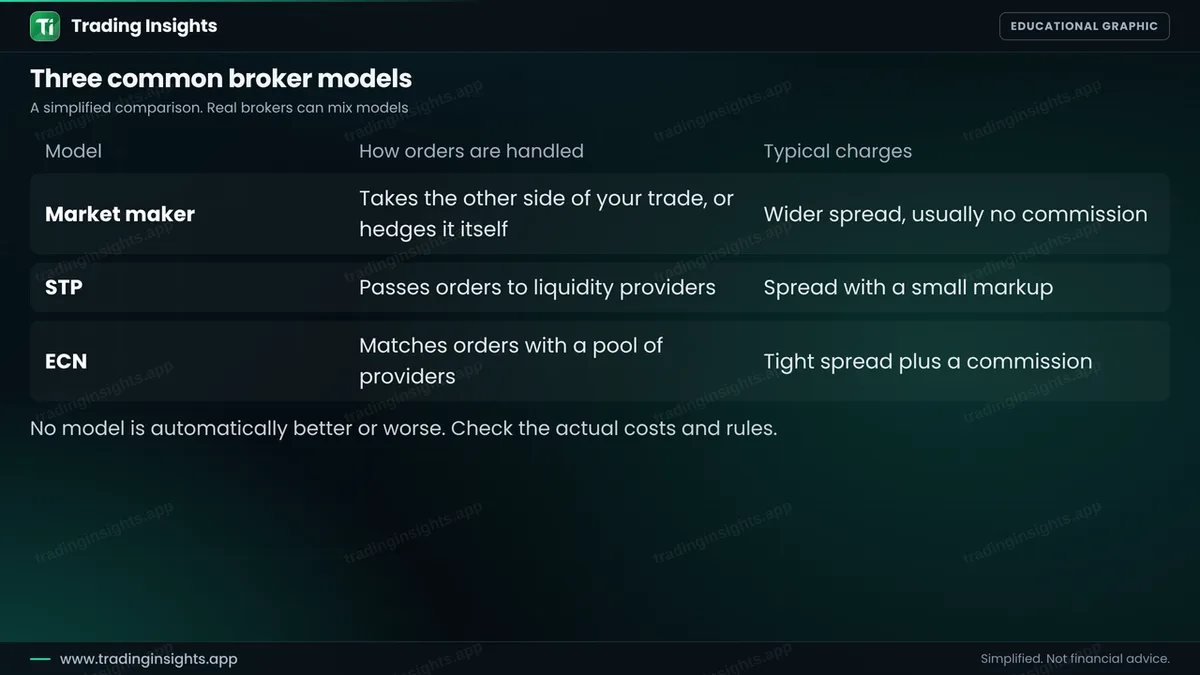
A market maker, also called a dealing desk broker, quotes its own prices and often takes the other side of your trade, or hedges it itself. It usually shows fixed or wider spreads and often no commission.
An STP (straight-through processing) broker passes your orders to liquidity providers, often adding a small markup to the spread.
An ECN broker connects your orders to a pool of participants, with raw spreads that can be very tight, and charges a commission per lot.
| Model | Order handling | Typical charge |
|---|---|---|
| Market maker | Often takes the other side | Wider spread, often no commission |
| STP | Passes orders to liquidity providers | Spread plus a markup |
| ECN | Matches with a pool of participants | Raw spread plus commission |
Which forex broker type is best?
No model is automatically better or worse. A market maker can be a fair option, especially for small accounts that want a simple cost structure. An ECN can be good for active traders who need tight spreads, but the commission must be counted.
What matters is how the broker behaves: whether it fills orders fairly, whether the costs are clear and whether it pays out withdrawals. The total cost is the number to compare: spread plus commission plus swap. See forex trading costs and bid and ask prices.
How to choose a forex broker: what to check
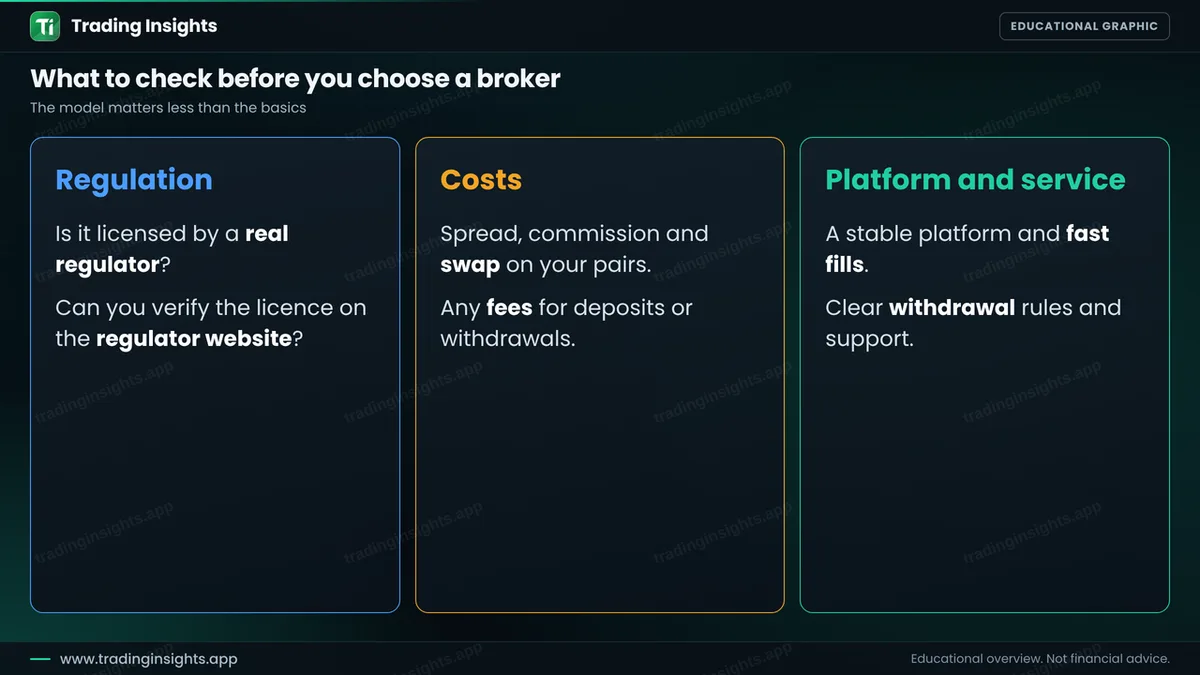
- Regulation. Check that the broker is licensed by a real financial regulator, and verify the licence on the regulator's own website. Do not rely on a logo alone.
- Costs. Compare the total cost for the pairs you trade, including spread, commission, swap and fees for deposits or withdrawals.
- Platform and execution. A stable platform, fast order fills and little slippage matter. See slippage in forex.
- Funds and withdrawals. Read how client money is held and how long withdrawals take.
- Support and education. Clear and quick answers help, especially for a beginner.
- Account options. Check the minimum deposit, the lot sizes (micro lots help small accounts) and the leverage rules. See leverage in forex.
Illustrative example: comparing the cost of two brokers
This is an illustrative example with made-up numbers, not real quotes. A trader takes a 1-lot EUR/USD round trip, where one pip is worth about $10.
Broker A (market maker): a typical spread of 1.4 pips and no commission. The cost is 1.4 x $10 = $14.
Broker B (ECN): a typical spread of 0.3 pips plus a commission of $7 per lot round trip. The cost is 0.3 x $10 + $7 = $10.
In this made-up case Broker B is cheaper by $4 per lot. But if Broker B's spread widens to 1.0 pip at the hours you trade, the cost becomes $10 + $7 = $17, and Broker A wins. That is why you compare the cost at your own trading times, not the advertised minimum. Real spreads and commissions vary by broker, so check your own.
A simple way to compare two brokers
- Choose one pair and one position size you trade often.
- Write the total cost on each broker for a round trip: spread plus commission.
- Check the typical spread at the times you trade.
- Check the withdrawal fees and time.
- Read recent reviews from independent sources, and be careful with reviews that look like advertising.
Red flags to avoid
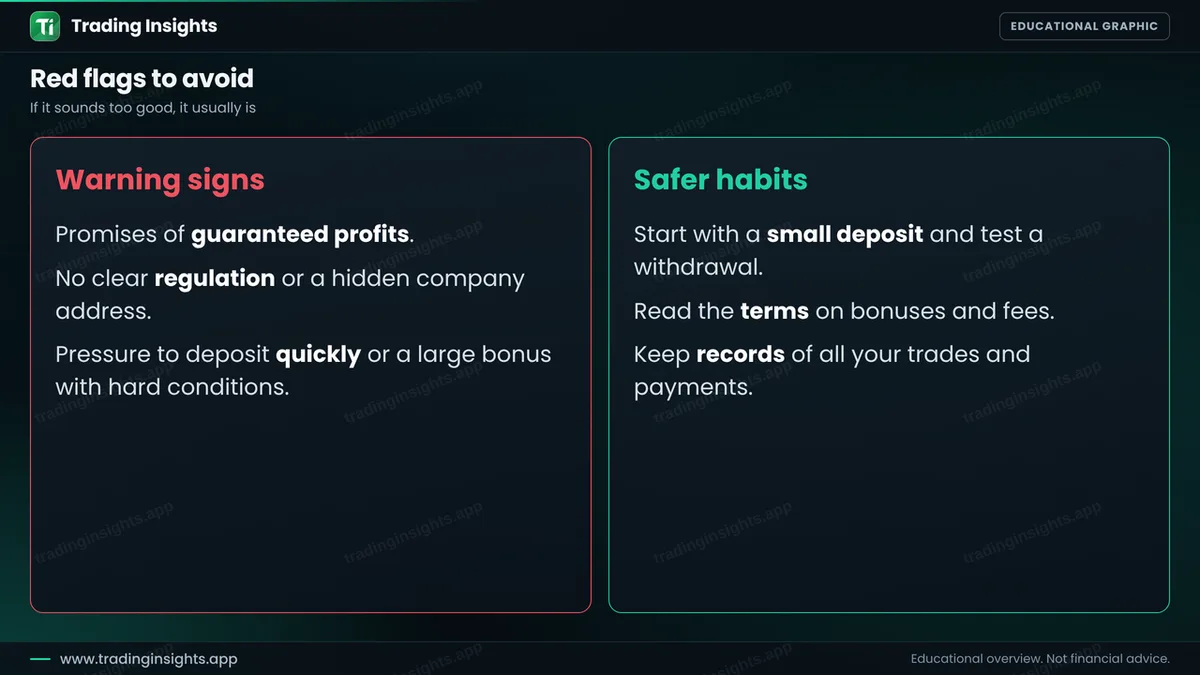
Be careful with brokers or people that promise that you cannot lose, hide the company address or regulator, pressure you to deposit quickly, or offer large bonuses with hard conditions.
A safer habit is to start with a small deposit and to test a withdrawal early, so that you know how the process works. Keep records of your trades and payments. If you are a beginner, it is also wise to learn on a demo account first.
Common mistakes
- Choosing a broker only because of a big bonus or very high leverage. Bonuses often come with hard conditions and high leverage raises risk. Choose on regulation and costs first.
- Comparing the spread but forgetting the commission. A raw spread looks small until the commission is added. Compare the total round-trip cost.
- Skipping the check of the regulator. A logo proves nothing. Verify the licence number on the regulator's own site.
- Depositing a large amount before testing the broker. Start small and test a withdrawal. Do not believe that one model is always honest and another always dishonest.
Frequently asked questions
What is a market maker broker?
It is a broker that quotes its own prices and often takes the other side of your trade. It usually earns from the spread rather than a commission.
What is an ECN broker?
It is a broker that connects your orders to a pool of liquidity providers, often with very tight spreads and a commission per lot.
What is STP?
Straight-through processing means that the broker passes your orders to its liquidity providers without a dealing desk, often adding a markup to the spread.
How do I check that a broker is regulated?
Find the licence number on the broker website and verify it on the official website of the regulator. Do not trust a logo alone.
Your next step
Pick two brokers you are considering and fill in the round-trip cost for your usual pair and lot size at the hours you trade. Verify each licence on the regulator's website, then open a demo account before you deposit. The glossary can help with any term you do not know.
This is education, not financial advice. Trading carries risk, and broker terms vary, so check them yourself. The charts are illustrative and not real market data.


