
To check if a forex broker is regulated, find its licence number, then search for that number on the regulator's official register, which you reach by typing the address yourself. The name, number and website on the register must match what the broker shows. Many brokers say they are "regulated", but the word can mean very different things, and some claims are simply false. This article explains the checks step by step and what regulation can and cannot do. Rules differ from one country to another, so check the rules where you live.
Why forex broker regulation matters
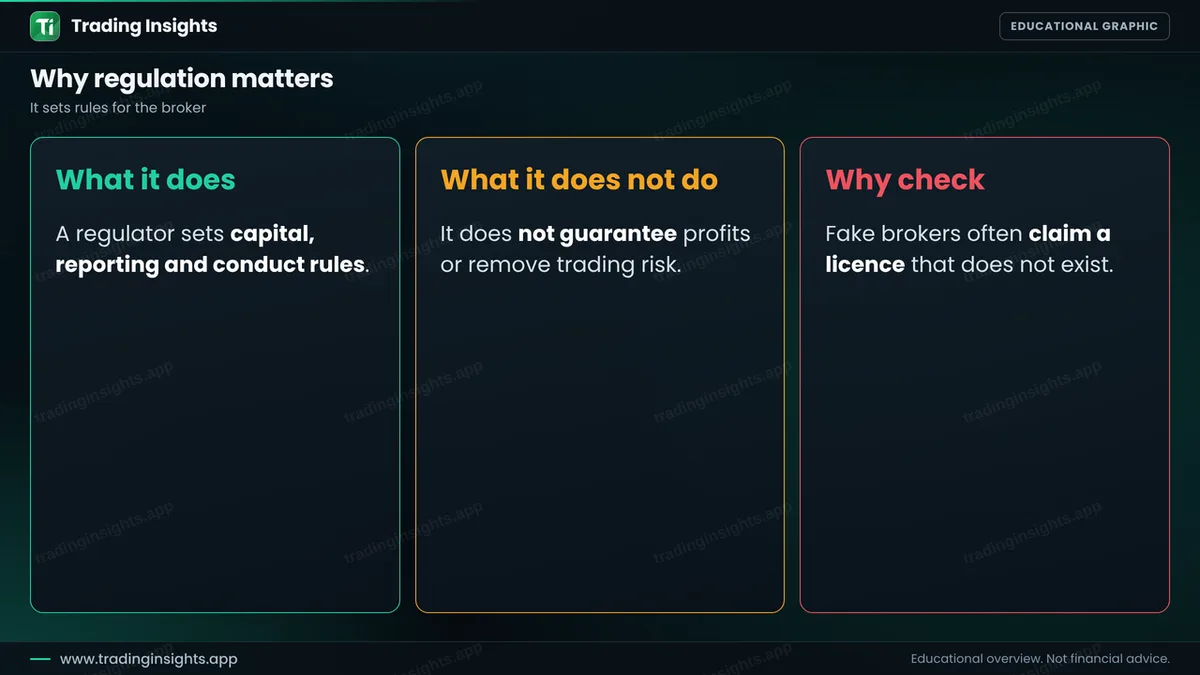
A financial regulator is a public body that sets rules for firms that offer financial services: how much capital they must hold, how they report, how they treat client money and how they handle complaints. A regulated broker can be inspected, fined or closed. An unregulated one answers to no one.
Regulation does not guarantee that you will make money, and it does not remove the risk of trading. It only makes it more likely that your deposit is handled honestly. See broker types for how brokers earn money, and read about the warning signs of fraud before you deposit.
How to check if a broker is regulated
Do not rely on the broker's own website alone. Anyone can place a logo and a licence number in a footer.
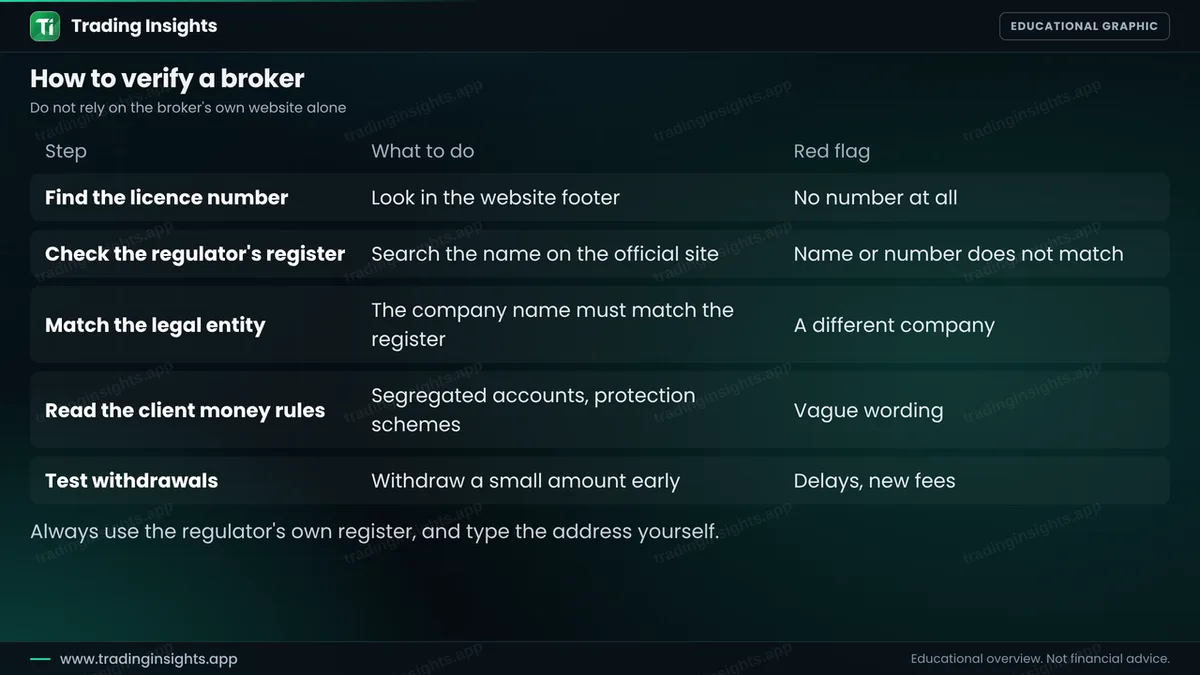
- Find the licence number. Look in the footer or the legal documents. If there is no number, treat that as a warning.
- Check the regulator's register. Open the regulator's official website by typing the address yourself, and search for the firm name or number. Do not use a link from the broker or from an advertisement.
- Match the legal entity. The company name, the number and the website address on the register should match what the broker shows. Some brands have several entities, and the one that serves you may be regulated in a weaker place than the one that is advertised.
- Read the client money rules. Look for segregated client accounts, and ask whether any compensation scheme applies. Rules and limits differ.
- Test withdrawals. Deposit a small amount, and withdraw part of it early. Delays, unexpected fees and excuses are red flags.
Illustrative example: a ten-minute check
This is an illustrative example, not a real broker. A trader finds a broker that claims to be "fully licensed" and shows a number in the footer. She types the regulator's address herself and searches for the number. The register shows a different company name, and the broker's website address is not listed. She stops, and chooses another broker whose name, number and address match.
The same trader then tests the new broker with small numbers. She deposits $200 and requests a withdrawal of $100. If the $100 arrives within the stated time and with no surprise fee, that is one good sign. If it is delayed, or the support team keeps asking for new documents without a reason, she stops before depositing more.
The cost of this test is a few dollars of time and effort. The cost of skipping it could be a large deposit that is hard to recover.
Good habits that reduce your risk
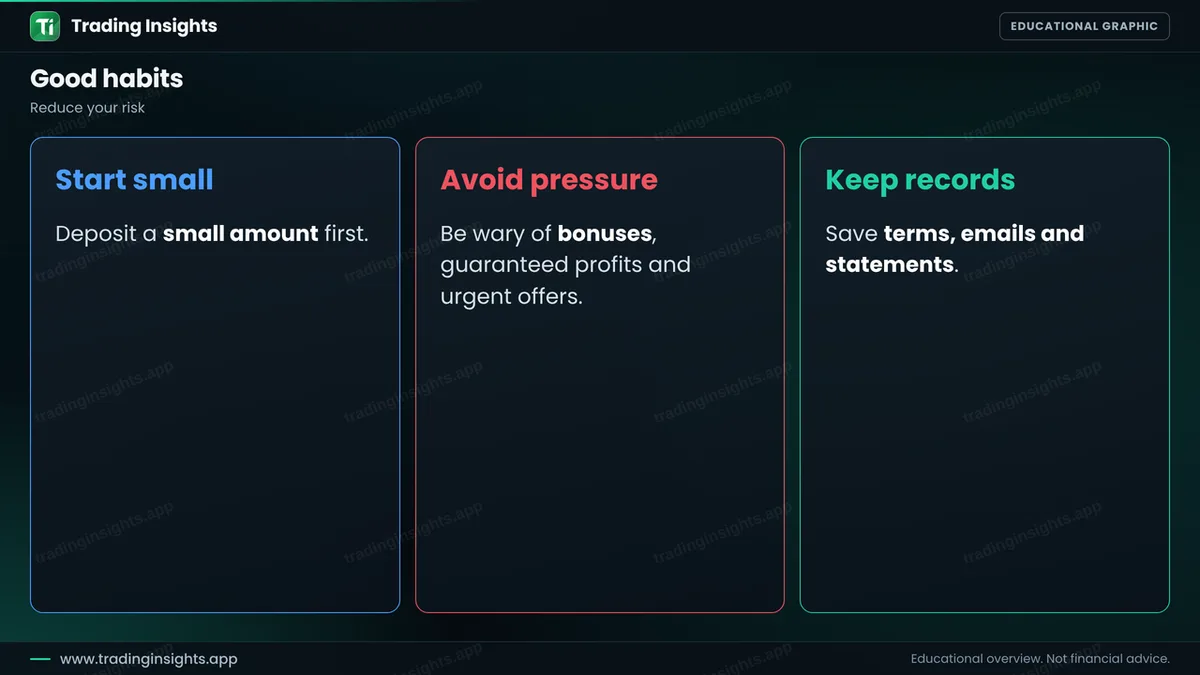
- Start small. Test the platform, the spreads and the withdrawals before you deposit more. See demo vs live accounts.
- Avoid pressure. Be careful with promises of fixed profits, large bonuses and calls that push you to deposit now.
- Understand the costs. Read the spreads, commissions and swaps. See forex trading costs.
- Keep records. Save the terms, emails and statements.
- Do not trust signals from strangers. See forex signals and copy trading.
What regulation cannot do
A regulated broker can still have a poor platform, wide spreads or slow support. Rules also differ between regulators: some require high capital and strict reporting, and some are very light.
Regulation does not protect you from your own losses either. Most retail traders lose money, and a licence does not change this. Treat regulation as a minimum check, not as a stamp of quality. It does not replace risk management. See the 1% rule.
Common mistakes
- Trusting the licence claim without checking the register. A number in a footer proves nothing. Search for it on the official site.
- Using a link from the broker to reach the "regulator". The link can lead to a copy of the real site. Type the address yourself.
- Ignoring the legal entity that holds your account. The advertised brand may be regulated while your entity is not. Match the names.
- Believing that regulation removes trading risk. It sets rules for the broker, not for the market. Use a stop and a small risk per trade.
Frequently asked questions
How do I know if a forex broker is regulated?
Find the licence number, and check it on the official register of the regulator, which you reach by typing its address yourself. Make sure the name and website match.
Does regulation guarantee that I will not lose money?
No. It does not remove trading risk. It only sets rules for how the broker operates.
What if the broker has several entities?
Check the one that will hold your account. Its regulator and protections may differ from the brand that is advertised.
What is a good first test of a broker?
Deposit a small amount and make a small withdrawal early to see how it is handled.
Your next step
Pick the broker you are considering, write down its legal entity name and licence number, and look it up on the regulator's official register today. Do this before you deposit anything.
This is education, not financial advice. Trading carries risk, and regulation does not remove it. The charts are illustrative and not real market data.


