
A pre-trade checklist is a short list of questions you answer before every entry, and it is one of the simplest ways to avoid impulsive forex trades. When a candle moves fast, it is easy to forget your rules and click. The checklist adds a pause at the right moment and turns your plan into a habit. This article shows how to build one and use it.
Why use a pre-trade checklist
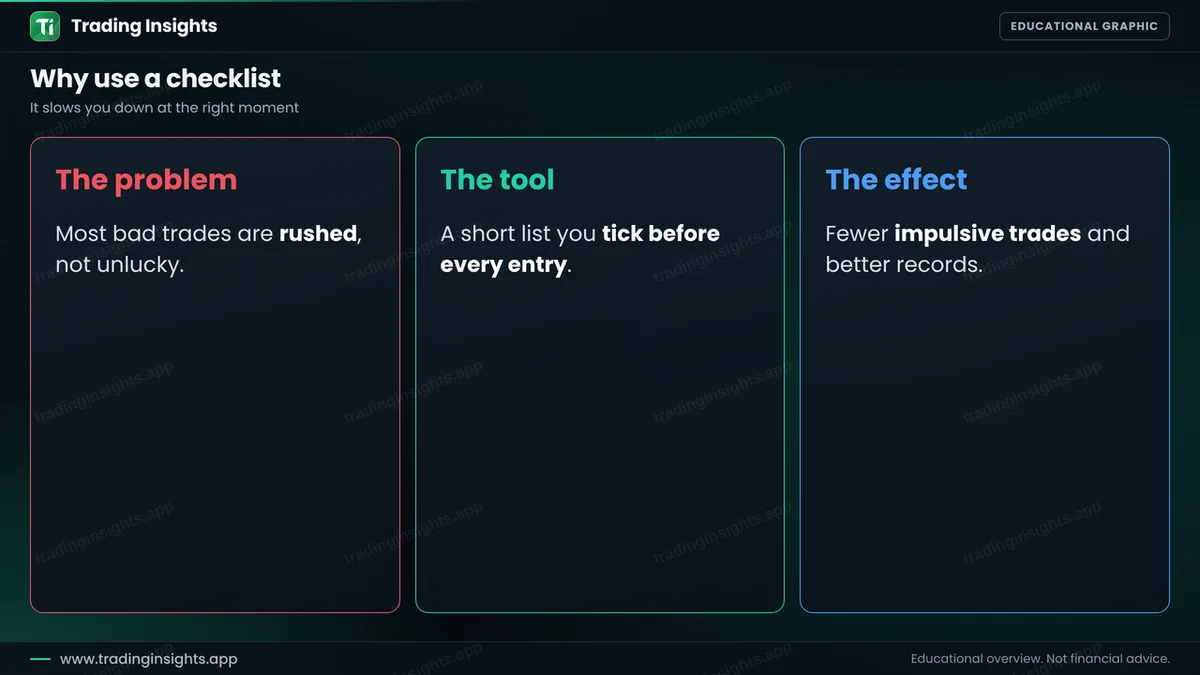
Pilots use checklists because memory fails under pressure, and traders face a similar problem. Looking back at losing trades, many were not bad luck. They broke a rule: a missing stop, a trade against the trend, an entry before the candle closed, or a position that was too large.
See common forex trading mistakes, FOMO and overtrading. A checklist works because it asks the questions that you would skip when excited. It does not make a good trade better, but it removes the worst ones.
A sample forex trading checklist
- Does it match my setup? All the rules of the setup are met, and not "almost". See confluence trading.
- Is the higher timeframe with me? If not, reduce the size or skip. See top-down analysis.
- Is the stop at a chart level? It should have a reason. See stop loss and take profit.
- Is the risk 1% or less? Calculate the size from the stop. See how to calculate position size and portfolio risk.
- Is news coming? Check the calendar. See trading forex news.
- Is the reward worth it? The target should offer at least the ratio in your plan. See the risk-to-reward ratio.
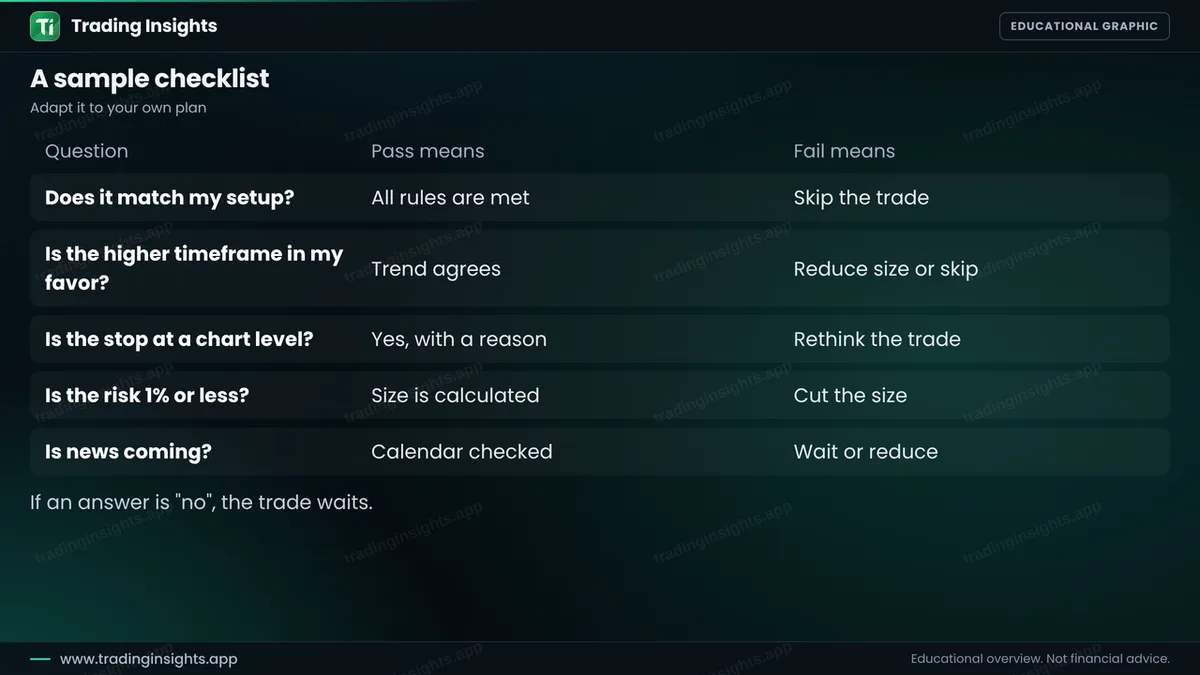
If any answer is "no", the trade waits. The checklist is not a negotiation.
How to make a checklist work
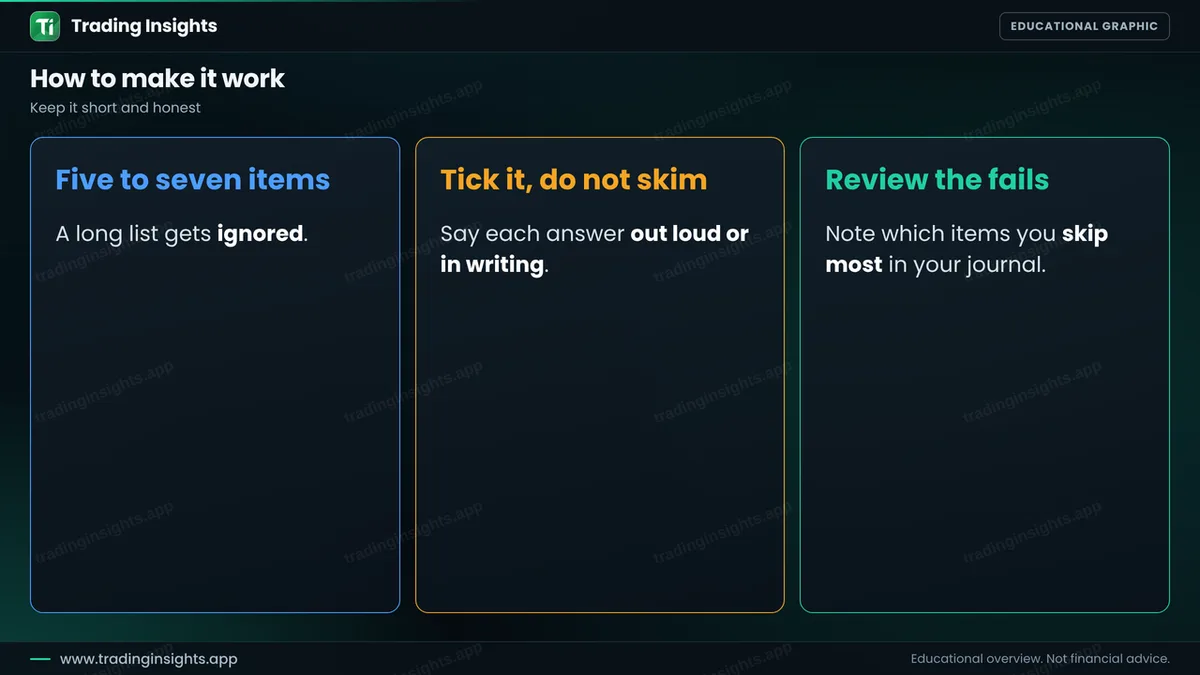
- Five to seven items. A long list gets ignored. Keep only what has caused you real losses.
- Tick it, do not skim. Answer each question in writing or out loud. A glance is not a check.
- Add your own weak spots. If you tend to trade when angry, add "Am I calm?". See trading burnout and stress.
- Review the fails. Record the items you skip most in your journal, and see where the pattern is. See trading journal metrics.
- Keep it where you trade. A printed card beside the screen, or a note in the platform.
Illustrative example: a checklist that says skip
This is an illustrative example, not a real trade. A trader sees a strong bullish candle on EUR/USD and wants to buy. Before clicking, she runs the list and scores each item pass or fail.
| Item | Result |
|---|---|
| Matches my setup | Pass |
| Higher timeframe with me | Fail (bearish) |
| Stop at a chart level | Fail (needs 60 pips) |
| Risk 1% or less | Pass, but only with a small size |
| News coming | Fail (central bank speech in 30 minutes) |
| Reward worth it | Pass |
Three of six fail, so she skips. The stop also shows why size matters: with a $10,000 account risking 1% ($100), a 60-pip stop gives $100 / (60 pips x $10 per pip per lot) = about 0.17 lot, and a 30-pip stop would allow about 0.33 lot. A trader who ignores this and uses 0.33 lot on a 60-pip stop risks about $200, or 2%.
Twenty minutes later, price reverses sharply on the speech. The checklist did not predict the move. It stopped her from entering a trade that broke her rules.
Pre-trade checklist for exits and management
Most checklists cover the entry only, but the trade is not over once it is open. Add two or three questions for management: Where will I move the stop, and under what condition? Will I take partial profit, and at what level? What would make me close early?
Deciding these before you enter keeps you from improvising when the trade is moving. If you cannot answer them, the plan is not finished, and the entry can wait.
Common mistakes
- Writing a list that is too long to use. Fifteen items will be skipped under pressure. Keep five to seven that matter.
- Ticking items without thinking. A habit tick is no check. Answer each item aloud or in writing.
- Changing the answers to justify a trade you already want. This is the checklist failing. If you notice yourself bending an answer, skip the trade.
- Never updating the list after a mistake. After a rule-breaking loss, add the question that would have stopped it.
Frequently asked questions
What is a pre-trade checklist?
It is a short list of questions that you answer before each entry, to make sure the trade follows your plan.
How long should a checklist be?
Five to seven items. A longer list tends to be ignored.
Does a checklist make my trades more profitable?
It does not improve the setup itself, but it removes impulsive trades that break your rules. Results still depend on your strategy and risk control.
What if one item fails?
Then the trade waits or is skipped. The checklist is a rule, not a suggestion.
Your next step
Write a six-item checklist on a card today, using the sample above and one item for your own weak spot. Put it next to your screen and use it on your next ten entries, marking any fails in your journal. The position size calculator can handle item four.
This is education, not financial advice. Trading carries risk, and no checklist or method guarantees results. The charts are illustrative and not real market data.


