
Trading burnout is the mental and physical exhaustion that builds when money is at risk, results are uncertain and the market is open most of the week. Tired, stressed traders make worse decisions, and worse decisions create more stress. You can break the cycle with rules that you set in advance, while you are calm, because willpower is the first thing that fails under pressure.
What stress does to trading
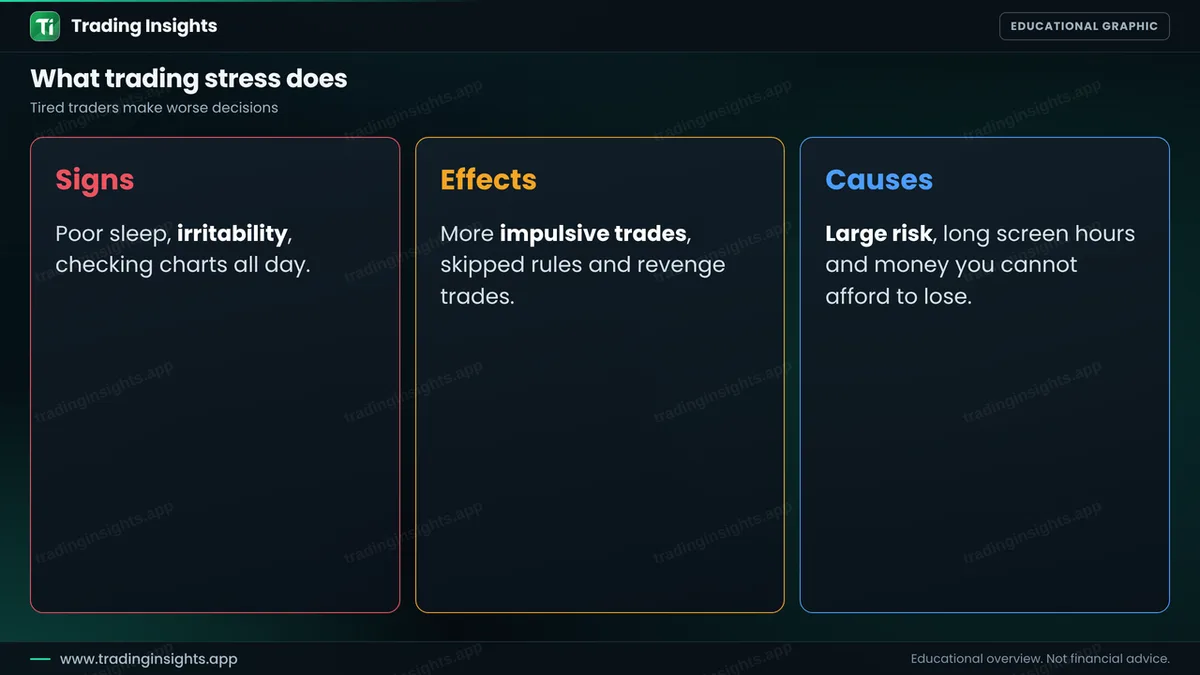
From the outside, trading looks calm: a person in front of a screen. In practice it can be exhausting. Common signs are poor sleep, irritability and checking the chart all day. The effects show up in the trades: impulsive entries, skipped rules, moved stops and revenge trades. The usual causes are risk that is too large, long screen hours and money you cannot afford to lose. A trader who risks the rent cannot think clearly about a stop.
Signs of burnout
Burnout usually builds slowly, so it helps to know the early signals.
- You dread opening the platform, or you cannot stop looking at it.
- You break your own rules and feel nothing, or feel angry afterwards.
- Your sleep suffers because of open positions or late sessions.
- Wins no longer feel good, and losses feel personal.
- You lose interest in the process, such as the journal and the review.
If you recognise several of these, treat it as information, not as weakness. Reduce your size, take a break and check your rules.
Habits that help
None of these needs willpower in the moment, because you set them when you are calm. The table shows five habits and what each protects.
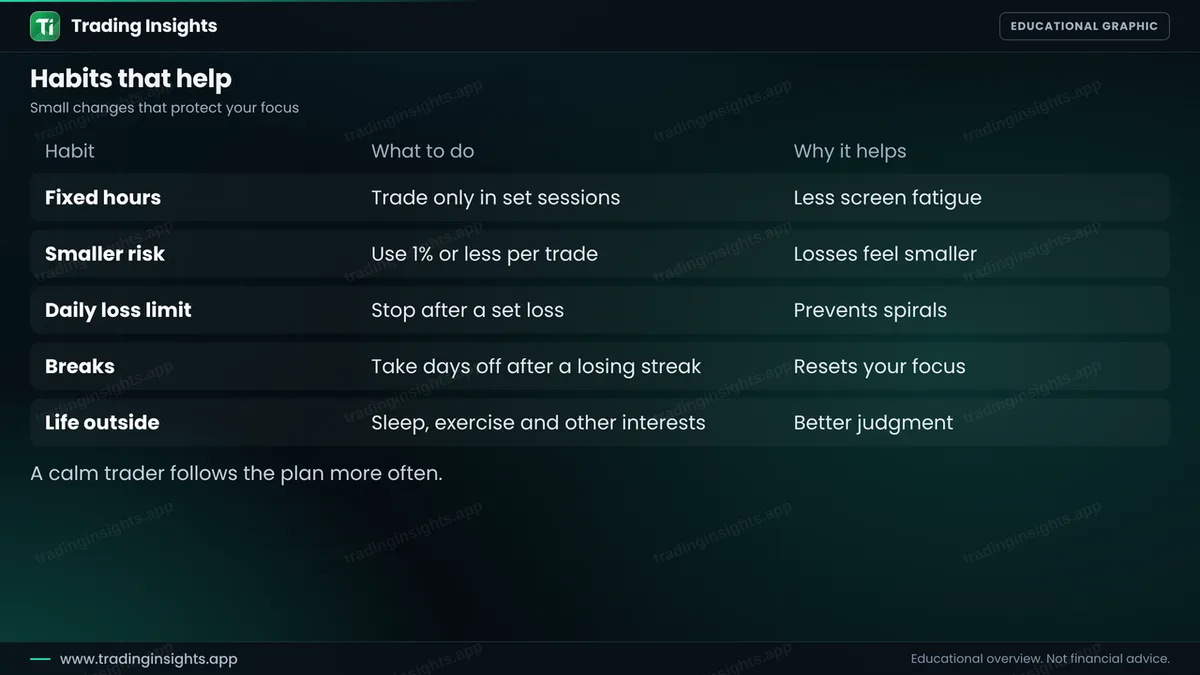
Fixed hours keep trading from spreading across the whole day. Smaller risk makes each loss feel minor. A daily loss limit ends a bad day before it becomes a bad week. Breaks after a losing streak let emotion settle. A life outside trading, including sleep and exercise, keeps your judgment clear.
Where these rules fall short
Rules cannot fix a problem that is not about trading. If anxiety, low mood or sleeplessness continue even when you are not trading, or trading is the only thing that feels important, a doctor or a mental health professional is the right next step. A trading plan is not a substitute. Rules also fail if you set them while stressed, because then they reflect the stress. Write them on a calm day, and change them only in a calm review.
A simple workflow
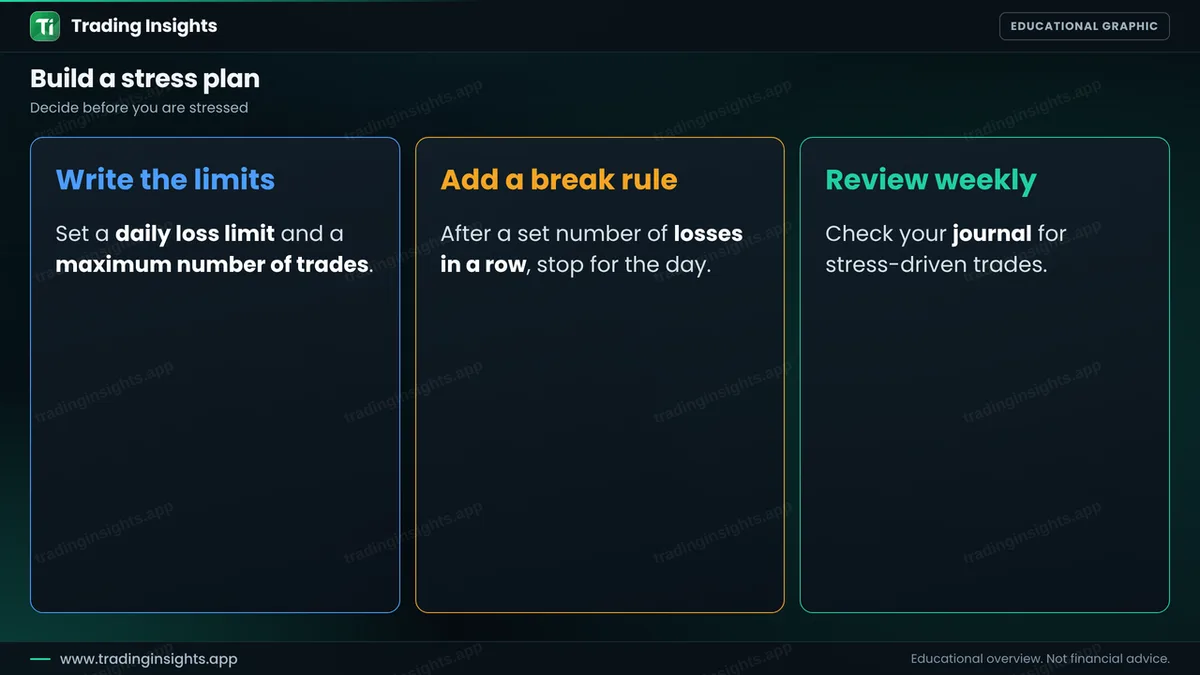
- Write the limits. Set a daily loss limit and a maximum number of trades per day.
- Add a break rule. After a set number of losses in a row, stop for the day.
- Review weekly. Look in your journal for trades made while stressed or tired.
- Check your capital. Trade only with money you can afford to lose.
- Size every trade from the stop, using the position size calculator, so risk stays at a fixed small share. Check pip value for the rule-bound trade with the pip calculator before you commit.
How risk size changes the pressure
Compare two traders using simple compounding. Eight losses in a row at 0.5% risk cost about 3.9% of the account, which is annoying but easy to survive. Eight losses in a row at 3% risk cost about 21.6%, and long before the eighth loss, fear and anger take over. Add a rule such as "stop after two losses or 2% in a day". With 0.5% risk, the cap allows four losses. With 3% risk, the cap allows only one, and the second loss ends the day. The rule works only when risk is small enough that stopping is not dramatic.
Illustrative example: a calm trade within the limits
This is an illustrative example, not a real trade. A trader on a $15,000 account risks 0.5%, or $75, per trade, with a daily limit of 2%. The first trade of the day sells GBP/USD at 1.2890, with a stop 45 pips higher at 1.2935 and a target 92 pips lower at 1.2798. Lot size is $75 divided by (45 x $10), about 0.16. Price reaches the target and the trade makes about $147, or 0.98%. The trader closes the platform, as planned, after the session.
Illustrative example: a loss and a stop to the day
Another illustrative case. The next day the trader buys EUR/USD at 1.0812, with a stop 33 pips lower at 1.0779 and a target 68 pips higher at 1.0880. Risk is 0.5% ($75), and lot size is about 0.22. The stop is hit for a loss of about $73, or 0.48%. A second setup also loses, and the day's total is about 1%. The rule says to continue only if the setup is valid, and the break rule triggers after three losses in a row. The trader does not need to decide under stress. The rule already decided.
Common mistakes
- Trading through exhaustion. Tired judgment skips checks. Set fixed hours and stop at the end.
- Raising risk to recover losses. A bigger size adds stress, not skill. Keep risk fixed, or cut it after a bad run.
- Having no daily loss limit. Without one, a bad morning becomes a bad week. Write the number down.
- Treating signs of burnout as weakness. Early signs are a signal to adjust. Reduce size and rest.
- Trading with money you need. Fear of losing the rent distorts every decision. Use only risk capital.
Pre-trade checklist
- I slept enough and am within my fixed trading hours.
- I have not hit my daily loss limit or my trade limit.
- Risk on this trade is 0.5% or less of my account.
- The stop is set at the invalidation point.
- Reward is at least twice the risk.
- I will stop after my planned number of losses in a row.
Frequently asked questions
What are the signs of trading burnout?
Poor sleep, irritability, dreading the platform or being unable to stop checking it, and breaking your rules without feeling anything are common signs. Wins no longer feeling good and losses feeling personal are also common. If several signs appear together, reduce size and take a break before changing your strategy.
How can I reduce trading stress?
Use smaller risk, fixed hours and a daily loss limit. Take breaks after losing streaks, and keep a life outside trading.
Should I stop trading if I am burned out?
A break can help, and many traders reduce size or pause until they feel steady. If stress is severe, speak to a doctor or mental health professional.
Does a smaller size really help?
Yes. A loss of 0.5% feels very different from a loss of 5%, so smaller risk makes it easier to follow rules.
This article is not financial advice and not a substitute for medical or mental health care. Trading carries risk of loss, and stress is a reason to cut size or take a break.


