
To read a forex economic calendar, look at four things on each line: the time, the currency, the impact rating and the three numbers (forecast, previous and actual). The calendar is a list of scheduled releases and events. It does not tell you what to trade, but it shows when the market is likely to become wild, so you can protect your account. Many traders open it every morning before they look at a chart.
What does an economic calendar show?
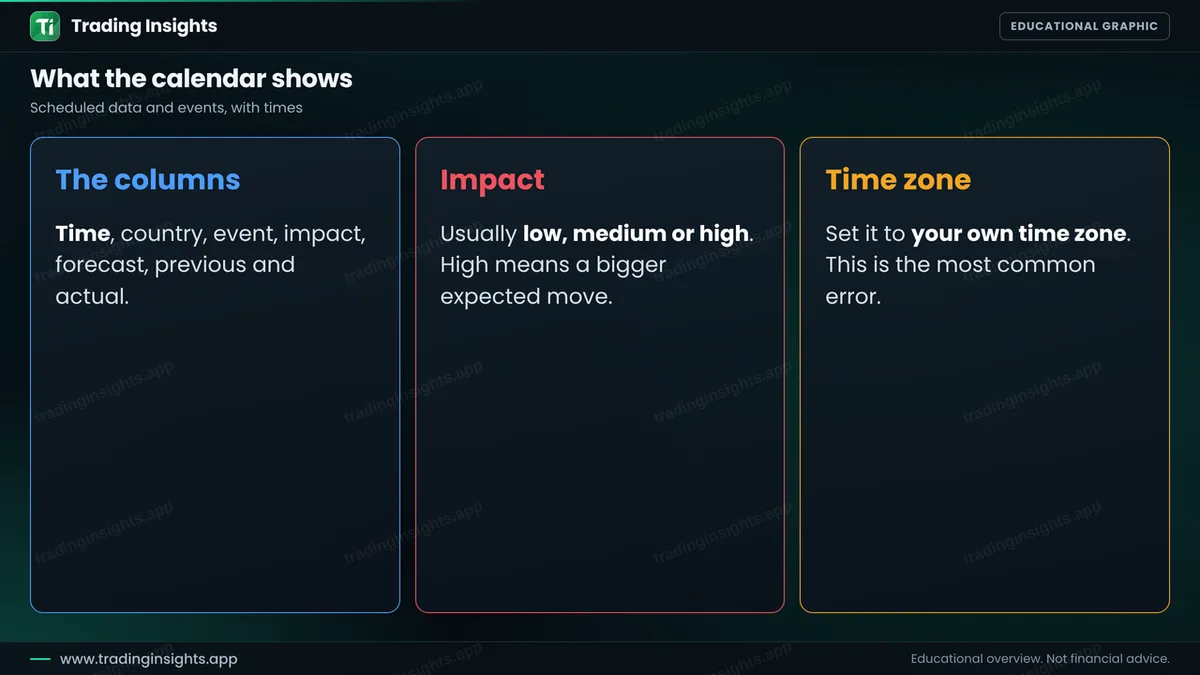
Each line is an event. The columns are usually the time, the country or currency, the event name, the impact rating and the forecast, previous and actual numbers. The actual result is filled in when the release comes out.
The impact rating (low, medium, high) shows how much the event is expected to move the market. Rate decisions, inflation and jobs data are usually high.
The most common beginner error is the time zone. If the calendar is set to another zone, you may think an event is hours away when it is minutes away. Set it to your own zone, then check it against a known event.
How to read one line: forecast, previous and actual
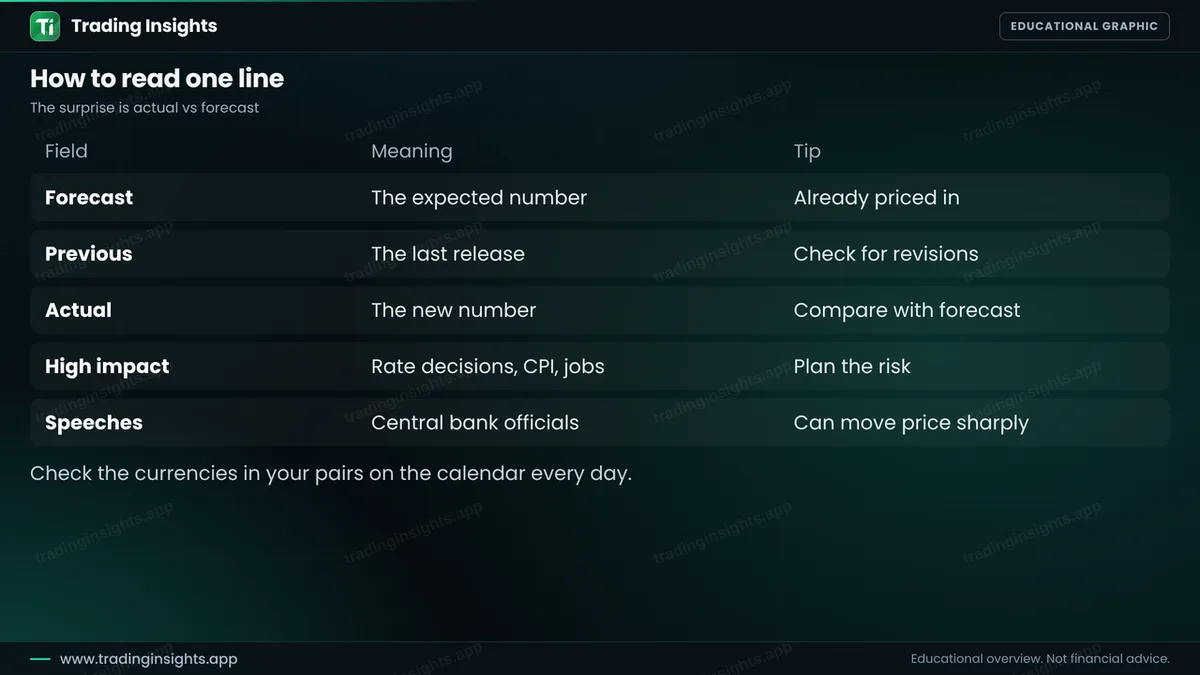
Take one release at a time and read it left to right.
- Forecast. The market's expected number, which is already in the price. See trading forex news.
- Previous. The last result, which may be revised. Revisions can matter as much as the new number.
- Actual. The new number. The market reacts to the gap between actual and forecast. A result above the forecast tends to support the currency if it implies higher rates, and a result below tends to weigh on it. See inflation and forex and the NFP report.
- Speeches. Central bank officials' speeches have no number, but they can move price sharply. See forward guidance.
Some events matter more than others. As a rough guide, central bank rate decisions and statements, inflation (CPI), jobs reports and GDP are the main ones. See what moves forex prices and growth data.
How to use the economic calendar every day
Here is a routine you can follow in about five minutes.
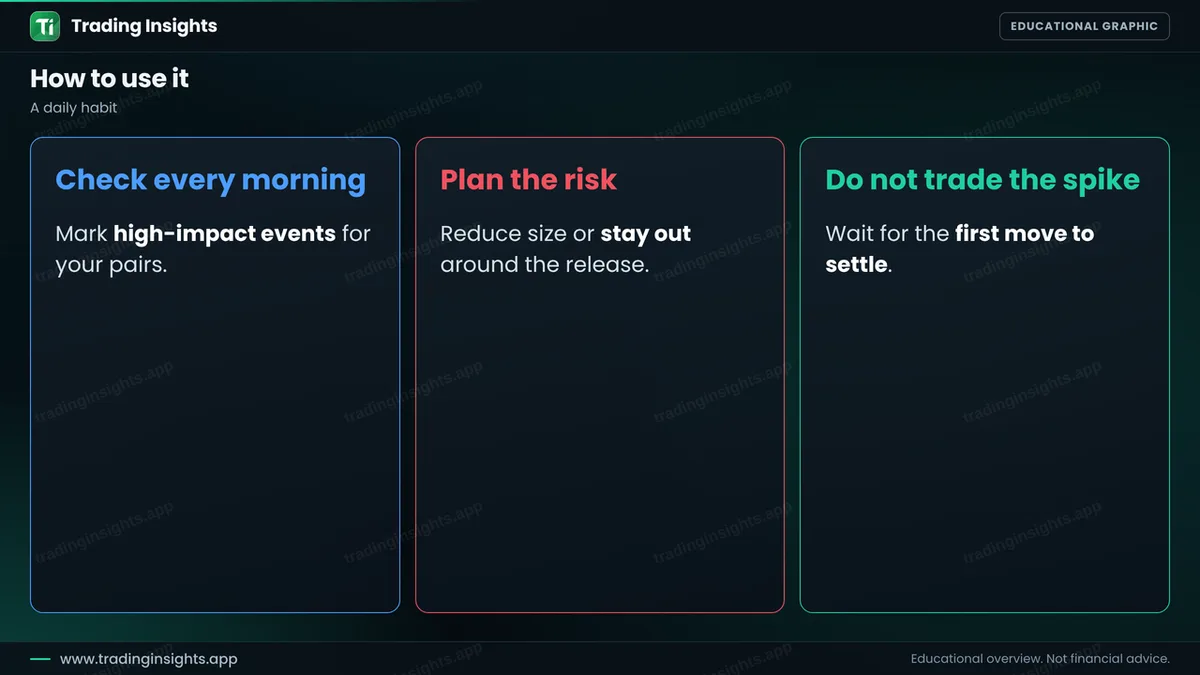
- Set the time zone first. Confirm it against an event you know.
- Filter the list. Show only the currencies in your pairs, and mark the high-impact events. See a daily forex trading routine.
- Check both sides. A pair has two currencies, so look at both calendars.
- Plan the risk. Around a major release, reduce your size, move stops to a safer level or stay out. Spreads widen and slippage grows. See slippage and forex volatility.
- Do not trade the first spike. Wait for the first move to settle, then trade a pullback to a level with a stop.
- Look at the week. On Sunday, mark the main events of the week, so you can plan around them.
Illustrative example: waiting for UK inflation data
A trader plans to buy GBP/USD at a support level near 1.2700. On the calendar, she sees UK inflation data due in 40 minutes, and the Fed chair speaks later. She has three options: enter now with a smaller size and a wider stop, wait until after the release, or skip the day. She chooses to wait.
The data comes out, price spikes in both directions and settles. She then buys the pullback to support at 1.2700, with the stop at 1.2670 (30 pips) and the target at 1.2760 (60 pips).
With a $10,000 account risking 1% ($100), the position size is $100 / (30 pips x $10 per pip per lot) = about 0.33 lot. A win pays about $200, and a loss costs about $100. The calendar did not give her the trade. It gave her the timing. Check the sizing with the position size calculator.
When is a calendar-based plan wrong?
- The release is rescheduled or revised. Always recheck the time before a trade.
- The surprise is large and one-sided. If price runs far without a pullback, there is no trade, and chasing it is not a plan.
- Another event lands close by. A speech or second release can undo the first move, so scan the next few hours too.
- Price breaks your level. If the pullback fails to hold, the setup is invalid and the stop should take you out.
Common mistakes
- Using the wrong time zone. You may be early or late by hours, so set it to your zone and check it against a known event.
- Ignoring the second currency. Every pair has two, so check both calendars before you enter.
- Opening a trade just before a major release with a tight stop. Spreads and spikes can hit the stop, so wait or reduce size.
- Treating the impact rating as a direction. It shows size of the expected move, not whether it goes up or down, so read forecast against actual.
Frequently asked questions
What is an economic calendar?
It is a schedule of data releases and events, with the time, country, impact rating, forecast, previous and actual results. Traders use it to know when volatility is likely.
What does the impact rating mean?
It shows how much the event is expected to move the market, usually as low, medium or high. It does not show the direction of the move.
Why does the forecast matter?
The market already prices in the forecast, so the move comes from the difference between the actual number and the forecast. A good number that matches the forecast may change nothing.
How often should I check it?
Every morning before you trade, and on Sunday for the week ahead. Recheck it if you plan a trade that you will hold through a release.
Your next step
Open your calendar, set the time zone, filter it to the two currencies of the pair you trade most and mark every high-impact event for this week. Then decide, before each one, whether you will trade smaller, wait or stay out.
This is education, not financial advice. Trading carries risk, and no method guarantees results. The charts are illustrative and not real market data.


