
Forward guidance is how a central bank signals what it may do with interest rates in the future, and it often moves a currency more than the rate decision itself. On meeting day the rate is usually priced in, so traders react to the tone of the statement, the press conference and later speeches. Learning to read central bank speeches explains why a currency can fall after a rate hike, or rise after a cut.
What forward guidance is
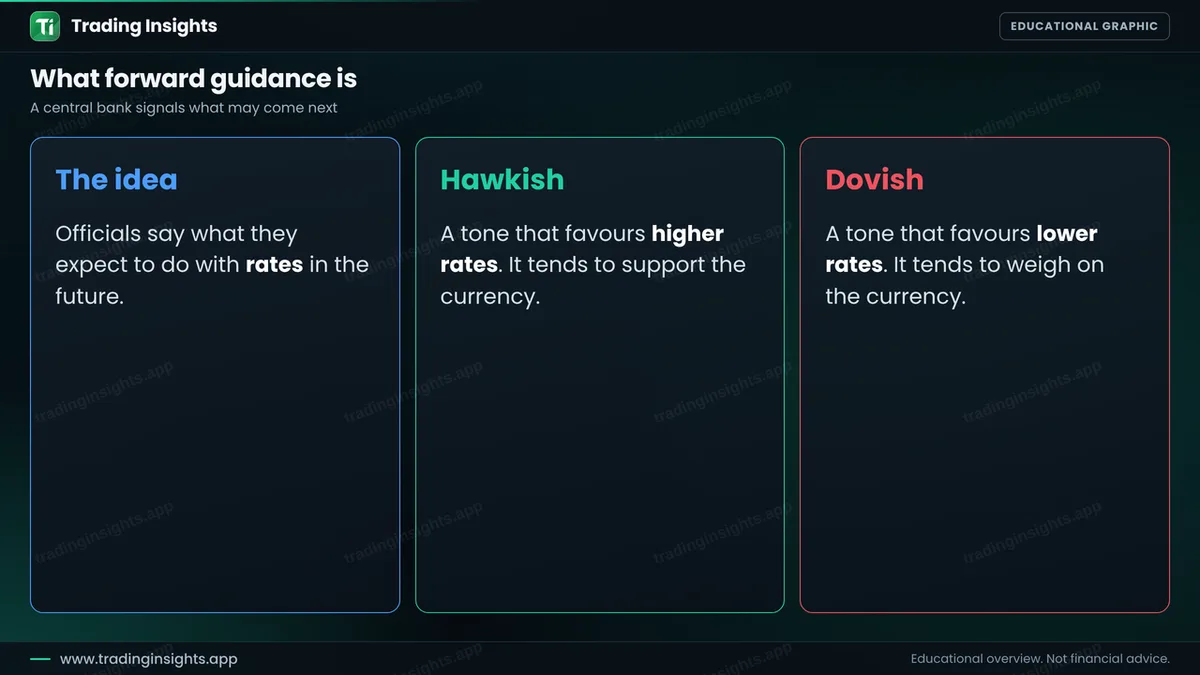
Officials signal future policy in statements, press conferences and speeches. A hawkish tone points to higher rates, usually because inflation is high, and it tends to support the currency. A dovish tone points to lower rates, and it tends to weigh on the currency.
For background, see central banks and forex, interest rates and forex and inflation and forex.
Markets trade expectations, not the number on the page. A bank that sounds "less hawkish than expected" can push its currency down even while it raises rates.
Hawkish vs dovish: what the words usually mean
Central banks rarely say "we will cut" or "we will hike" outright. They use phrases that shift slowly, and traders compare each statement with the previous one. The change in wording matters more than the wording itself.
- Hawkish signals: worry about inflation, talk of further tightening, "data dependent" with an upward lean, strong views on jobs and growth.
- Dovish signals: talk of easing inflation, concern about growth or jobs, patience, openness to cuts, or a pause in hikes.
- Neutral signals: a balanced view of risks, with no hint of the next step.
If you are unsure of a term, the glossary has short definitions.
How to read a central bank event
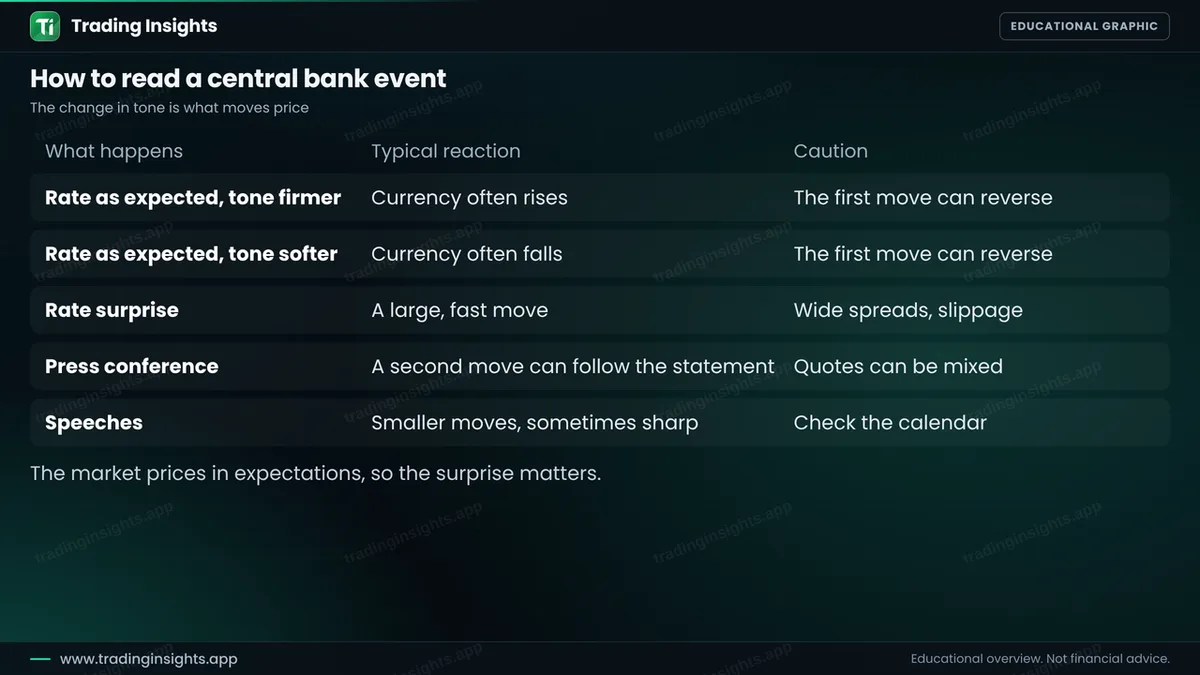
- Expected rate, firmer tone. The currency often rises, but the first move can reverse.
- Expected rate, softer tone. The currency often falls, with the same warning.
- A rate surprise. A large, fast move, with wide spreads and slippage. See slippage.
- The press conference. It starts after the statement and can cause a second move, sometimes in the opposite direction.
- Speeches. Smaller moves, though sometimes sharp when an official changes the message.
How to trade central bank speeches
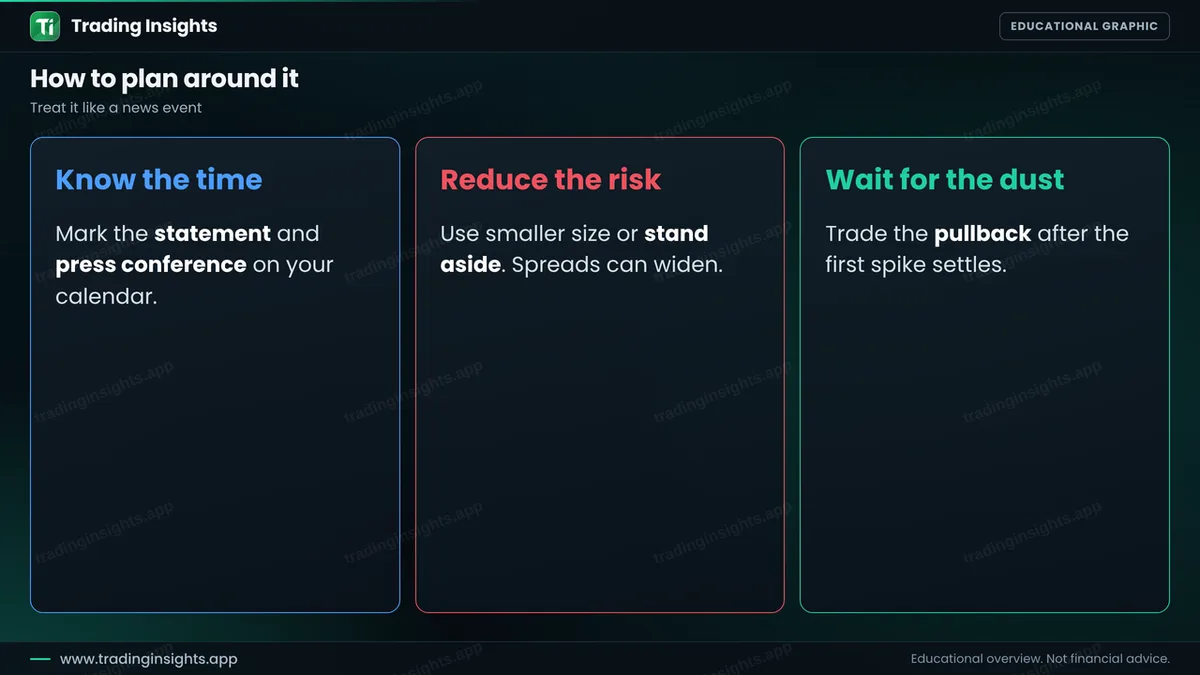
- Know the time. Mark the statement and the press conference on your calendar, in your own time zone. See trading forex news.
- Reduce the risk. Use smaller size, or stand aside. Spreads widen.
- Wait for the dust. Trade the pullback after the first spike, with a clear level and a stop. See break and retest.
- Check the other side. A pair has two central banks, so check both calendars.
Why waiting often works better than chasing
The first minute after a statement is the hardest to trade. Spreads can be several times wider than normal, orders can fill far from the price you saw, and algorithms may push price both ways before a direction settles. A stop can be hit by a spike that reverses a minute later.
After the spike, the market has digested the headline and often gives a pullback to the level it broke. That is a cleaner place to define risk. You may miss the first part of the move, and that is the price of a clearer stop.
Illustrative example: selling a pullback after a dovish hike
This is an illustrative example, not a real trade. A central bank raises its rate by 0.25%, as everyone expected. In the statement, it says inflation is easing and that further hikes are not planned. The currency falls about 70 pips in a few minutes, even though the rate went up.
A trader who bought on the rate hike with a tight stop was stopped out. A trader who waited, let the spike settle and then sold a pullback to the broken level had a clearer trade. On an EUR/USD-style pair, she sells at 1.0850 after the pullback, with a stop at 1.0890 (40 pips) and a target at 1.0770 (80 pips), a 1 to 2 reward-to-risk ratio.
With a $10,000 account risking 1% ($100), the position size is $100 / (40 pips x $10 per pip per lot) = 0.25 lot. A win pays about $200, and a loss costs about $100. If the pullback never comes, she skips the trade, and that is a fine outcome.
Common mistakes
- Trading the rate number and ignoring the tone. The rate is usually priced in. Read what the bank says about the next step.
- Entering in the first seconds. Spreads are widest and fills are worst. Wait for the first spike to settle.
- Holding a large position with a tight stop through the event. A spike can hit the stop and then reverse. Cut the size or stay out.
- Forgetting the second move at the press conference. Tone can change in the questions. Keep the calendar open until it ends.
Frequently asked questions
What is forward guidance?
It is the way a central bank signals what it may do with interest rates in the future. It appears in statements, press conferences and speeches.
What do hawkish and dovish mean?
Hawkish means favouring higher rates to fight inflation, and dovish means favouring lower rates to support growth. Traders compare each message with the last one, so the change is what counts.
Why can a currency fall after a rate hike?
Because the market may have expected a stronger message. The tone and the surprise matter more than the rate alone.
Should I trade during the announcement?
It is risky because of wide spreads and fast spikes. Many traders reduce size or wait for the first reaction to settle.
Your next step
Open the economic calendar and pick the next central bank meeting for one of your pairs. Write down the time of the statement and the press conference, and decide in advance whether you will trade or stand aside. Use the position size calculator to set the size if you trade.
This is education, not financial advice. Trading carries risk, and central bank events can cause fast moves, wide spreads and slippage. The charts are illustrative and not real market data.


