
Inflation moves currencies because it shapes what central banks do with interest rates. When the consumer price index (CPI) comes in hotter than expected, traders often expect higher rates for longer, and the currency tends to rise. When it comes in cooler, the opposite often happens. CPI is a high-volatility release, so this article explains how to read it and how to plan your risk around it.
Why inflation matters to currencies
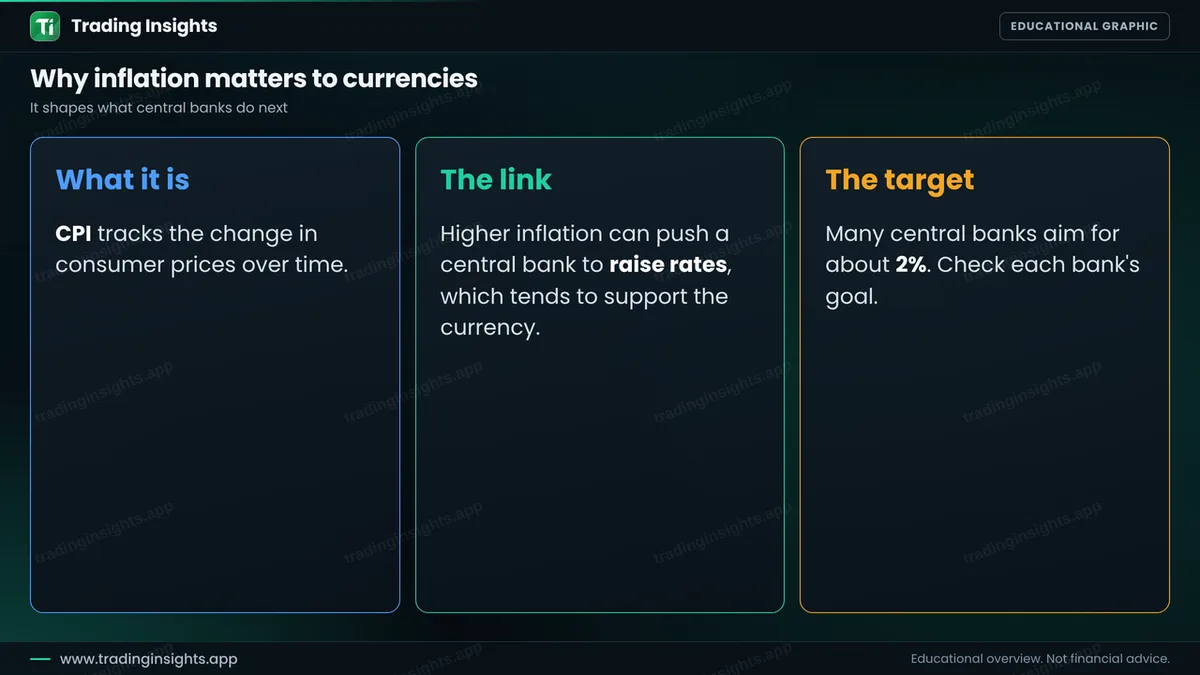
Inflation is the rise in prices over time. Many central banks aim for a low and stable rate, often around 2%, though each bank has its own goal. When inflation is above the target, a bank may raise interest rates to cool the economy, and higher rates tend to support a currency because they attract capital.
When inflation is low, a bank may keep rates low or cut them, which tends to weigh on the currency. The market reads each CPI report as a hint about future rates. See interest rates and forex and central banks and forex.
What CPI actually measures
CPI tracks the change in the prices of a basket of goods and services that households buy. Most countries publish it monthly, and the report usually shows the change from the previous month and from a year earlier. Release dates and times differ by country, so check an economic calendar.
Traders watch two versions. Headline CPI includes everything, while core CPI removes food and energy, which can jump around. Many central banks pay close attention to core, so a gap between the two can change the reaction.
How to read a CPI release
The number alone is not enough. What counts is how it compares with what the market expected.
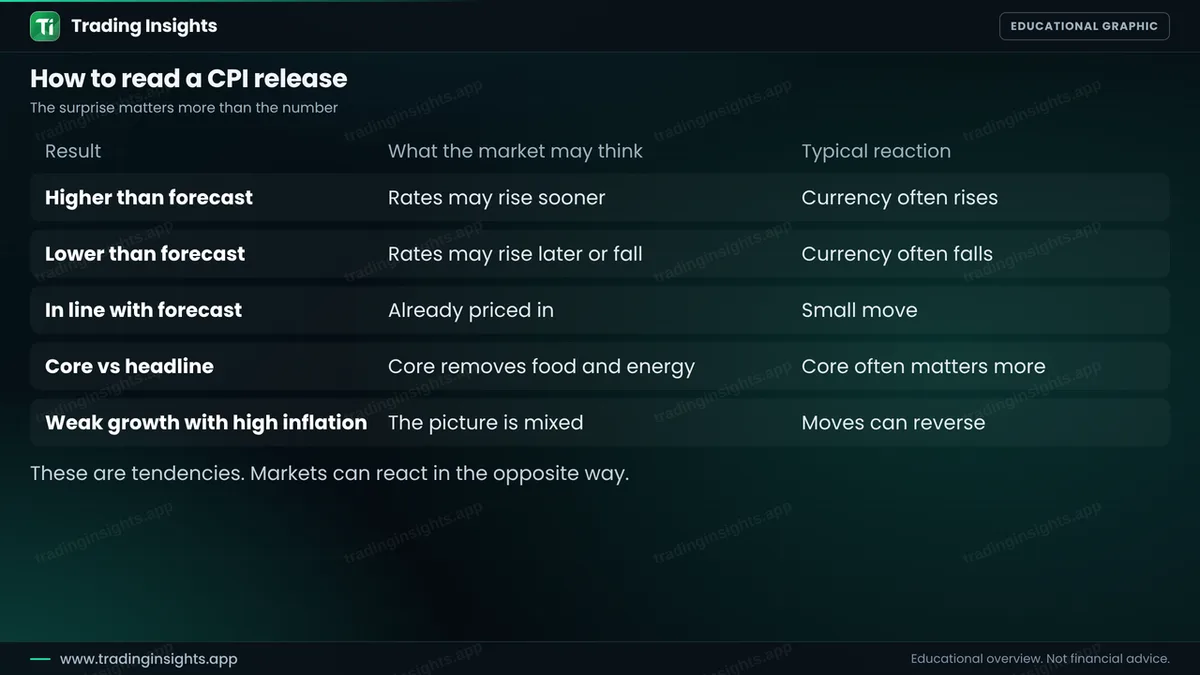
- Forecast versus result. The market prices in the forecast before the release. A result above the forecast often lifts the currency, and a result below it often weighs on it.
- In line. If the number matches the forecast, the reaction is usually small.
- Core and headline. A headline surprise driven by energy may fade, while a core surprise can last longer.
- The wider picture. High inflation with weak growth is a mixed signal, and the move can reverse in the hours after the release.
These are tendencies, not rules. Sometimes the market moves the opposite way because of details in the report, revisions to earlier months, or other news that arrives at the same time. See trading forex news for the general method.
How to trade around CPI
A CPI release is a fast event, so risk control matters more than prediction.
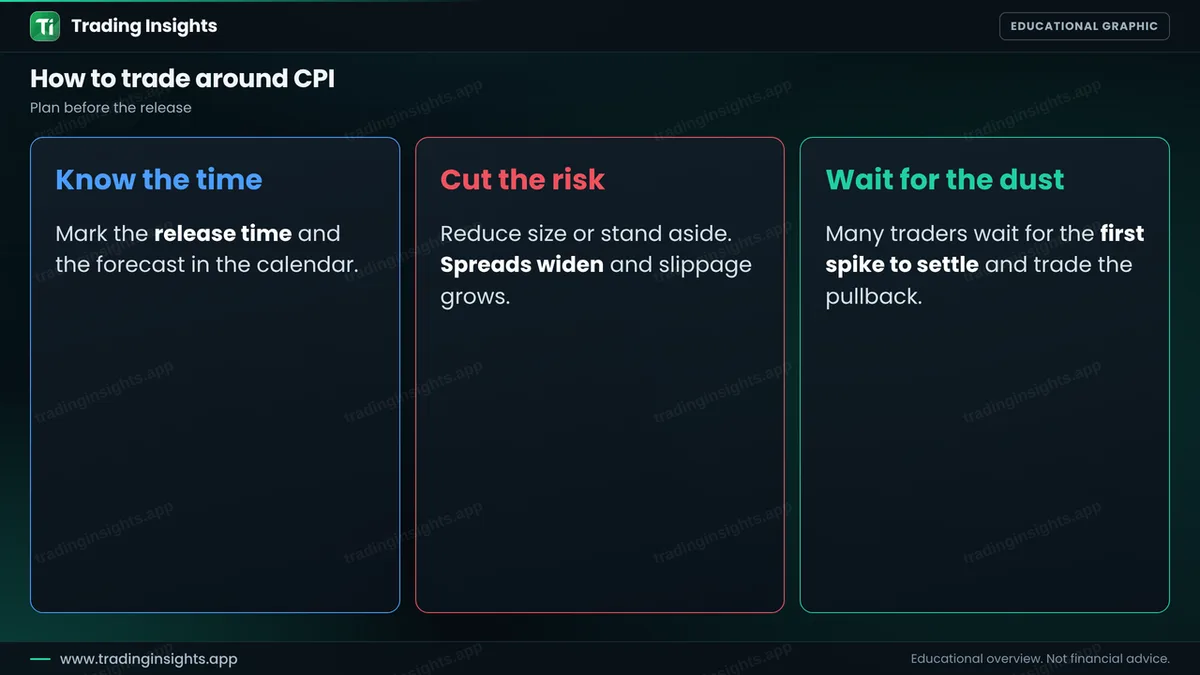
- Know the time. Mark the release time and the forecast in the economic calendar, in your own time zone.
- Cut the risk. Reduce the size or stand aside. Spreads widen and slippage grows. See slippage and forex volatility.
- Wait for the dust. Many traders let the first spike settle and trade the pullback at a clear level. See break and retest.
- Do not hold tight stops through it. A spike can hit them, and then the price can return.
- Combine with the chart. The data gives the bias, and the chart gives the entry. See fundamental vs technical analysis.
Illustrative example: trading the retest after a hot CPI
This is an illustrative example, not a real trade. US inflation is expected at 3.0%, and the result is 3.4%. Traders now expect the Fed to keep rates high for longer, so US yields rise and the dollar strengthens. EUR/USD falls 60 pips within a minute, and a trader holding a long position with a 25-pip stop is out almost at once.
A second trader stands aside during the spike. Twenty minutes later, price retests the broken support at 1.0840 and prints a bearish candle. She sells at 1.0840 with a stop at 1.0880 (40 pips) and a target at 1.0760 (80 pips), a 1 to 2 reward-to-risk ratio.
With a $10,000 account risking 1% ($100), the position size is $100 / (40 pips x $10 per pip per lot) = 0.25 lot. A win pays about $200, and a loss costs about $100. Because the release adds risk, she could also cut the risk to 0.5% ($50), which gives 0.125 lot.
A simple release-day checklist
Before a CPI release, run through a short list. It takes two minutes and prevents most of the avoidable damage.
- What is the forecast, and what was the previous reading?
- Which pairs are exposed? The currency of the country releasing the data is the one in play.
- Are other reports due at the same hour, such as jobs or central bank speeches?
- Do I have open trades with tight stops? Close them, widen them with a smaller size, or accept the risk before the release.
- Where are the nearest support and resistance levels for a retest entry?
After the release, give the market time. The first move is often driven by algorithms and wide spreads, and the more considered move can come later in the session.
Common mistakes
- Trading the headline without checking the forecast. A rise in inflation can still be a miss if the market expected more. Always compare the result with the forecast.
- Holding a large position with a tight stop through the release. A spike can take you out and then reverse. Cut the size or close the trade before the event.
- Assuming that higher inflation always means a stronger currency. If it comes with weak growth or the market fears a slowdown, the reaction can flip. Treat the reaction as a tendency.
- Entering in the first seconds. Spreads are widest then, and fills can be poor. Wait for the move to settle and use a level.
Frequently asked questions
How does inflation affect a currency?
Higher inflation can lead a central bank to raise rates, which tends to support the currency. Lower inflation can lead to lower rates and a weaker currency. The effect depends on what the market already expected.
What is the difference between core and headline CPI?
Headline CPI includes all items, and core CPI excludes volatile items such as food and energy. Central banks often watch core closely because it shows the underlying trend.
Why does the forecast matter?
The market has already priced in the expected number. The move comes from the surprise, which is the difference between the forecast and the result.
Should I trade during the CPI release?
It is risky because of wide spreads and fast spikes. Many traders reduce size or wait until the first reaction has settled.
Your next step
Open an economic calendar and find the next CPI release for a currency you trade. Write down the forecast and the time, then watch the reaction without trading and note how far price moved and whether it reversed. A few of these records will show you how that pair behaves. For sizing on later trades, use the position size calculator.
This is education, not financial advice. Trading carries risk, and prices can move fast and against you around news releases. The charts are illustrative and not real market data.


