
Growth data such as GDP, PMI and retail sales moves forex because it shows how fast an economy is expanding, and that shapes what central banks may do with interest rates. A result better than forecast tends to support a currency, and a worse one tends to weigh on it, though the reaction depends on context. This article explains what each report measures and how to trade around the releases without guessing.
GDP, PMI and retail sales: three growth reports
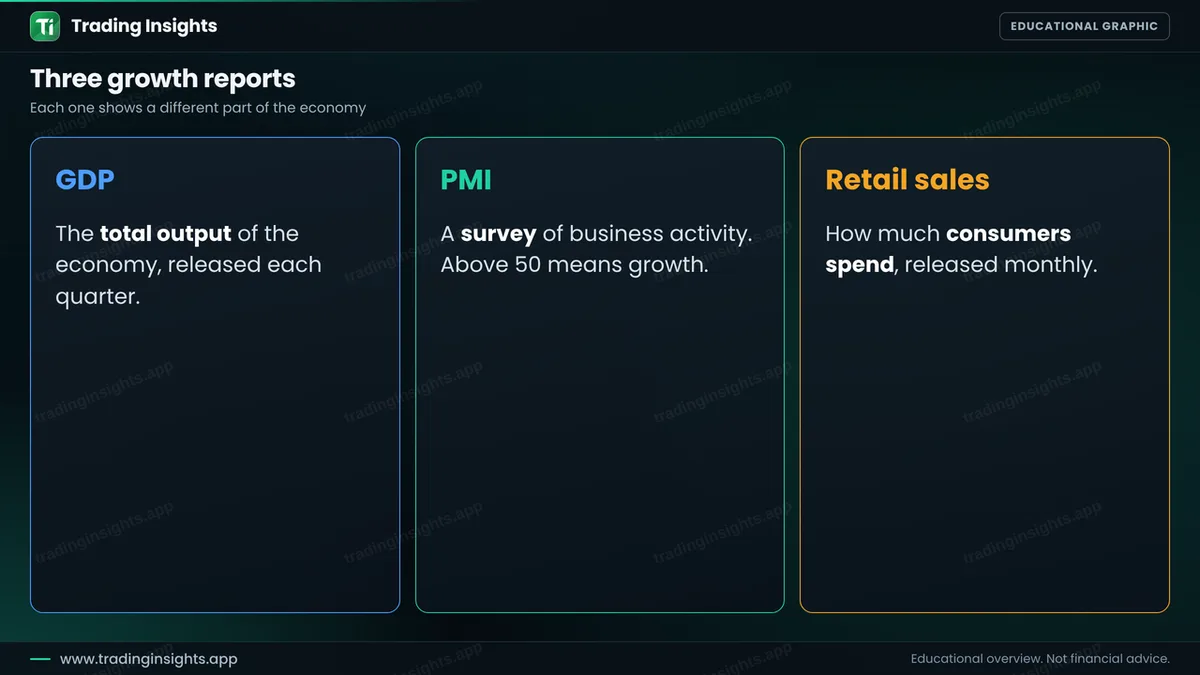
GDP (gross domestic product) is the total output of an economy, released every quarter, with several estimates. It is important, but it is old news by the time it comes out.
PMI (purchasing managers' index) is a monthly survey of business activity: a reading above 50 suggests growth, and below 50 suggests contraction. It comes early, so it is watched closely. Retail sales measure what consumers spend, released monthly. Consumer spending is a large part of most economies. See what moves forex prices for the wider list of reports.
How growth data moves forex: reading a release
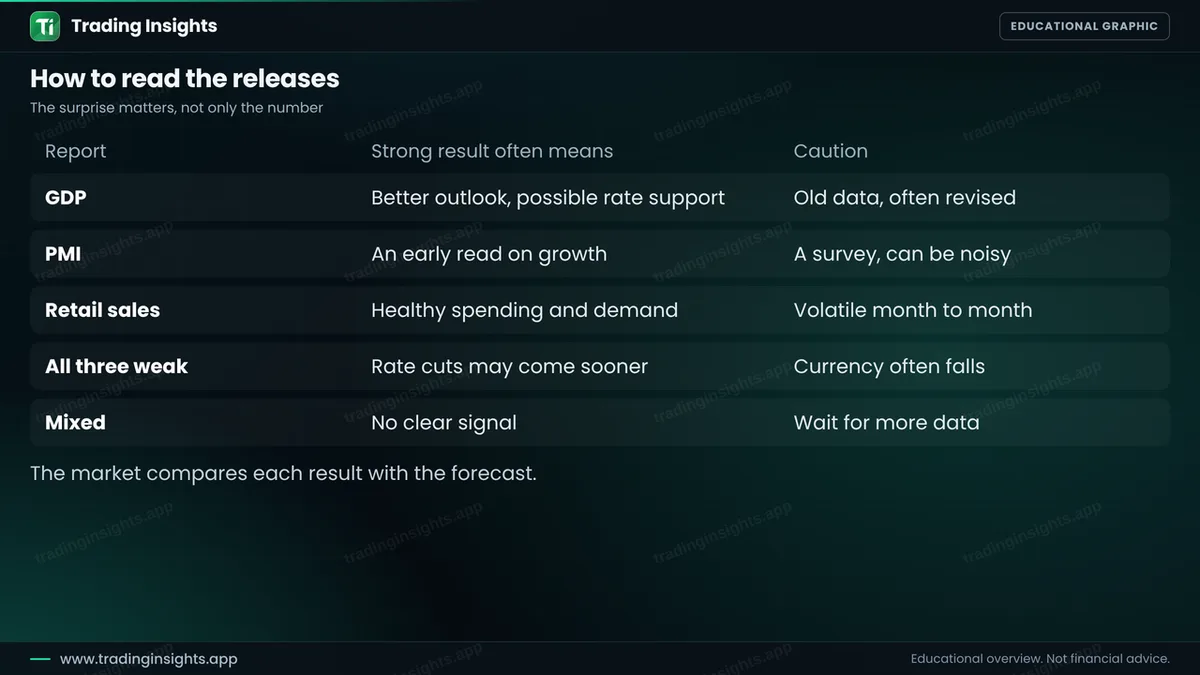
As with other data, the market compares the result with the forecast. A result above the forecast tends to support the currency, because it suggests a stronger economy and perhaps higher rates later. A result below tends to weigh on it. See inflation and forex for the same logic. Some practical points:
- One report is not a trend. Look at several reports and at revisions.
- Growth and inflation interact. Strong growth with high inflation is more supportive for a currency than strong growth with falling inflation.
- Central banks matter. Ask what the data means for the next rate decision. See interest rates and forex and forward guidance.
- Weak data is not always bearish. Sometimes bad news lifts stocks, because it lowers the chance of rate hikes, and the currency reacts in a different way.
Which report matters most?
There is no fixed ranking, and it changes with the economic story. When the market is worried about a slowdown, early surveys such as the PMI often get the most attention, because they hint at what GDP will show later.
When the central bank is focused on consumer demand, retail sales can matter more. GDP usually confirms what the market already suspects, so it moves prices mainly when it surprises. Check which report the calendar marks as high impact for your currency.
How to trade around growth data
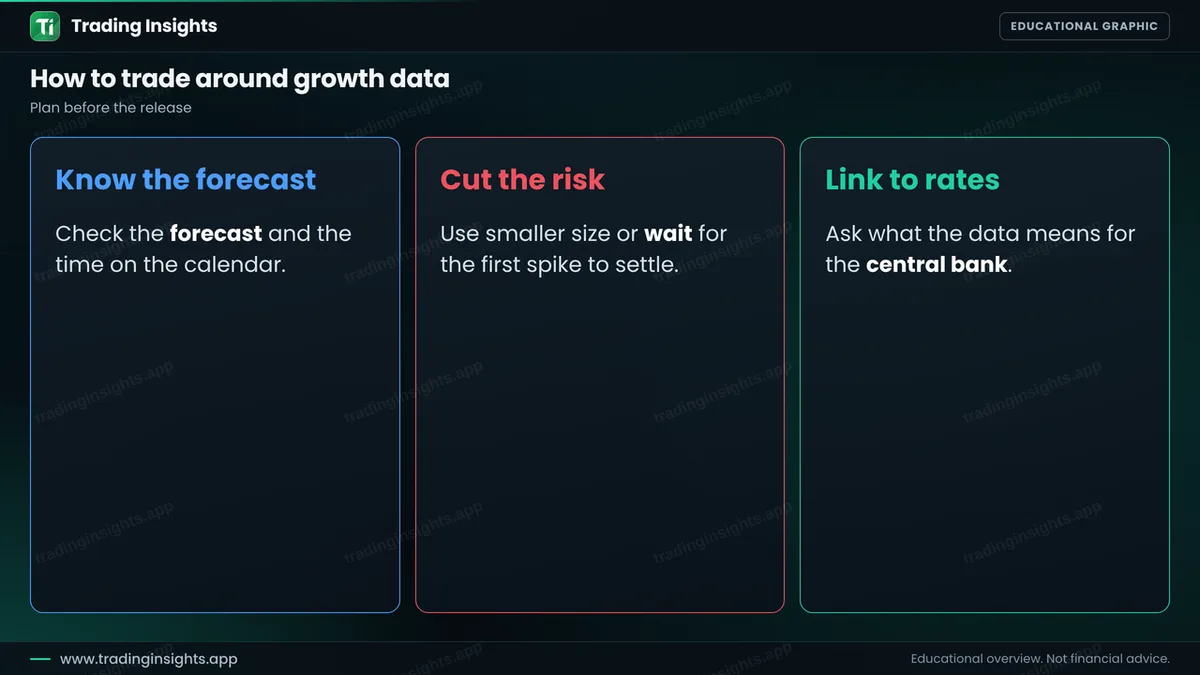
- Know the forecast and the time. Check the economic calendar in your time zone. See trading forex news.
- Cut the risk. Use smaller size or wait. Spreads widen and slippage grows. See slippage.
- Wait for the first spike to settle. Trade a pullback to a level with a stop. See break and retest.
- Link it to the central bank. Data that changes rate expectations moves the currency more.
Illustrative example: a PMI surprise and a pullback entry
This is an illustrative example, not a real trade. Suppose that the euro zone manufacturing PMI is expected at 48.5 and comes in at 50.3, a surprise of 1.8 points and the first reading above 50 in months. The market sees a chance of a recovery, so EUR/USD rises 40 pips in minutes, breaking a level at 1.0800.
A trader who bought the spike at the top with a tight stop is hit by the pullback. Another trader waits for the pullback to the broken level and buys at 1.0830 with a stop at 1.0790 (40 pips) and a target at 1.0910 (80 pips), a 1 to 2 reward-to-risk ratio.
With a $10,000 account risking 1% ($100), the position size is $100 / (40 pips x $10 per pip per lot) = 0.25 lot. A win pays about $200, and a loss costs about $100. The data gave a bias, and the chart gave the entry. If price falls back below 1.0790, the idea is wrong and the stop does its job.
Common mistakes
- Trading the number without the forecast. A strong figure that matches the forecast may do nothing. Compare the result with the expectation.
- Reading one report as a trend. A single surprise can be revised or reversed next month. Look at several reports.
- Entering in the first seconds. Spreads are widest and prices jump. Wait for the first reaction to settle.
- Ignoring what the data means for rates. Growth data matters mainly through the central bank. Ask what it changes for the next decision.
Frequently asked questions
What does a PMI above 50 mean?
It suggests that business activity is expanding. A reading below 50 suggests contraction.
Why is GDP less useful for short-term trading?
It is released late, and it describes the past, so markets often react more to early data such as the PMI.
Do strong retail sales lift a currency?
Often, if they beat the forecast, since they may lead to higher rates. But the effect depends on the context.
How do I trade a data release?
Know the forecast and the time, reduce your size, and wait for the first reaction to settle before trading a pullback.
Your next step
Open the economic calendar for the coming week, pick one PMI or retail sales release for a currency you trade, and write down the forecast, the time and the nearest chart level. After the release, note what happened in the first 15 minutes. Use the position size calculator before any trade.
This is education, not financial advice. Trading carries risk, and data releases can cause fast, unpredictable moves. The charts are illustrative and not real market data.


