
Loss aversion is the tendency to feel the pain of a loss more strongly than the pleasure of an equal gain. If you win $100 and then lose $100, you are even in money terms, yet most people feel worse after the loss than they felt good after the win. In trading, loss aversion quietly changes how you exit trades, and it can turn a profitable plan into a losing one. This article shows how it appears, what it costs in numbers and how to reduce it with simple rules.
How loss aversion shows up in trading
Loss aversion does not feel like a bias. It feels like being careful. But the actions it causes are the opposite of what a good plan needs, which is small losses and winners that run.
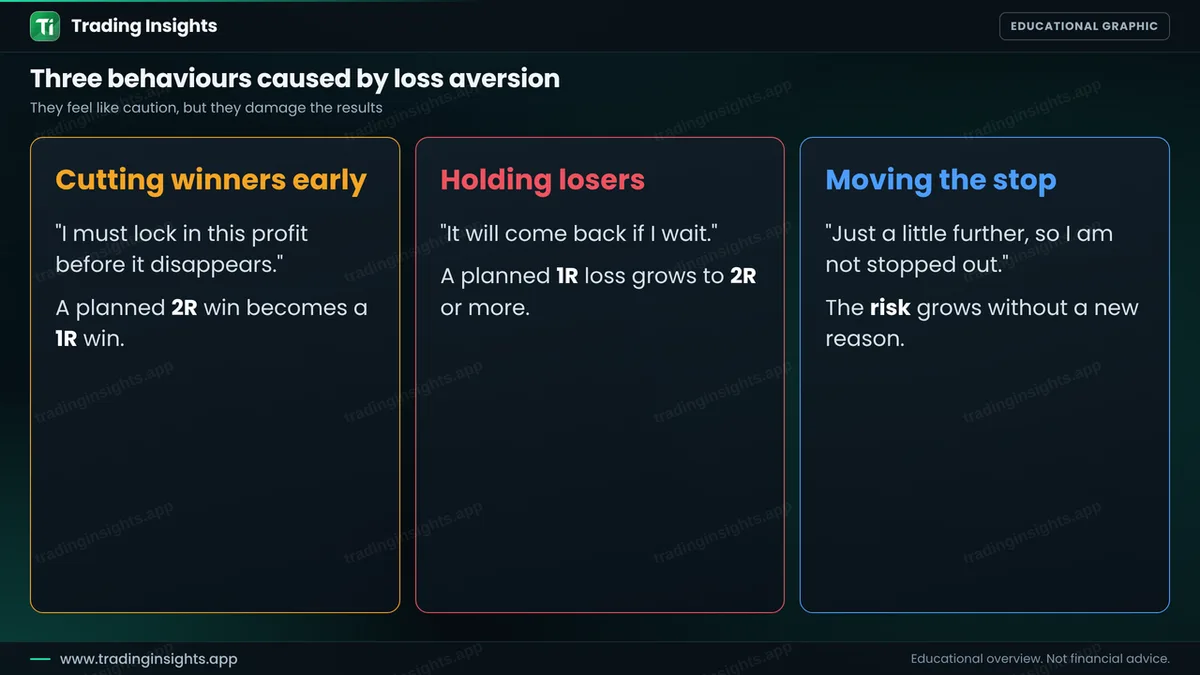
- Cutting winners early. A trade is in profit, and you fear that the profit will vanish. You close it at 1R, although the plan said 2R.
- Holding losers. A trade is in loss, and closing it would make the loss real. You hope that price will come back, so you wait.
- Moving the stop. To avoid being stopped out, you move the stop further away. The risk grows without any new reason.
What loss aversion does to your results
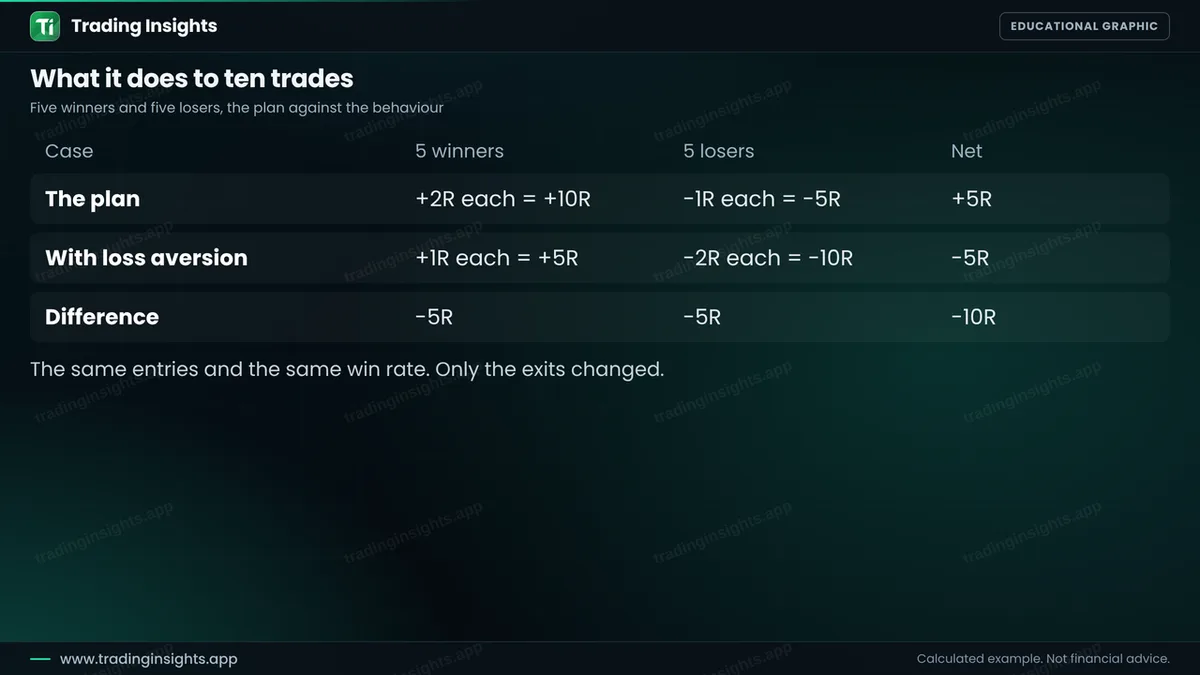
Take ten trades with five winners and five losers. The plan has a stop of 1R and a target of 2R. If you follow it, the winners give +10R, the losers cost -5R, and the result is +5R.
Now add loss aversion. You cut the winners at +1R and let the losers run to -2R. The winners give +5R, the losers cost -10R, and the result is -5R. The strategy did not change, and the win rate did not change. Only the exits changed, and 10R was lost. The idea of a positive plan is explained in trading expectancy.
Why the pain of loss is so strong
A stop loss is a promise to take a small, certain pain now. The brain would rather gamble on avoiding it. A target is the opposite: a profit in your hand feels safer than a bigger profit that you do not have yet.
Both feelings are normal, and every trader has them. That is why the fix is not to try to feel differently, but to build rules that do not depend on feelings.
Illustrative example: one trade, two behaviours
This is an illustrative example, not a real trade. A trader buys EUR/USD at 1.0800 with a stop at 1.0770 (30 pips) and a target at 1.0860 (60 pips), a 1 to 2 ratio.
With a $10,000 account risking 1% ($100), the position size is $100 / (30 pips x $10 per pip per lot) = about 0.33 lot. A win pays about $200, and a loss costs about $100.
Price rises to 1.0830 and stalls. Following the plan, the trader waits. Driven by loss aversion, the trader closes at +30 pips for about $100, which is half of the planned profit. If the next trade is a full loss of $100, the two trades together make zero instead of +$100. Repeat this over many trades, and the edge disappears.
How to reduce loss aversion
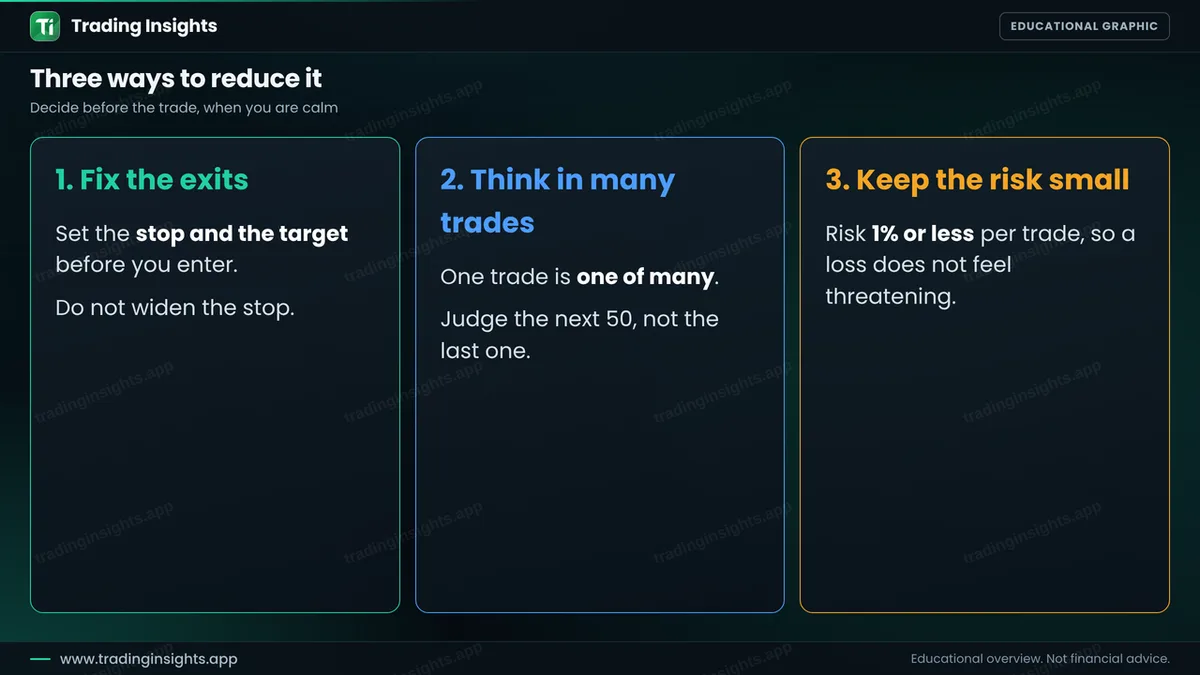
- Fix the exits. Set the stop and the target before you enter, and place the stop order in the platform. Do not widen it. See stop loss and take profit. If you want to protect profit, use a rule, such as a trailing stop or partial profits, instead of a feeling. See trailing and break-even stops and taking partial profits.
- Think in many trades. One trade is one of hundreds. If your edge exists, it shows over a series, not in one result. Judge the next 50 trades, not the last one. See losing streaks in trading.
- Keep the risk small. When one loss is only 1% of the account, it hurts less, and it is easier to accept. See how to calculate position size and use the position size calculator.
Common mistakes
- Calling an early exit "risk management". If the plan said 2R and you took 1R out of fear, it was a deviation. Mark it in the journal as such.
- Moving the stop "just this once". One exception becomes a habit. Place the stop before entry and leave it.
- Counting a loss as a failure. A stop-out is a cost of doing business, like rent. Judge the process, not one result.
- Risking so much that every loss feels dangerous. Large risk makes fear louder. Lower the risk until a loss does not change your mood.
Frequently asked questions
What is loss aversion?
It is the tendency to feel the pain of a loss more strongly than the pleasure of an equal gain. In trading, it pushes people to avoid taking losses, even when taking them is the right move.
How does loss aversion hurt traders?
It leads to cutting winners early, holding losers too long and moving stops. This lowers the average win and raises the average loss, so a plan with an edge can lose money.
Is closing a winner early always wrong?
No. If the plan says to close, or you follow a rule such as partial profits, it is fine. The problem is deviating from the plan out of fear.
How can I reduce loss aversion?
Set exits before the trade, keep the risk small, think in a series of trades and review your exits in a journal. Rules help because they work even when you feel afraid.
Your next step
Open your last 20 trades and mark every one where you closed early or moved a stop. Add up what those decisions cost in R. That number shows how much loss aversion is costing you, and it is a good reason to write your exit rules down.
This is education, not financial advice. Trading carries risk, and no method guarantees results. The charts are illustrative and not real market data.


