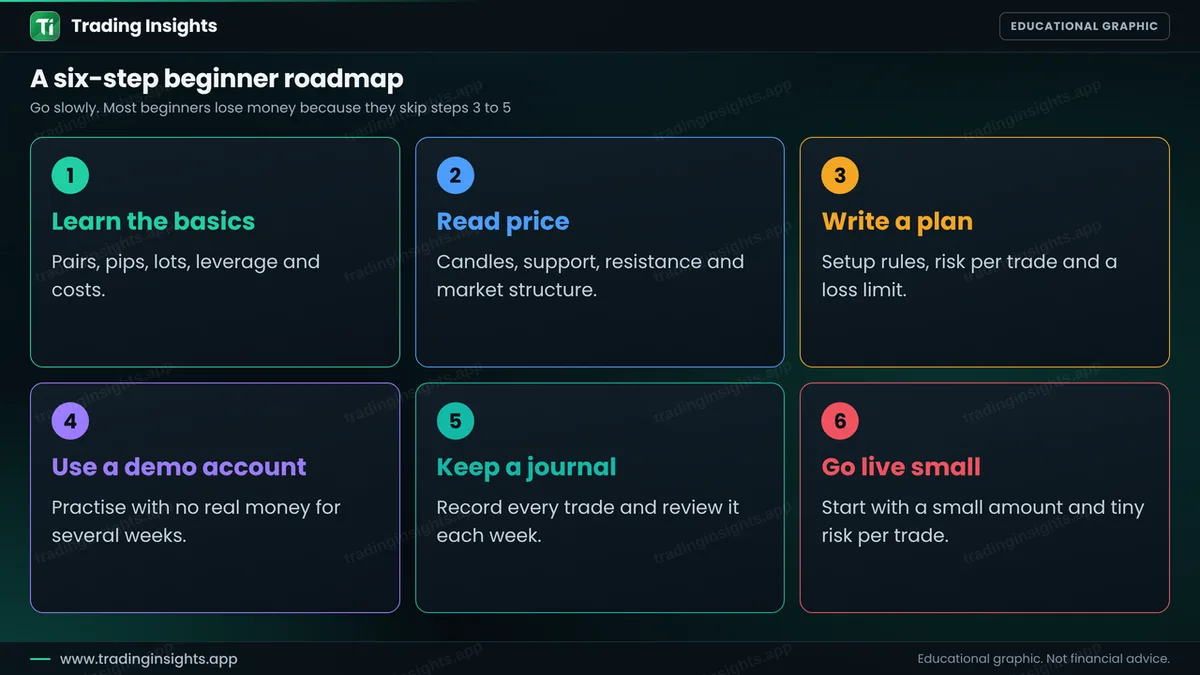
Forex, short for foreign exchange, is the market where currencies are traded against each other. When you trade forex, you do not buy a currency in isolation: you buy one and sell another at the same time, so every trade is on a pair such as EUR/USD. This guide explains how that works, the six terms to learn before placing a trade, a simple example with real arithmetic, and a six-step roadmap for beginners. The message that matters most is that most beginners lose money, usually because they skip the basics and risk too much, so go slowly.
How forex trading works
A pair shows how much of the second currency (the quote) is needed to buy one unit of the first (the base). If EUR/USD is 1.0850, one euro costs 1.0850 US dollars. If you think the euro will rise against the dollar, you buy EUR/USD. If it rises to 1.0900, the trade is profitable. If you think it will fall, you sell. You always trade the price movement, and you do not take delivery of the currency. For the pairs themselves see forex currency pairs explained.
The market runs five days a week, from Monday to Friday, in sessions around the world, and it has no single exchange. Prices come from a network of banks and brokers. Retail traders access it through a broker, and the choice of a regulated broker is an important first step. Trading is also risky: you can lose more than you expect, and no method wins every time.
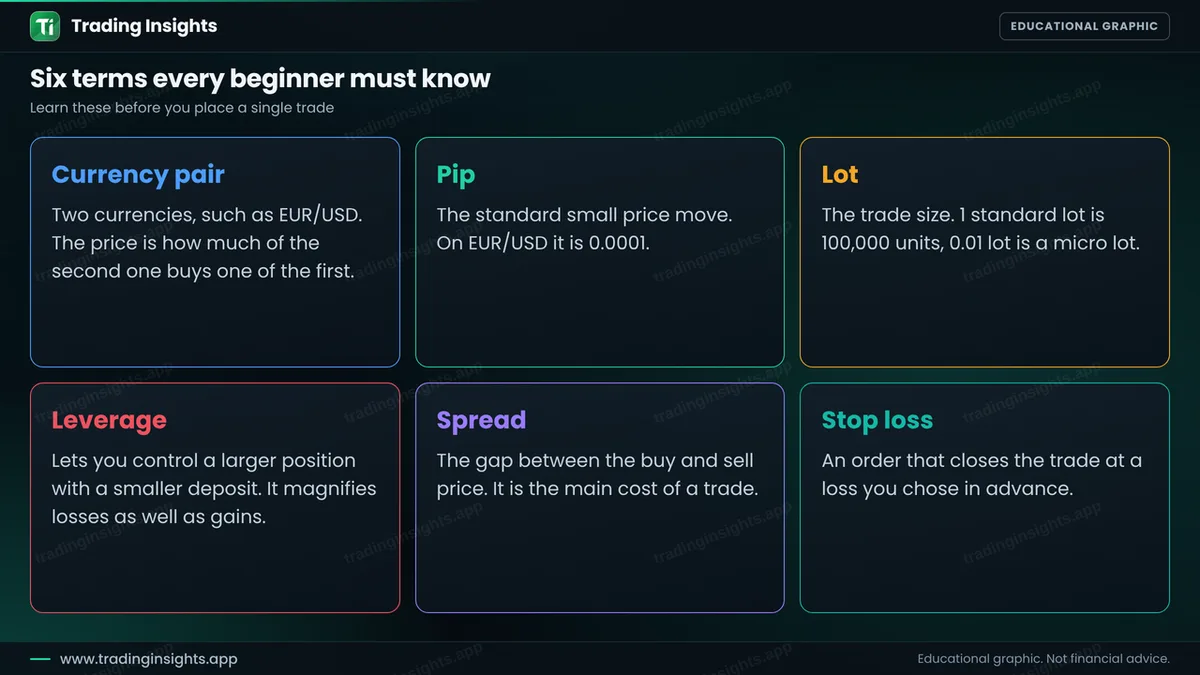
Six terms to know
- Currency pair. Two currencies quoted against each other, like EUR/USD.
- Pip. The usual smallest price step, 0.0001 for most pairs. See what a pip is.
- Lot. The trade size. A standard lot is 100,000 units, a mini is 10,000 and a micro is 1,000. See lot size.
- Spread. The difference between the buy price and the sell price. It is a cost of every trade.
- Leverage. Borrowed exposure that lets a small deposit control a large position. It magnifies both gains and losses. See leverage.
- Stop loss. An order that closes a trade at a set loss. See stop loss and take profit.
A simple trade with numbers
This is an illustrative buy of EUR/USD. You buy 0.10 lot at 1.0850. A pip on 0.10 lot is worth about $1. You place a stop at 1.0830 and a take profit at 1.0900.
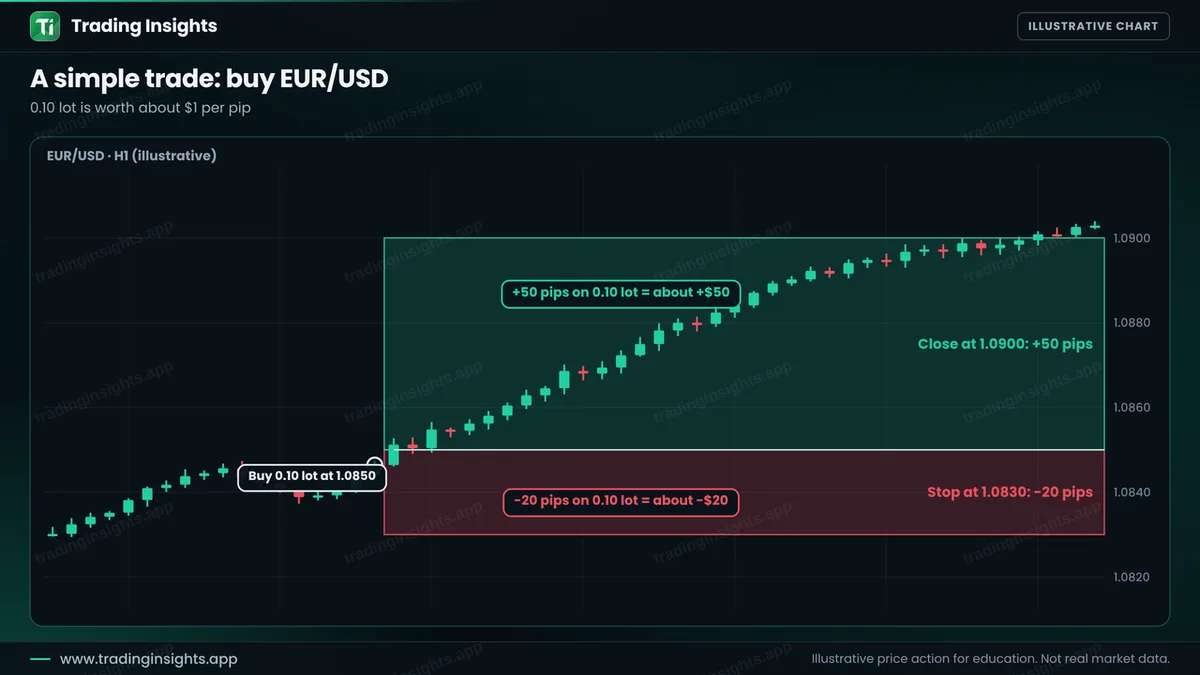
- If the stop is hit: 20 pips x $1 = a loss of about $20.
- If the target is hit: 50 pips x $1 = a gain of about $50.
- Ratio: 20 to 50, or 1:2.5.