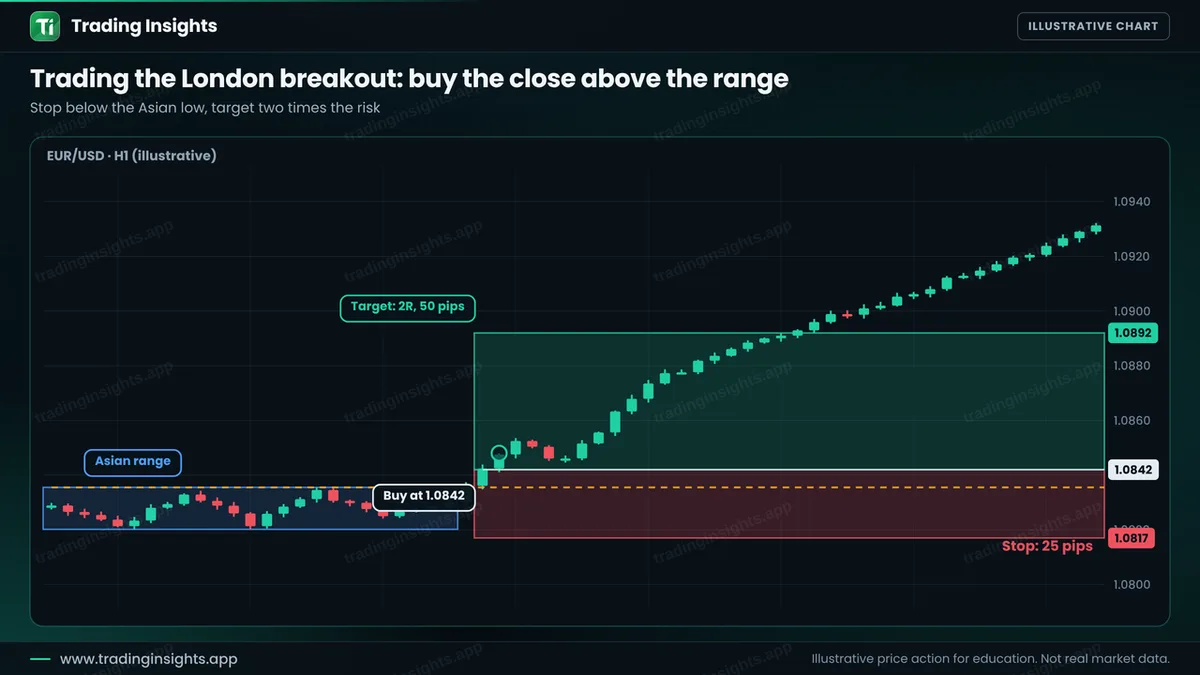
The London breakout is a simple day-trading strategy built on how the forex sessions follow each other. The Asian session is often quiet, so price moves in a narrow range. When London opens, volume and volatility usually rise, and price often leaves that range. The strategy marks the Asian high and low and trades a break of one of them. It is easy to describe, but it is not a guaranteed edge: many breaks fail. This guide explains the rules, how to separate a real breakout from a fakeout, a worked trade with a stop, a target and a lot size, and the limits you should know before you use it.
Why the Asian range matters
During the Asian session, most major pairs trade with lower volume, especially pairs like EUR/USD and GBP/USD. Price tends to drift sideways and build a tight box. Orders collect above the high and below the low of that box: stops, pending breakout orders and new entries. When London opens, more participants arrive and those levels are often tested. For the background on the sessions, see forex trading sessions explained.
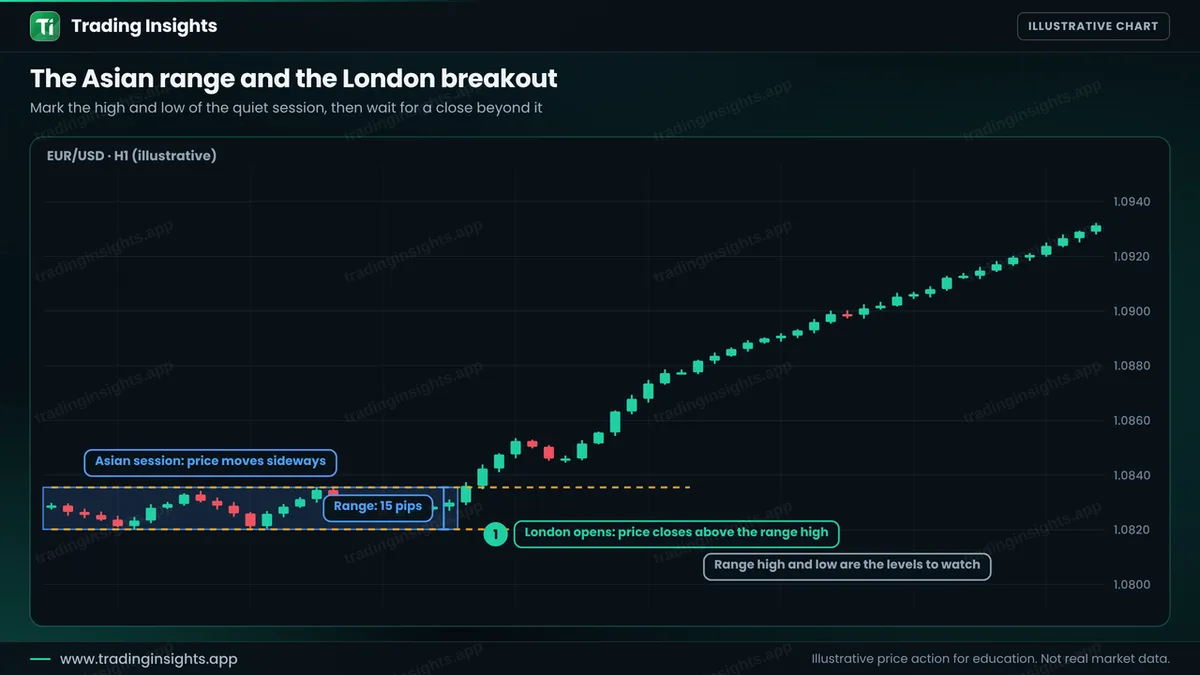
The exact hours depend on your chart's time zone and on daylight saving. A common choice is to use the range from around midnight to the London open, but you should check the clock on your own platform and keep the same definition every day.
The rules, step by step
- Mark the Asian range. Draw a box from the start of the session to the London open, covering the highest high and the lowest low.
- Check the size. A very wide range means that the move has already happened, and a very narrow range gives a stop that is smaller than normal noise. Many traders skip days outside a size they have tested.
- Wait for London. Do not trade inside the box. Wait until the London session starts.
- Wait for a close beyond the range. A candle on your chosen timeframe, such as M15 or H1, must close above the high (for a buy) or below the low (for a sell).
- Place the stop. Beyond the opposite side of the range, with a small buffer. Some traders use the middle of the range for a tighter stop, at the cost of more stop-outs.
- Set the target. A multiple of the risk, such as 2R, or a nearby level. See stop loss and take profit.
- Size the trade. From the stop distance and a fixed risk percentage.
Real breakout or fakeout?
The main danger of the strategy is the fakeout: price spikes beyond the range, triggers the breakout orders and then returns inside. This is a liquidity sweep of the range, and it often marks a move in the other direction.
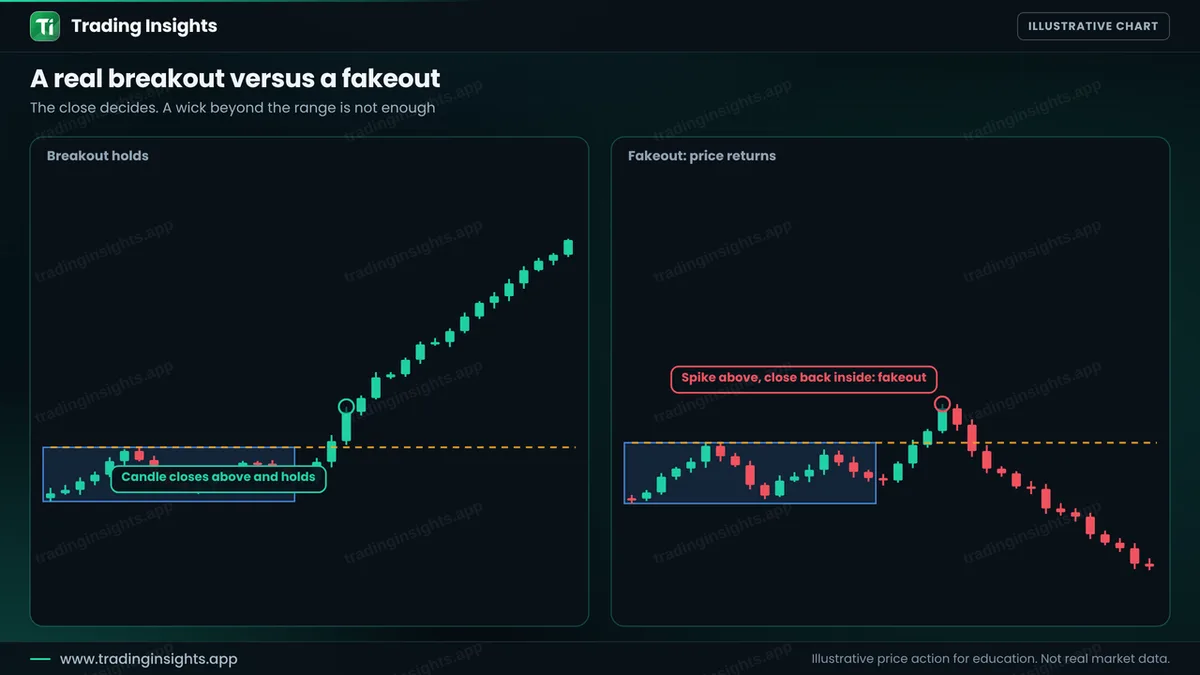
Waiting for the close removes many fakeouts, but not all. Some traders also wait for a retest of the broken level, which gives a closer stop and a better ratio but means that they miss trades where price does not return. Others avoid the first hour after the London open when the spikes are common. Test these choices, and do not change them after a few trades. A method for testing is in how to backtest a forex trading strategy.