
To recover from a losing month in forex, do not chase the loss. Stop, review your journal to find the cause, cut your position size, restart with half the usual risk, and raise it again only after you follow your rules for a set number of trades. A bad month is information, not a verdict.
Every trader has one. Some are normal variation in a strategy, and some come from mistakes. Either way the account is lower, and the urge is to trade bigger and faster. That is usually where a bad month becomes a bad year.
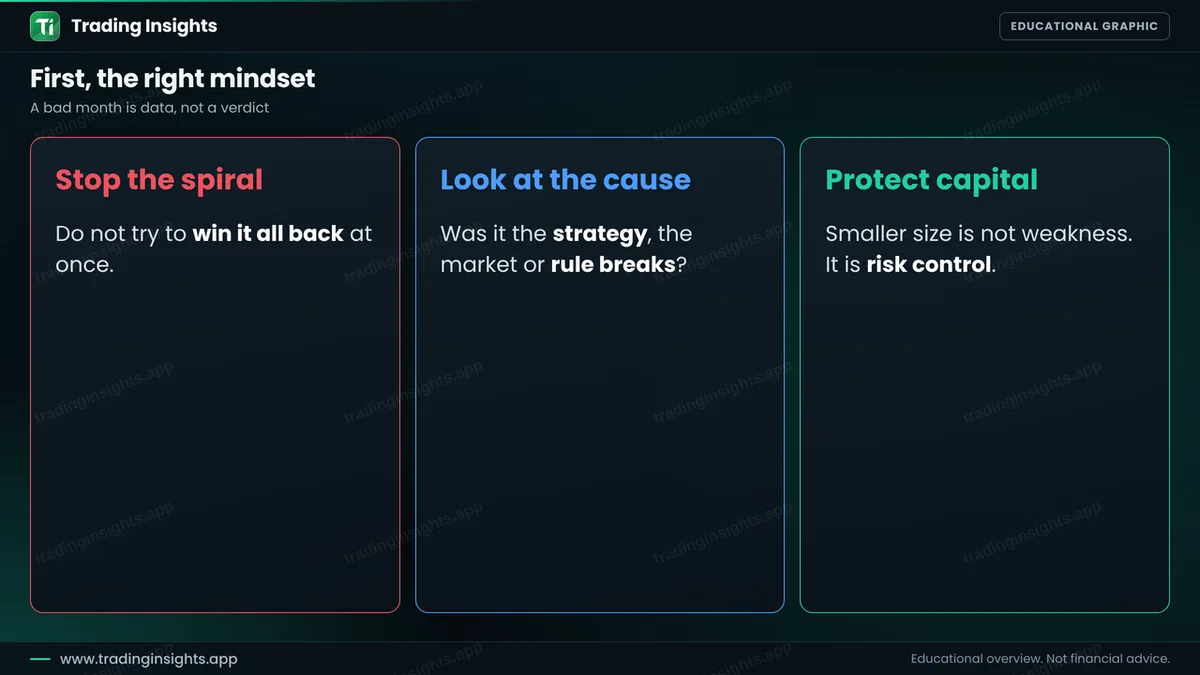
How to recover from a losing month: start with the mindset
The first rule is not to chase. Trying to win everything back at once leads to larger positions and looser rules, which is how revenge trading starts.
Second, treat the month as data: what happened, and why? Third, protect what is left. Reducing size after a loss is not weakness. It is risk control, and it buys you time to think.
The math of recovery is harsh: a 10% loss needs an 11% gain, and a 20% loss needs a 25% gain. Small steps beat a large leap.
Review a losing month with your journal
Use your journal for the review, not your memory. If you have none, start one now. See trading journal metrics.
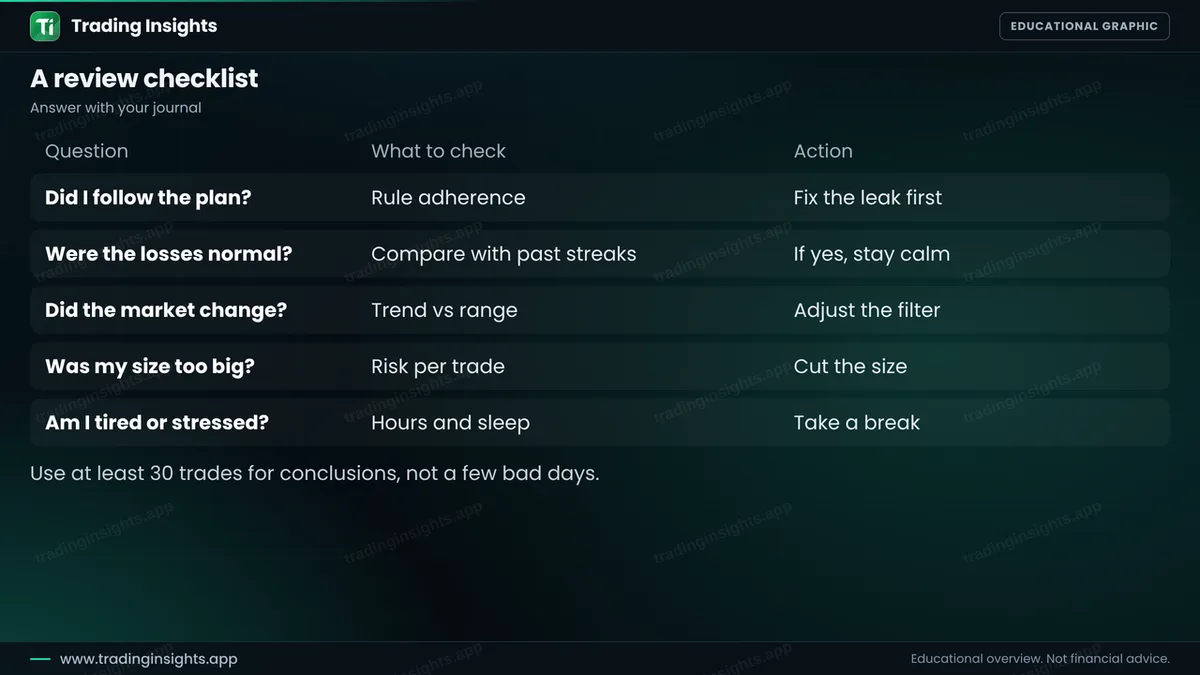
- Did I follow the plan? If not, the problem is discipline, not the strategy. Fix rule breaks first. See a pre-trade checklist.
- Were the losses normal? Compare with past streaks. Even good strategies have losing runs. See losing streaks in trading and trading expectancy.
- Did the market change? A trend strategy may suffer in a range, and the reverse. See trend following vs mean reversion.
- Was my size too big? Check the risk per trade and the total risk. See portfolio risk.
- Am I tired or stressed? See trading burnout and stress.
A single month is a small sample. Before you change a strategy, look at at least 30 trades, not a few bad days. Changing the rules after a bad month is a common way to make them worse.
How to restart trading after a loss
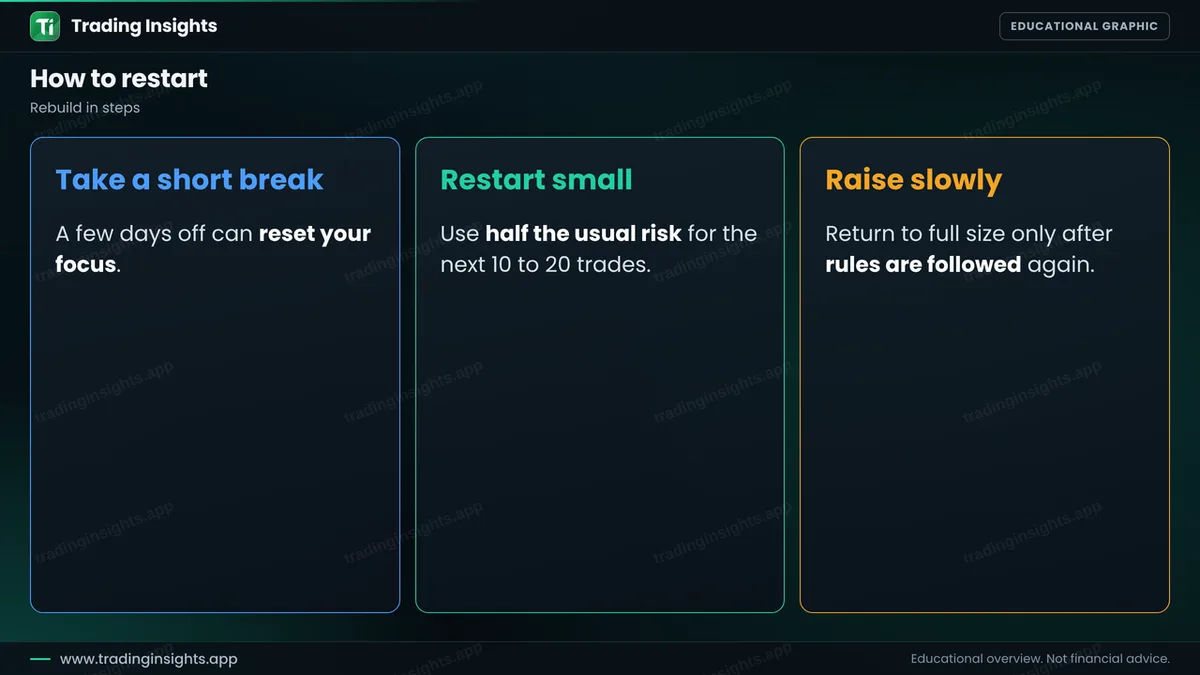
- Take a short break. A few days away can reset your focus. Use the time to review.
- Restart small. Use half the usual risk for the next 10 to 20 trades. See the 1% rule.
- Use a checklist and a daily loss limit. See the daily loss limit.
- Raise the size slowly. Return to full size only after you follow the rules for a set number of trades.
- Test changes first. If you changed the plan, test it on a demo account. See forward testing.
An illustrative example of a restart
A trader starts the month with $10,000 and loses 10%, leaving $9,000. His first thought is to double the size. Instead he opens his journal. Of 28 trades, seven broke his rules: he entered before the candle closed and moved two stops. The trades that followed the rules were close to break-even.
He takes three days off and restarts at 0.5% risk, which is $45 on the $9,000 account. On a EUR/USD trade with a 30-pip stop, the position size is $45 / (30 pips x $10 per pip per lot) = about 0.15 lot. A win at 60 pips pays about $90, and a loss costs about $45.
After 20 trades with no rule breaks, he returns to 1% risk. The recovery needs about 11% on the lower balance, so he accepts that it will take time. You can check sizes with the position size calculator.
What invalidates a recovery plan
- You break the reduced-size rule after one or two wins.
- You skip the journal review and trade on feeling.
- You change the strategy again before you have 30 trades.
- You trade while angry, tired or stressed.
When it is more than a bad month
If losses are large relative to your savings, or trading causes serious stress, sleeplessness or problems in your relationships, stop trading and seek help from someone you trust or a professional. Your health and finances matter more than any trade. Only trade with money you can afford to lose.
Common mistakes
- Increasing size to recover quickly. Bigger positions make the next loss larger. Cut size instead.
- Changing the whole strategy after a few bad days. Small samples mislead. Review at least 30 trades first.
- Skipping the review. Without the cause, the same errors repeat. Use the journal.
- Hiding the loss from yourself. An unrecorded loss cannot teach you anything. Log every trade.
Frequently asked questions
How do I recover from a losing month?
Do not chase. Review your journal, find the cause, cut the size, take a short break and rebuild the risk in steps. Use the risk reward calculator to check that each trade is worth taking.
Should I change my strategy after a bad month?
Not based on a single month. Review at least 30 trades, and first check whether you followed the rules.
How much should I cut the size?
Many traders use half the usual risk for the next 10 to 20 trades, then return to full size when the rules are followed.
When should I stop trading altogether?
If losses are large for your finances, or trading causes serious stress, stop and get support.
Your next step
Open your journal today and mark every trade from the last month that broke your rules. Count them, and write one rule you will fix first.
This is education, not financial advice. Trading carries risk, and no method guarantees results. The charts are illustrative and not real market data.


