
Gold trades under the symbol XAU/USD at many forex brokers, and it is priced in US dollars per troy ounce. Its price is driven mainly by the dollar, real yields, fear in the markets, central bank buying and inflation worries, and these forces often pull in different directions. The bigger practical issue is size: gold moves in dollars per ounce, so a position that feels normal on a forex pair can carry far more risk. This XAU/USD trading guide covers what moves gold prices and how to size a trade sensibly.
What is XAU/USD?
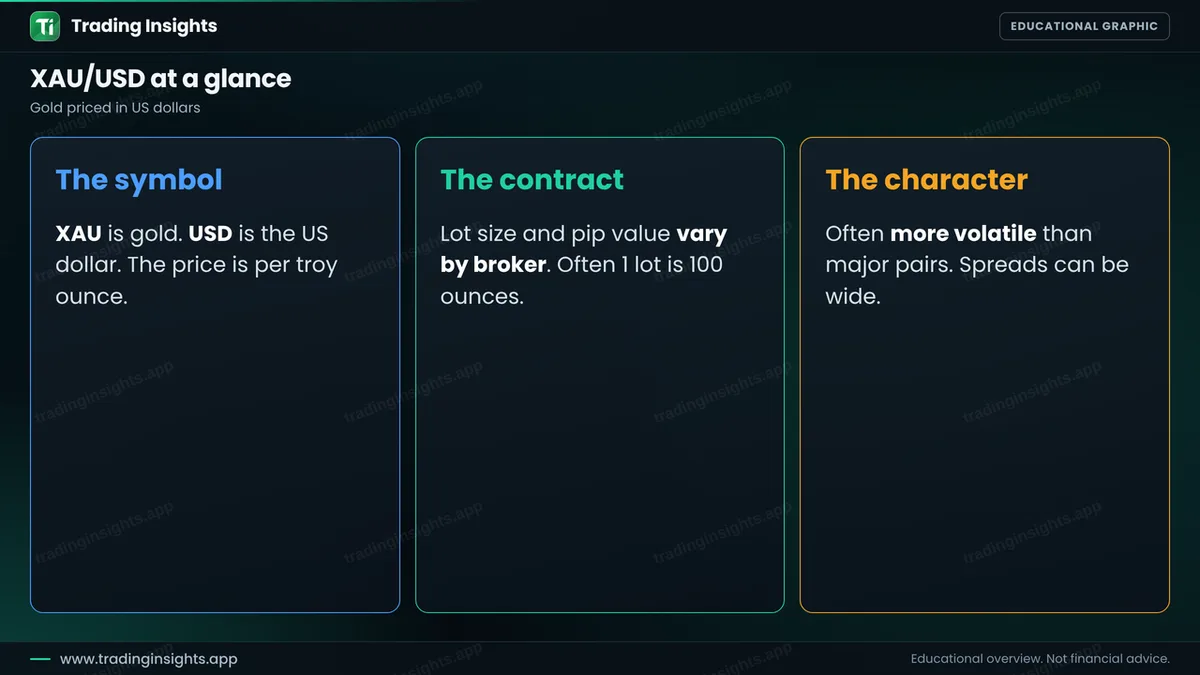
XAU is the code for one troy ounce of gold, and the quote shows how many US dollars that ounce costs. If you buy XAU/USD, you gain when gold rises against the dollar and lose when it falls. Gold is not a currency, but it is quoted like a pair, so it fits in the same platform.
Contract details are not standard. One broker may define a lot as 100 ounces, another as something else, and the meaning of a pip or a point differs as well. Always read the contract specification, the margin requirement and the cost per move before you trade. See how to calculate pip value for the method.
What moves gold prices
Gold pays no interest and has no earnings. Its price depends on demand, and on what investors expect from money and from risk.
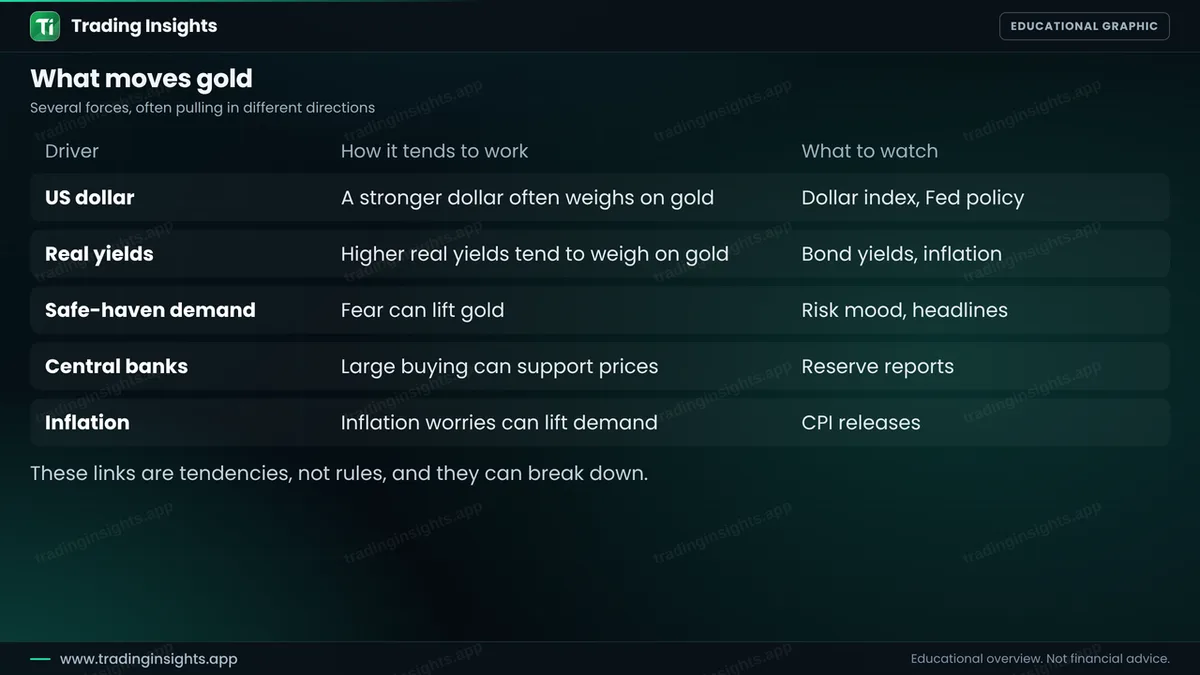
- The US dollar. Because gold is priced in dollars, a stronger dollar often weighs on it, and a weaker dollar often supports it.
- Real yields. Gold pays nothing, so when yields after inflation are high, holding it is less attractive. See bond yields and forex and interest rates and forex.
- Safe-haven demand. Fear can lift gold. See safe-haven currencies.
- Central banks. Large purchases by central banks can support prices.
- Inflation. Worry about inflation can raise demand, though the effect is not constant. See inflation and forex.
These are tendencies, not rules. Sometimes gold and the dollar rise together, and sometimes gold falls in a crisis. Treat each driver as one piece of context, not as a signal.
Is gold a safe haven?
Gold often attracts buyers when investors are nervous, which is where its reputation comes from. But the reaction depends on the cause of the fear. If a crisis sends investors rushing into the dollar and yields rise, gold can fall at the same time.
So do not buy gold only because the news looks scary. Wait for a setup on the chart, with a stop, and accept that the "safe" label does not protect a leveraged position from losses.
How to trade gold with care
The main risk is size: a move of a few dollars per ounce can be a large amount on a full lot.
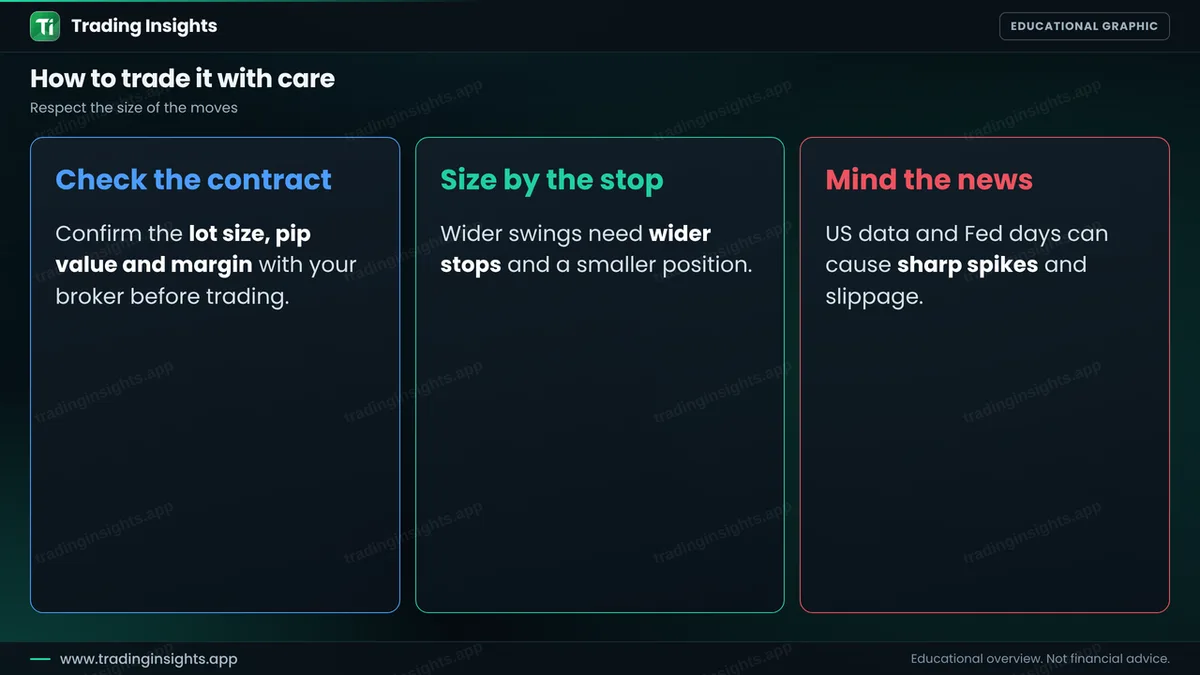
- Check the contract. Confirm the lot size, pip value and margin with your broker. See leverage in forex.
- Size by the stop. Gold moves widely, so stops are wider and positions are smaller. See how to calculate position size and ATR stop loss.
- Mind the news. US data and Fed days can cause sharp spikes and slippage. See trading forex news and central banks and forex.
- Check the spread. It is often wider than on major pairs, and it grows around news. See forex trading costs.
- Use the chart. Round numbers and previous highs and lows matter. See round numbers.
Illustrative example: sizing a gold trade
This is an illustrative example, not a real trade, and the contract numbers are only an assumption, so use the ones from your broker. Suppose 1 lot is 100 ounces, so a $1 move on 1 lot is $100. A trader buys at 2,400.00 with a stop at 2,390.00 ($10 per ounce) and a target at 2,420.00 ($20 per ounce), a 1 to 2 reward-to-risk ratio.
With a $10,000 account risking 1% ($100), the position size is $100 / ($10 x 100 ounces) = 0.1 lot. A win pays about $200, and a loss costs about $100.
If the stop had been $25 wide, the right size would be $100 / ($25 x 100) = 0.04 lot. A trader who used a fixed 1 lot, as on a forex pair, would risk $1,000 on the $10 stop, which is 10% of the account. Wider stop, smaller position: that is the rule for gold.
Gold around US data and Fed days
Gold reacts quickly to US jobs data, inflation reports and central bank decisions, because they change expectations for the dollar and yields. The price can jump, the spread can widen and your stop can fill worse than planned.
Check the calendar before you enter. If a major release is minutes away, either wait until the market settles or stand aside. Do not use a tight stop through the release and hope.
Common mistakes
- Using the same size as on forex pairs. A lot of gold carries much more dollar risk per move. Size from the stop and the contract.
- Assuming that gold always rises in a crisis. It depends on the dollar and yields too. Wait for a chart setup.
- Ignoring the contract size and the margin. These differ by broker. Read the specification first.
- Trading through US data with a tight stop. Spikes and slippage can hit it. Wait or stand aside.
- Adding to a loser because "gold is a safe haven". The label does not limit your loss. Keep your stop.
Frequently asked questions
What does XAU/USD mean?
XAU is the code for one troy ounce of gold, and USD is the US dollar. The quote shows the dollar price of gold.
Is gold a safe haven?
It often attracts demand in fear, but not always. Its moves depend on the dollar, yields and the cause of the fear.
What is the lot size for gold?
It varies by broker. Often 1 lot is 100 ounces, but check your own contract specification.
Why is gold so volatile?
Its price reacts to the dollar, yields, inflation and sentiment at the same time, and the market can move fast on news.
Your next step
Open the contract specification for XAU/USD at your broker and write down the lot size, margin and typical spread. Then run a stop of $10 and a stop of $25 through the position size calculator and compare the lot sizes.
This is education, not financial advice. Trading carries risk, and gold can move sharply and reverse quickly. The charts are illustrative and not real market data.


