
Bond yields move currencies because investors compare the returns on government bonds in different countries, and money tends to flow toward the higher return. When the yield in one country rises compared with another, the currency with the higher yield may gain support. The effect comes from the gap between two countries, called the yield differential, and this article shows how to read it as context for a trade without treating it as a signal.
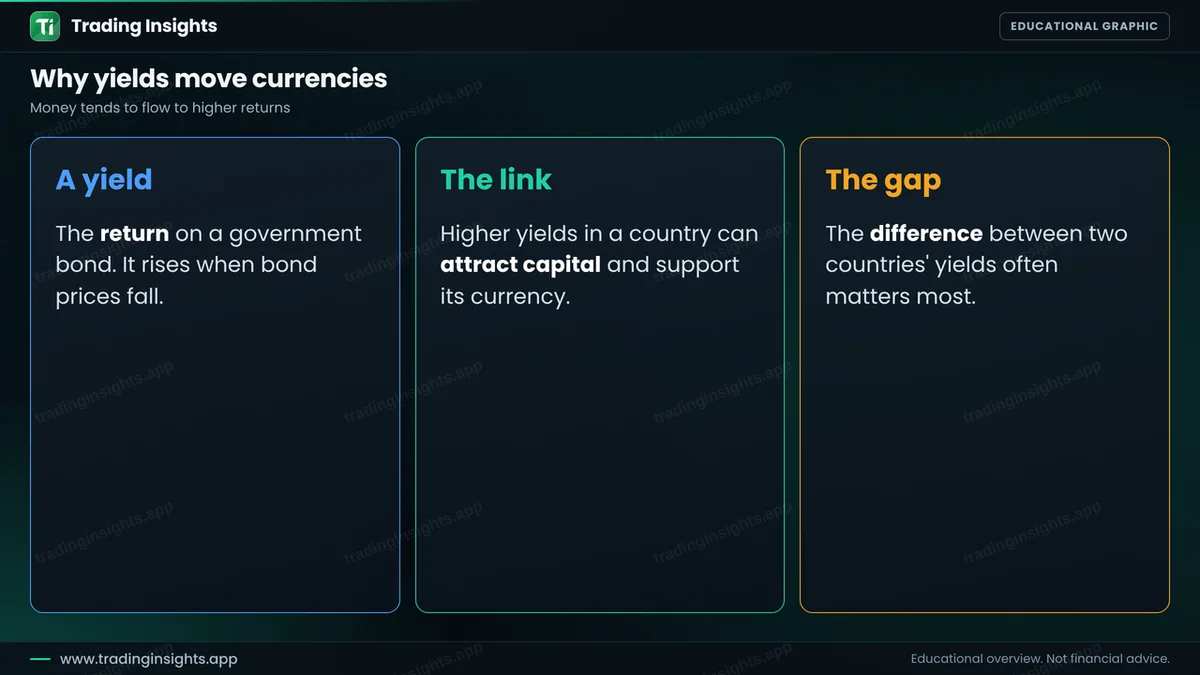
Why bond yields move currencies
A government bond pays a fixed interest to the holder. If the price of the bond falls, the yield, which is the return for a new buyer, rises. Investors compare the yield they can earn in different countries, after thinking about risk.
If US yields rise while German yields stay the same, the US offers a better return, and the demand for dollars may increase. The effect on a currency pair comes from the difference, and not from one country alone. See interest rates and forex for the link to central bank policy.
How to read yield differentials with a currency pair
The two-year yield is often used, because it follows expectations about central bank rates in the near term. The ten-year yield shows the broader outlook for growth and inflation.
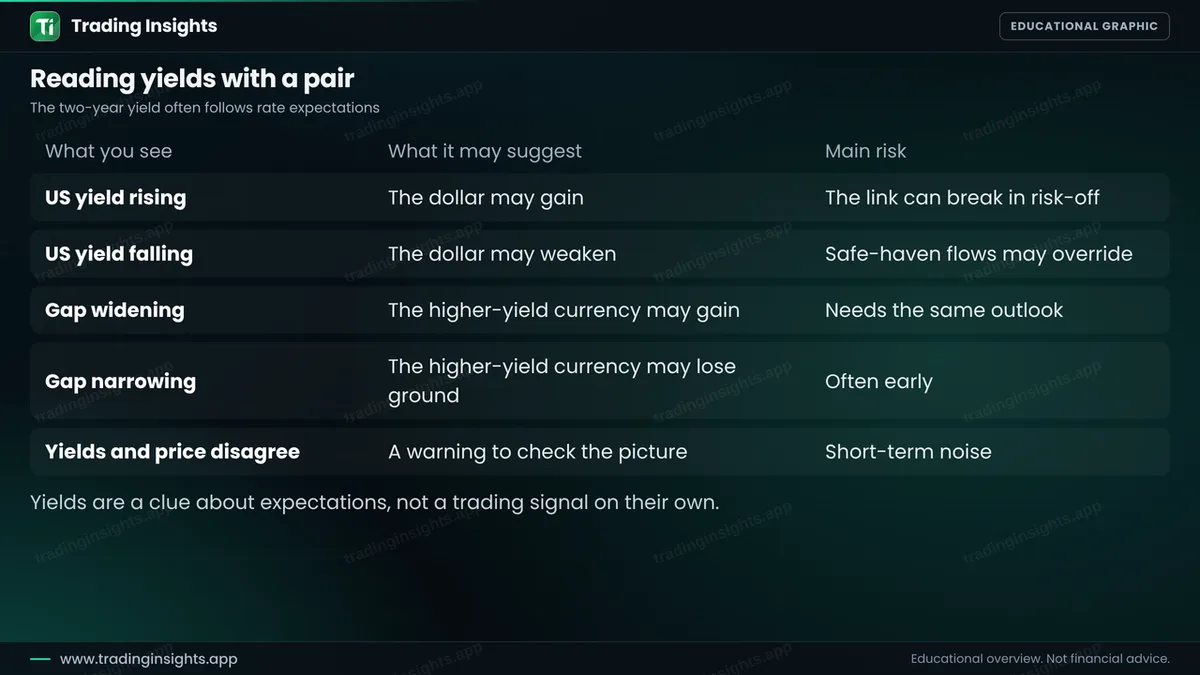
- A rising yield in one country often goes with a stronger currency, as long as the reason is a better outlook for growth and rates.
- A widening gap between two countries tends to support the currency with the higher yield. This idea sits behind the carry trade.
- A narrowing gap may weigh on it.
- Disagreement between yields and price is a warning to check the picture: the market may be driven by something else, such as risk mood.
When the link breaks
The link is not constant. In a crisis, investors may buy government bonds as a safe haven, which pushes yields down, while the dollar may rise at the same time. See safe-haven currencies.
Markets also price in expectations before the data. A yield can rise for weeks before a rate decision, and the currency may already have moved by the time the news arrives. Real yields, which are yields after inflation, are especially important for gold. See the gold guide and inflation and forex.
How to use bond yields in trading
Yields give a bias. The entry, stop and target still come from the chart.
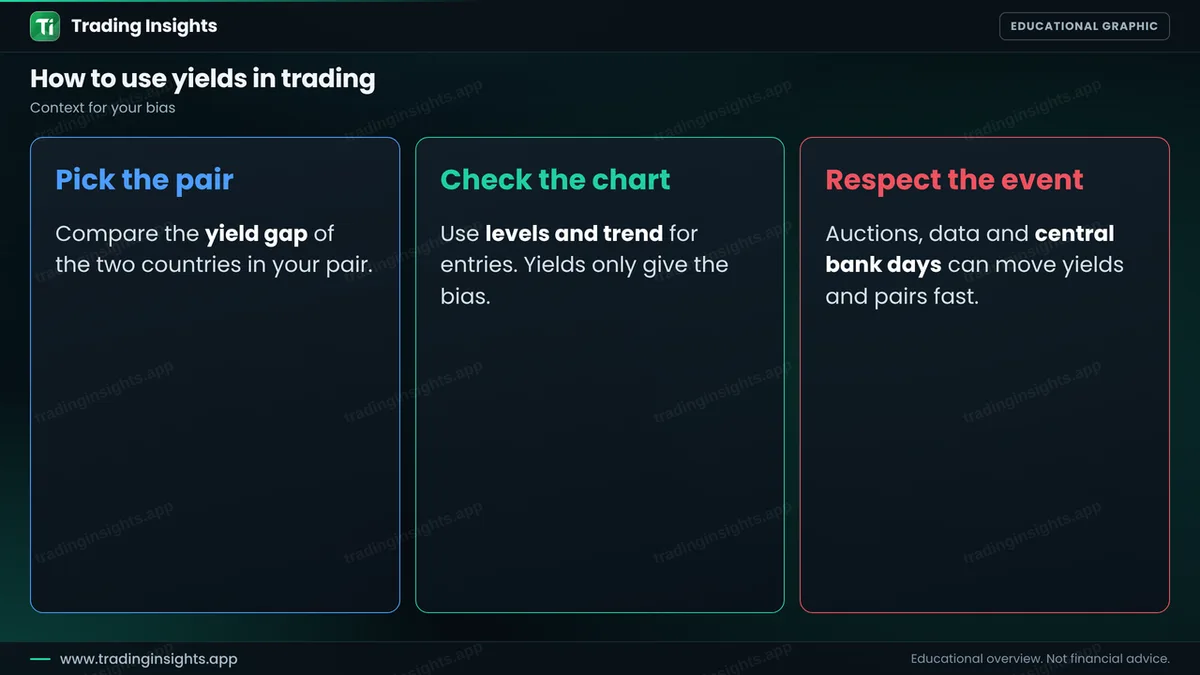
- Pick the pair. Compare the yields of the two countries in your pair. A clear gap with a clear direction supports a bias.
- Check the chart. Use levels and trend for the entry. See top-down analysis and how to identify a trend.
- Respect the events. Bond auctions, inflation and jobs data, and central bank days can move yields and pairs quickly. See trading forex news.
- Manage the risk. A good macro view can still be early. Use a stop and a modest size. See stop loss and take profit.
Illustrative example: a widening yield gap on EUR/USD
This is an illustrative example with made-up numbers, not real market data. Suppose the US two-year yield is 4.50% and the German two-year yield is 2.50%, a gap of 2.00 percentage points. Over several weeks, strong US jobs data lifts the US yield to 4.80% while the German yield stays at 2.50%, so the gap widens to 2.30 points. That supports a bearish bias for EUR/USD.
Now the chart decides the entry. Price rallies to resistance at 1.0900 and a bearish candle closes below it. The trader sells at 1.0900 with a stop at 1.0940 (40 pips) and a target at 1.0820 (80 pips), a 1 to 2 reward-to-risk ratio.
With a $10,000 account risking 1% ($100), the position size is $100 / (40 pips x $10 per pip per lot) = 0.25 lot. A win pays about $200, and a loss costs about $100.
If the US yield then fell sharply on weak data while the pair kept falling, the two would no longer agree, and the bias would be weaker. You can check the sizing with the position size calculator.
Common mistakes
- Treating yields as a buy or sell signal. Yields are context. Wait for a setup on the pair itself.
- Looking at only one country's yield. The pair responds to the gap. Always compare both sides.
- Ignoring the risk-off effect. In a panic, yields and currencies can move in unusual ways. Check the market mood first.
- Skipping the chart and the stop because the macro view "must" be right. A correct idea can still be early. Define your risk before you enter.
Frequently asked questions
What is a bond yield?
It is the return an investor earns on a government bond. It rises when the bond price falls and falls when the price rises.
Why do yields affect currencies?
Higher yields can attract capital to a country, which raises the demand for its currency. The difference between two countries matters most.
Which yield should I watch?
Many traders watch the two-year yield for rate expectations and the ten-year yield for the broader outlook.
Can I trade on yields alone?
No. Yields give context and a bias, but you need a chart setup, a stop and a risk plan for the trade.
Your next step
Pick one pair, such as EUR/USD, and note the two-year yields of both countries from a free data source. Check once a week for a month whether the gap widened or narrowed and compare it with the pair's direction. That record will show how much weight yields deserve right now.
This is education, not financial advice. Trading carries risk, and yield-based views can be wrong or early. The charts are illustrative and not real market data.


