
Going long means buying a currency pair because you expect the price to rise, and going short means selling it because you expect the price to fall. In forex you can profit in both directions, because every position is one or the other. Understanding long and short is one of the first steps in reading a trade, a chart or a quote.
What does going long and going short mean?
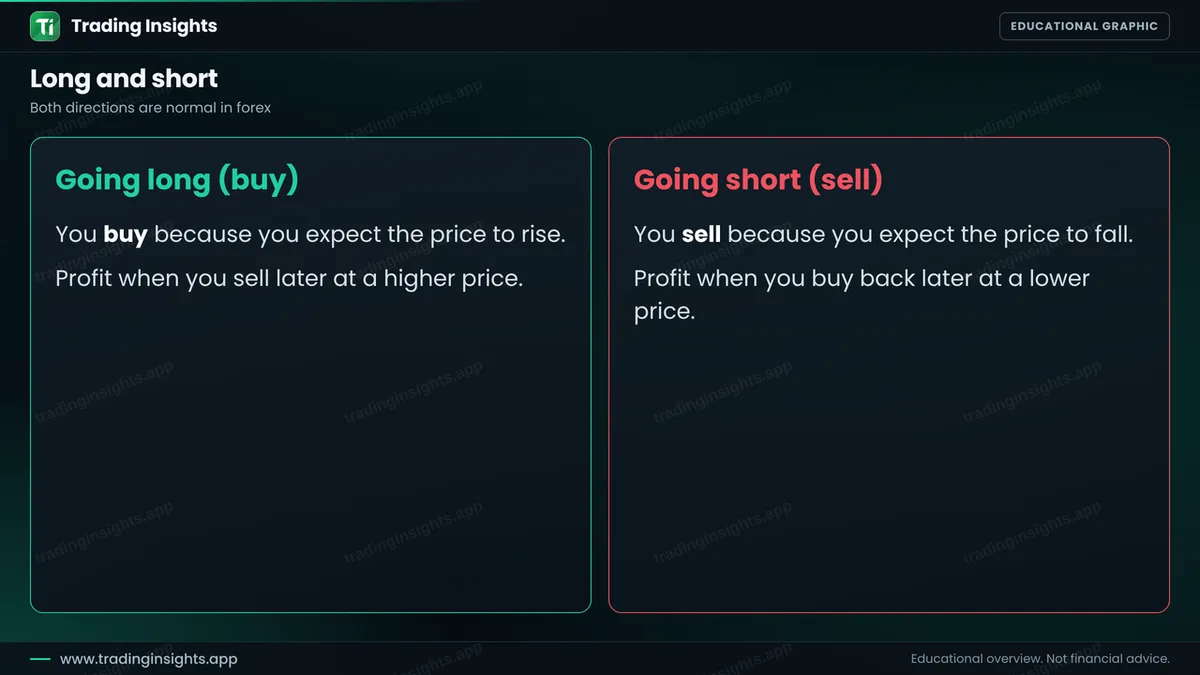
Going long means buying. You profit if you later sell at a higher price. Going short means selling. You profit if you later buy back at a lower price.
In the platform, you simply choose Buy or Sell. You do not need to own the currency first, as in some stock markets, because every forex trade is an exchange of two currencies.
Long and short on a currency pair
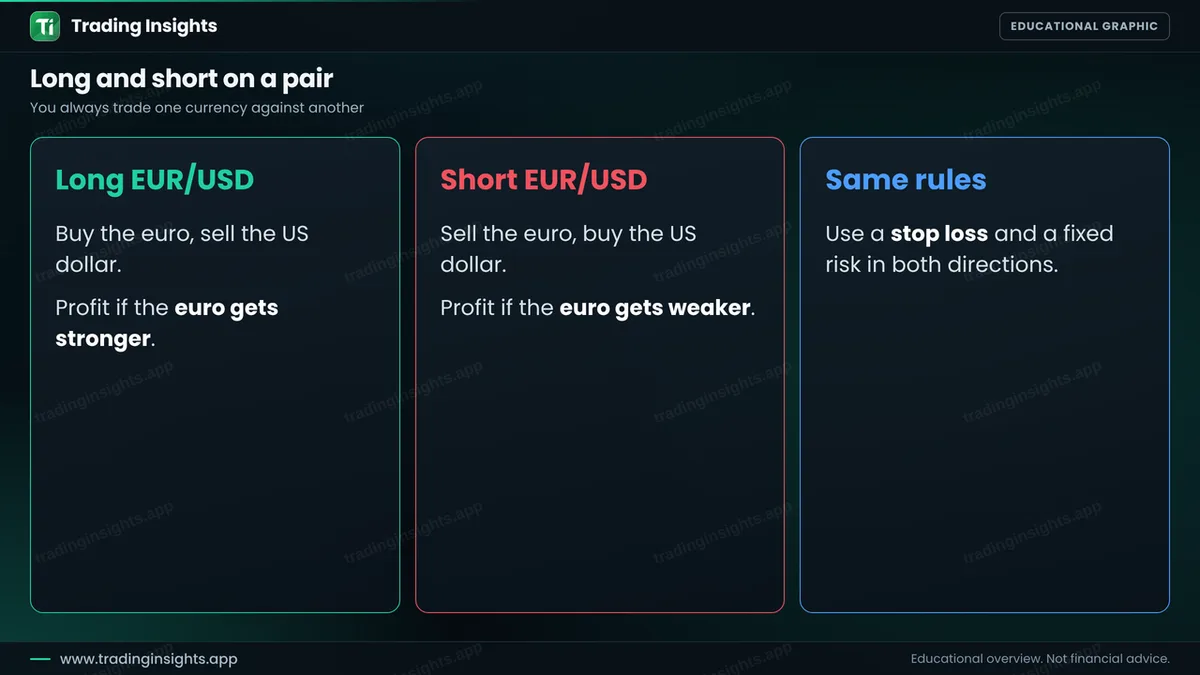
A currency pair has a base and a quote currency. See forex currency pairs. If you go long on EUR/USD, you buy the euro and sell the US dollar, and you profit if the euro becomes stronger.
If you go short, you sell the euro and buy the dollar, and you profit if the euro becomes weaker. A single pair has two sides, so a rise in one currency is a fall in the other.
Long vs short examples with numbers
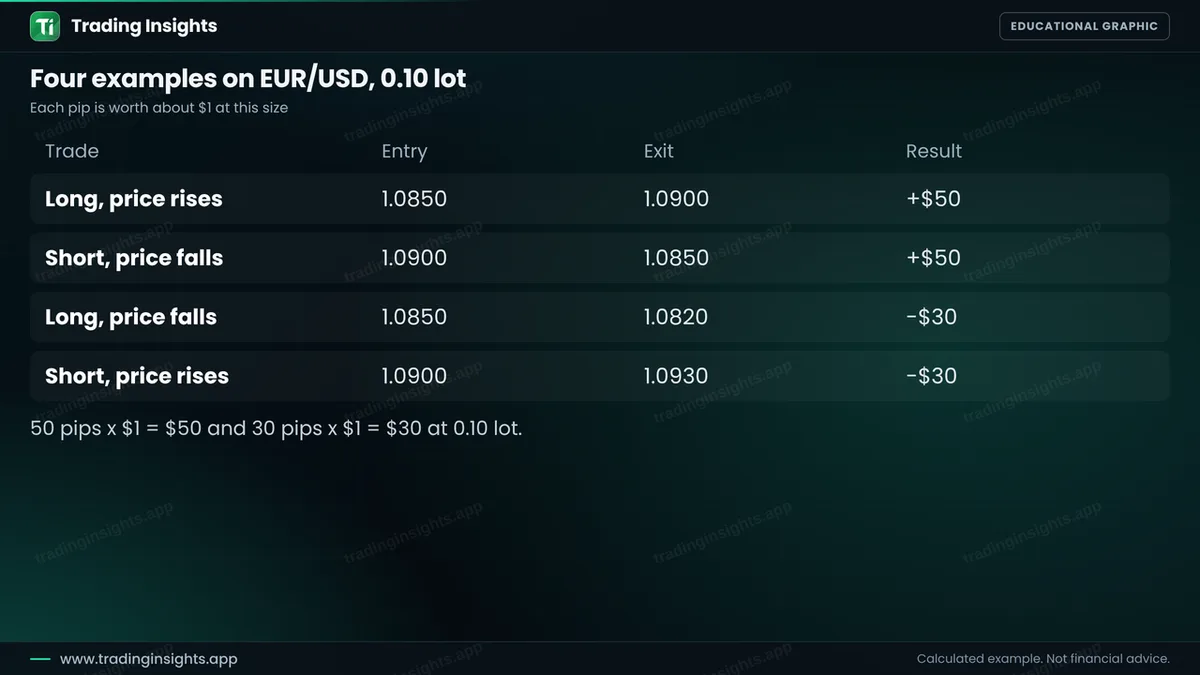
At 0.10 lot on EUR/USD, one pip is worth about $1. If you buy at 1.0850 and sell at 1.0900, you gain 50 pips, or $50. If you sell at 1.0900 and buy back at 1.0850, you also gain 50 pips, or $50.
If the price goes the wrong way, the loss is calculated in the same way. Buying at 1.0850 and selling at 1.0820 loses 30 pips, or $30, and selling at 1.0900 and buying back at 1.0930 also loses $30. For the pip values of other pairs, see how to calculate pip value.
What is the same and what is different
- Risk rules are the same. Use a stop loss and a fixed risk per trade in both directions. See stop loss and take profit and how to calculate position size.
- The spread is the same. Both directions pay it. See bid and ask prices.
- The swap can differ. Holding long or short overnight may pay or earn different amounts, because of interest rates. See interest rates and forex.
- The psychology can differ. Many beginners feel comfortable buying, but uncomfortable selling. A strategy should work in both directions: buy in uptrends and sell in downtrends.
- The speed can differ. Markets often fall faster than they rise, which can mean larger candles and more slippage on short trades. See slippage.
How to choose between a long and a short trade
- Find the trend on a higher timeframe. See how to identify a trend.
- Trade with it. Buy pullbacks in an uptrend and sell rallies in a downtrend.
- Use levels. Buy near support and sell near resistance. See support and resistance.
- Plan the exit. Set the stop and the target before the trade, in both directions.
- Keep the same checklist for buys and sells.
Illustrative example: the same setup, long and short
This is an illustrative example, not a real trade. Take two mirror-image setups on EUR/USD with the same risk.
Long: price is in an uptrend and pulls back to support. The trader buys at 1.0850, with a stop at 1.0810 (40 pips) and a target at 1.0930 (80 pips).
Short: price is in a downtrend and rallies to resistance. The trader sells at 1.0850, with a stop at 1.0890 (40 pips) and a target at 1.0770 (80 pips).
With a $10,000 account risking 1% ($100), the position size is $100 / (40 pips x $10 per pip per lot) = 0.25 lot in both cases. A win pays about $200, and a loss costs about $100. Only the direction changed. The stop sits on the other side of the entry, which is the part beginners most often get wrong on a short.
A note on the short side and the stop
On a short trade, your stop is a buy order above your entry, and your target is a buy order below it. Because you buy back at the ask price, the spread can trigger a short stop slightly early. Leave a few pips of room beyond the level, and use the position size calculator so the risk stays fixed even when the stop is wider.
Common mistakes
- Only looking for buy trades. You ignore half of the market. Learn to read downtrends as carefully as uptrends.
- Placing the stop on the wrong side of the entry. For a long the stop is below, and for a short it is above. Check this before you click.
- Selling only because "price has gone up too much". A rising market can keep rising. Wait for a sign of a reversal and a level.
- Using larger risk on shorts because the move looks easy. No move is easy. Keep the same fixed risk for both directions.
Frequently asked questions
What does going long mean?
It means buying a currency pair because you expect its price to rise.
What does going short mean?
It means selling a currency pair because you expect its price to fall, and buying it back later at a lower price.
Can I really make money when a price falls?
Yes. In forex, a short trade profits when the price falls, as the profit is the difference between the sell price and the later buy price.
Is short selling riskier than buying?
Both have risk. In both cases, use a stop loss and a fixed risk per trade. Prices can move against a short as easily as against a long.
Your next step
Open a demo account and place one small long trade and one small short trade on EUR/USD, each with a stop. Watch how the profit and loss move in each case, and note where the stop sits relative to the entry.
This is education, not financial advice. Trading carries risk, and either direction can lose money. The charts are illustrative and not real market data.


