
EUR/USD is the most traded currency pair in the world, and it is where most beginners start because spreads are usually tight and there is plenty of news and analysis. It is driven mainly by the gap between European and US interest rates, economic data from both regions and the market's risk mood. That does not make it easy to trade, but it does make it a good pair for learning how a major behaves. This EUR/USD trading guide covers what the pair is, what moves it, when to trade it and how to size a trade.
EUR/USD basics: what the quote means
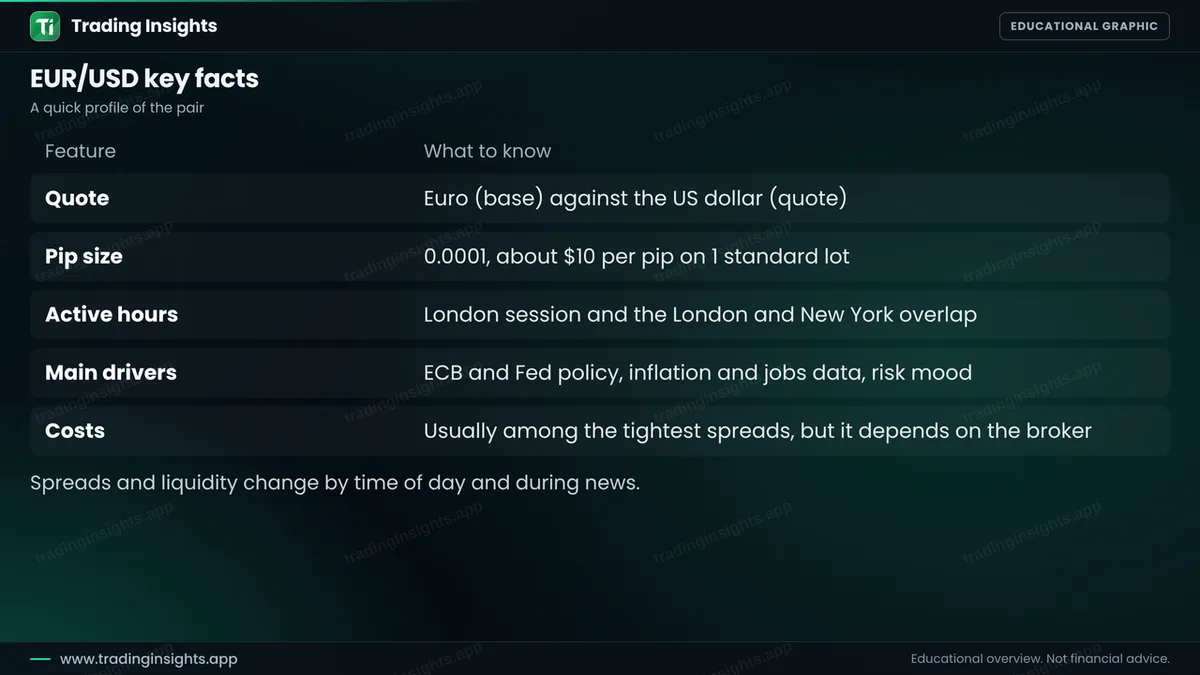
EUR/USD shows how many US dollars are needed to buy one euro. If the quote is 1.0900, one euro costs 1.0900 dollars. The euro is the base currency and the dollar is the quote currency. See forex currency pairs explained for the full picture.
One pip is 0.0001. On a standard lot of 100,000 units, a pip is worth about $10, which is why many examples use that value. For other sizes and pairs, see how to calculate pip value.
What moves EUR/USD
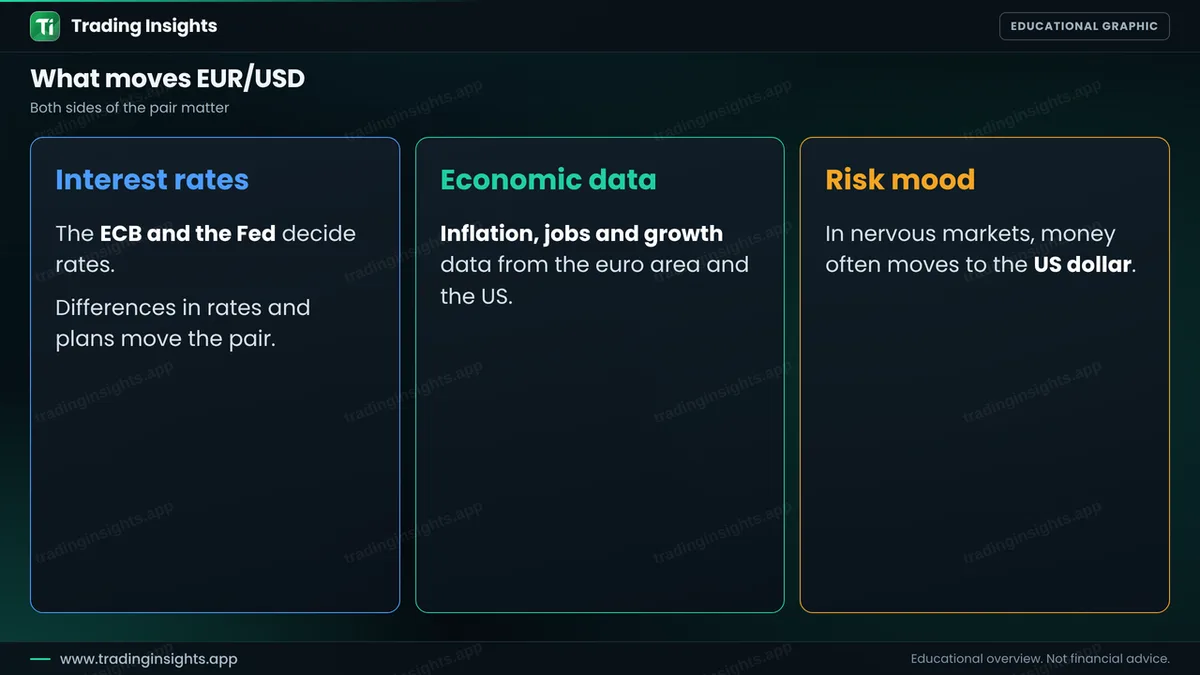
- Interest rates and policy. The European Central Bank (ECB) and the US Federal Reserve (Fed) set the rates for the euro and the dollar. Changes in rates, and in expectations of future rates, are among the most important drivers. See interest rates and forex.
- Economic data. Inflation, jobs and growth figures from the euro area and the United States. US data often moves the pair strongly. See what moves forex prices.
- Risk mood. In nervous markets, investors often buy the US dollar for safety, which can push EUR/USD lower. In calmer markets, the dollar may weaken.
- Politics and events. Elections, trade news and regional events in Europe or the US can add sudden moves.
Remember that EUR/USD moves because of the difference between two economies. A good result in Europe can lift the euro, but a better result in the US can lift the dollar more.
Why the dollar side often leads
Because the US dollar sits on one side of most major pairs, a big move in the dollar can push EUR/USD even when nothing has changed in Europe. A surprise in US jobs or inflation data can move the pair within seconds. For that reason, many traders read the pair as "the dollar versus everything" first and as "the euro story" second.
Check which side is driving the move before you trade. If GBP/USD and AUD/USD are moving the same way as EUR/USD, the dollar is probably the cause. If only the euro pairs are moving, something euro-specific may be going on.
Best time to trade EUR/USD
EUR/USD trades all day, but the most movement usually comes during the London session and the overlap with New York. In quiet Asian hours, the pair often moves less. Spreads are usually tight in busy hours and wider when the market is quiet or around news.
See forex trading sessions and forex trading costs. Exact spreads vary by broker, so check your own platform.
How to trade EUR/USD step by step
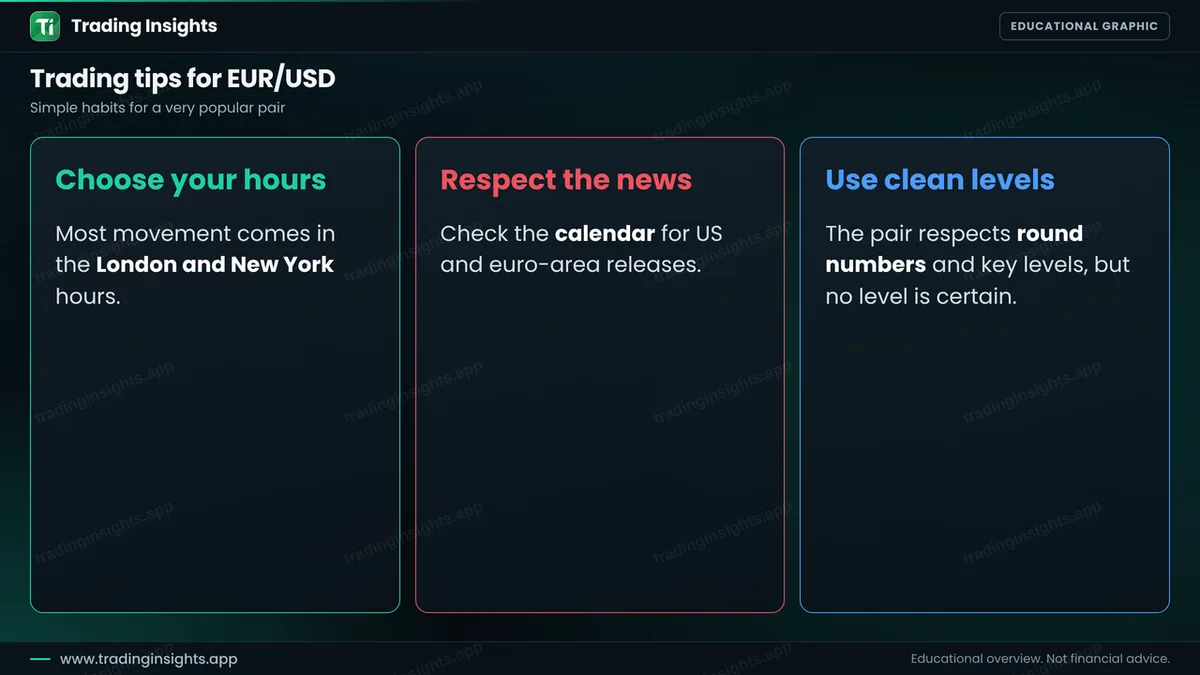
- Choose your hours. Trade when the pair is active, and avoid the quietest hours if your strategy needs movement.
- Check the calendar. Know when the ECB, the Fed and major data are due, and decide in advance whether to trade or stand aside. See trading forex news.
- Use clean levels. The pair is watched by so many traders that round numbers and key highs and lows are often respected, but not always. See support and resistance.
- Size by the stop. Place the stop first and then calculate the lots with the position size calculator.
- Know the correlations. EUR/USD often moves opposite to USD/CHF and is related to GBP/USD. See currency correlation in forex.
Illustrative example: a EUR/USD pullback buy
This is an illustrative example, not a real trade. EUR/USD is in an uptrend on the H1 chart during the London session. Price pulls back to a support level at 1.0830 and prints a bullish candle. The trader buys at 1.0850 with a stop at 1.0820 (30 pips) below the support and a target at 1.0910 (60 pips), a 1 to 2 reward-to-risk ratio.
With a $10,000 account risking 1% ($100), the position size is $100 / (30 pips x $10 per pip per lot) = about 0.33 lot. A win pays about $200, and a loss costs about $100.
If a major US release was due ten minutes later, a careful trader would either skip the trade or wait until after the news, because the spread can widen and the price can jump past the stop.
Why EUR/USD is popular with beginners
- High liquidity, so orders are usually filled close to the quoted price.
- Tight spreads, which lower the cost of each trade.
- A lot of educational material and news.
- Smoother price action than many minor and exotic pairs, although it can still spike during news.
Common mistakes
- Thinking that a popular pair is automatically safe. Liquidity lowers costs, not risk. Use a stop on every trade.
- Trading through major US or euro-area news with no plan. The price can jump and spreads can widen. Decide before the release whether to stand aside.
- Looking only at the euro side. The dollar often drives the move. Check other dollar pairs first.
- Using the same stop in every session. A stop that suits the London session can be too tight during news. Size stops by current volatility, see forex volatility.
Frequently asked questions
Why is EUR/USD the most traded pair?
Because the euro and the US dollar are two of the largest currencies in the world, and the pair has deep liquidity and wide interest from banks, companies and retail traders.
What is the best time to trade EUR/USD?
Many traders prefer the London session and the London and New York overlap, when volume and movement are usually highest.
What is a pip on EUR/USD?
A pip is 0.0001. On a standard lot, one pip is worth about $10.
What moves EUR/USD the most?
Interest rate policy of the ECB and the Fed, economic data from both regions, and the risk mood of the market.
Your next step
Open an EUR/USD H1 chart and mark the London open each day for a week. Note how far the pair moved in the first three hours compared with the Asian session. That simple record will show you when the pair is worth trading.
This is education, not financial advice. Trading carries risk, and no method guarantees results. The charts are illustrative and not real market data.


