
USD/CHF is the US dollar against the Swiss franc, nicknamed the "Swissie". The franc is a classic safe-haven currency, and the pair often moves in the opposite direction to EUR/USD. These two facts shape most of its behavior, and they also create a trap for traders who hold both pairs at once.
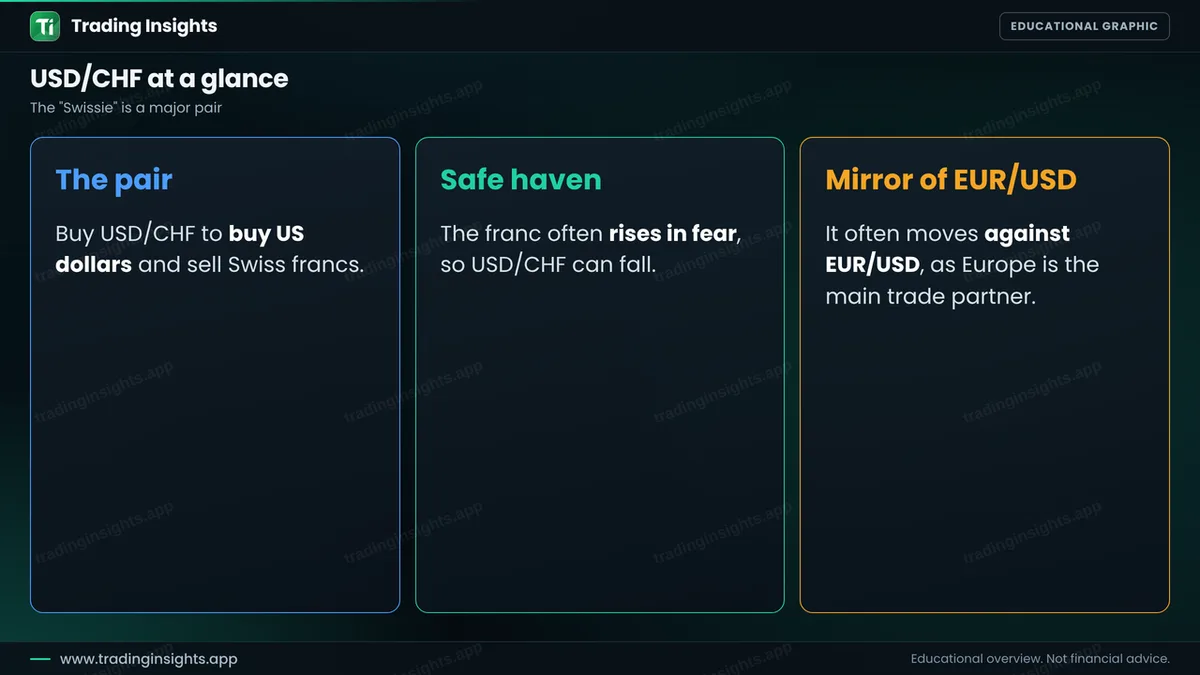
USD/CHF at a glance
If you buy USD/CHF, you buy US dollars and sell Swiss francs. The pip is 0.0001. The franc has a reputation for stability, and it often attracts money in times of fear. See safe-haven currencies.
The euro zone is Switzerland's main trading partner, and both USD/CHF and EUR/USD have the dollar on opposite sides. As a result, the two pairs tend to move in opposite directions. See the EUR/USD guide.
What moves USD/CHF
- Risk mood. Fear tends to lift the franc, so the pair falls.
- Swiss National Bank (SNB). Its rate decisions and comments about the franc move the currency. See central banks and forex.
- The Fed. A higher US rate outlook tends to lift the pair. See interest rates and forex.
- EUR/USD. Often the mirror of USD/CHF.
- The interest gap. Switzerland has had low rates, which matters for carry. See the carry trade.
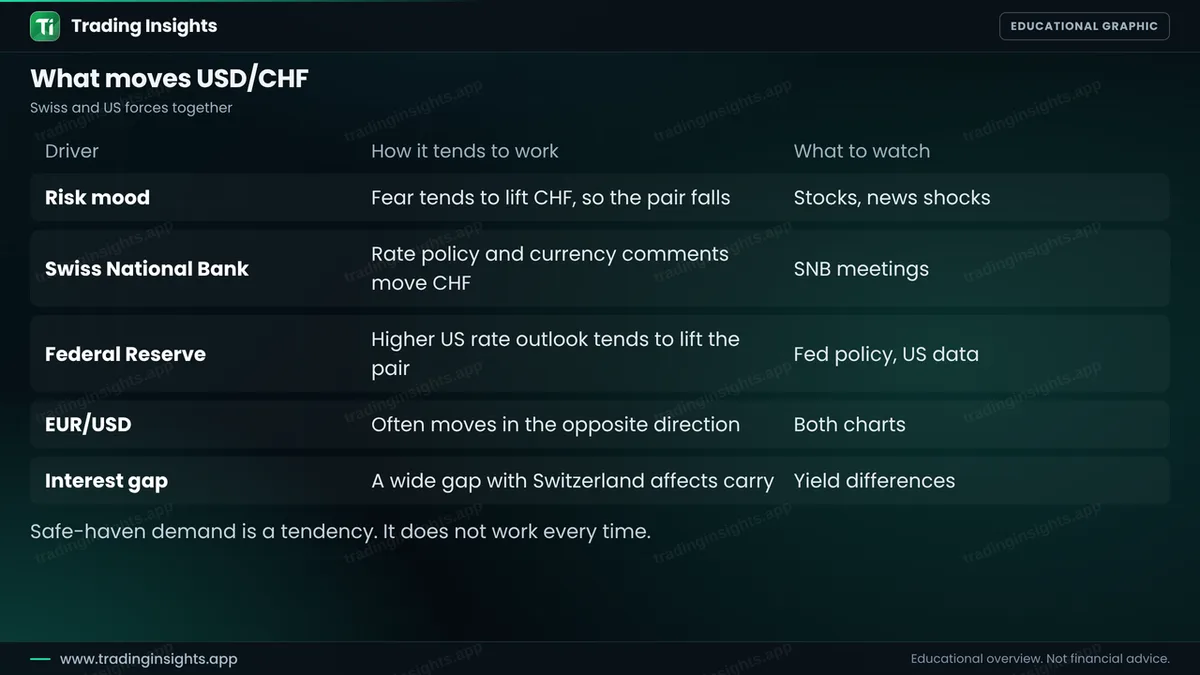
The safe-haven role is a tendency, not a rule. In some crises the dollar rises at the same time as the franc, so the pair may not fall. Check the chart and the wider mood before you lean on the story.
Why USD/CHF and EUR/USD move in opposite directions
Both pairs share the dollar. When the dollar strengthens, EUR/USD tends to fall and USD/CHF tends to rise. When the dollar weakens, the reverse tends to happen. The euro and the franc also move together to a degree, which strengthens the mirror effect.
The link is not perfect. A Swiss-specific event, such as an SNB decision, can move USD/CHF while EUR/USD barely reacts. Treat the mirror as a strong tendency and measure it yourself on your timeframe. See currency correlation.
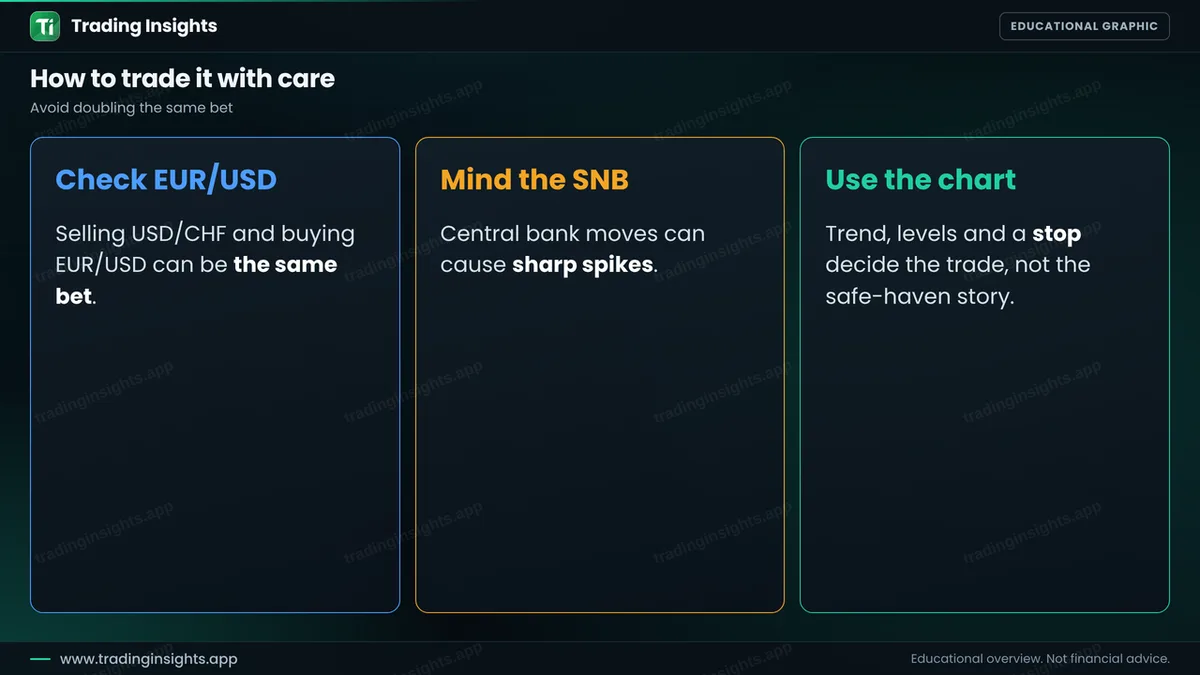
How to trade USD/CHF with care
- Check EUR/USD. Selling USD/CHF and buying EUR/USD can be one idea in two trades.
- Mind the SNB. A central bank surprise can cause a sharp spike. See slippage.
- Use the chart. Trend, levels and a stop decide the trade. See top-down analysis.
- Size by the stop. See how to calculate position size.
Illustrative example: a USD/CHF sell and the double bet
This is an illustrative example, not a real trade. USD/CHF is in a downtrend and pulls back to resistance at 0.8800. A bearish candle closes below it, and the trader sells at 0.8800 with a stop at 0.8830 (30 pips) and a target at 0.8740 (60 pips), a 1 to 2 ratio.
With a $10,000 account risking 1% ($100), the position size is $100 / (30 pips x $10 per pip per lot) = about 0.33 lot. A win pays about $200, and a loss costs about $100. The pip value of USD/CHF is quoted in francs, so it differs a little from $10 depending on the exchange rate. Use a calculator for the real figure.
Now add the trap. The same trader is also long EUR/USD with 1% risk, because both charts look bearish for the dollar. A strong US jobs report lifts the dollar, and both trades hit their stops together. Instead of a 1% loss, the account loses about 2%, or $200.
If the trader had counted the two trades as one idea and risked 0.5% on each, the combined loss would have been about 1%, or $100.
A quick check before you add a second dollar trade
Ask three questions before you open a second trade that involves the dollar. Is it the same direction on the dollar as the first trade? Would one data release hit both stops? Is the combined risk still inside your limit for a single idea?
If the answers are yes, yes and no, cut the size on each or take only the cleaner chart. See the position size calculator to work out the lots.
Common mistakes
- Holding USD/CHF and EUR/USD in a way that doubles the bet. The pairs often mirror each other. Count them as one idea and split the risk.
- Assuming that the franc always rises in a crisis. Safe-haven flows are a tendency. Confirm with the chart before you trade the story.
- Ignoring SNB announcements. Policy surprises can cause sharp spikes and slippage. Check the calendar and stay out around the release.
- Using a tight stop around data. Spreads widen and price jumps. Give the trade room or wait until the market settles.
Frequently asked questions
Why is the Swiss franc a safe haven?
Switzerland has a stable economy and political system, so investors often buy the franc in times of fear. It is a tendency and not a guarantee in every crisis.
Why does USD/CHF move against EUR/USD?
Both contain the dollar on opposite sides, and the euro zone is a major partner of Switzerland, so the pairs often mirror each other.
What does the SNB do?
It is the Swiss central bank. Its rate decisions and comments about the franc can move the pair sharply.
Is USD/CHF good for beginners?
It can be, but check the overlap with EUR/USD, and always use a stop. Learn the dollar side first on one pair before adding a second.
Your next step
Open USD/CHF and EUR/USD on the same timeframe and scroll back three months. Note how often they moved in opposite directions and when they did not. Use that to set a combined risk limit for dollar trades. The glossary explains any term you are unsure about.
This is education, not financial advice. Trading carries risk, and correlations can break down quickly. The charts are illustrative and not real market data.


