
Quantitative easing (QE) is when a central bank creates money to buy bonds, and quantitative tightening (QT) is the reverse. Both change bond yields, and through yields they can influence currencies. For forex traders the key point is that the market trades expectations, so the tone of the central bank often moves a currency before any actual change in bond purchases.
What quantitative easing and tightening are
Central banks have more tools than the interest rate. After the financial crisis and during later shocks, many banks bought large amounts of bonds, and some later reversed course.
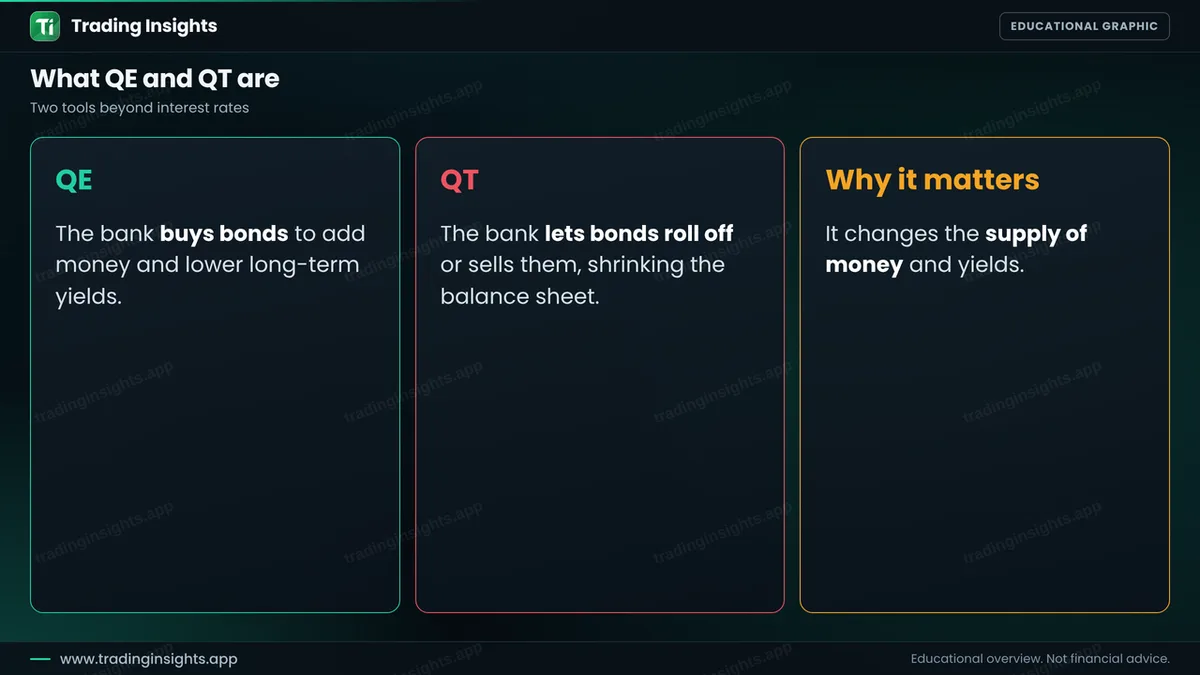
In QE, a central bank creates money to buy bonds, usually government bonds. This adds money to the financial system and pushes long-term yields down, which is meant to support lending and growth when the policy rate is already low.
In QT, the bank does the reverse. It stops reinvesting the money from maturing bonds, or sells bonds, so its balance sheet shrinks. This removes money from the system and can push yields up. See central banks and forex and interest rates and forex for the main tool, the policy rate.
How QE and QT can affect currencies
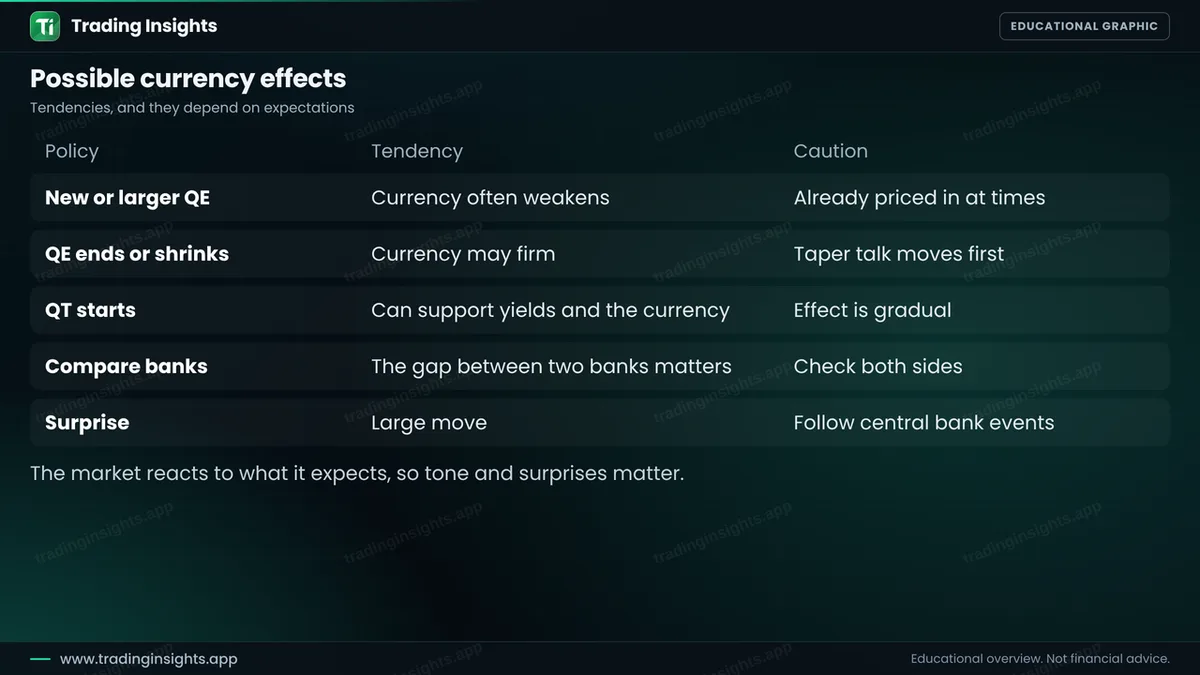
- More QE. More money and lower yields tend to weigh on a currency, as investors seek better returns elsewhere.
- Less QE (tapering). It can support the currency. The market often reacts to talk about a taper before the taper itself.
- QT. Higher yields can support the currency, but the effect is gradual and depends on the pace.
- The gap. A currency pair depends on two central banks, so the difference between their policies matters. See bond yields and forex.
- Surprises. The market trades expectations. If a bank delivers less than expected, the currency may rise even though the policy is easy, and the reverse can happen too.
These are tendencies, not rules. Many other drivers act at the same time, such as inflation, growth and risk mood. For gold, the real yield matters. See the gold guide.
Why the market reacts to expectations first
Bond and currency prices already contain what most traders expect. When a central bank confirms the expected path, little happens. When it hints at a change, the price has to adjust, and the move can be fast.
That is why a speech or a set of minutes can matter more than the policy action that follows months later. By the time the bank acts, the news is usually in the price.
How to use QE and QT in your trading: step by step
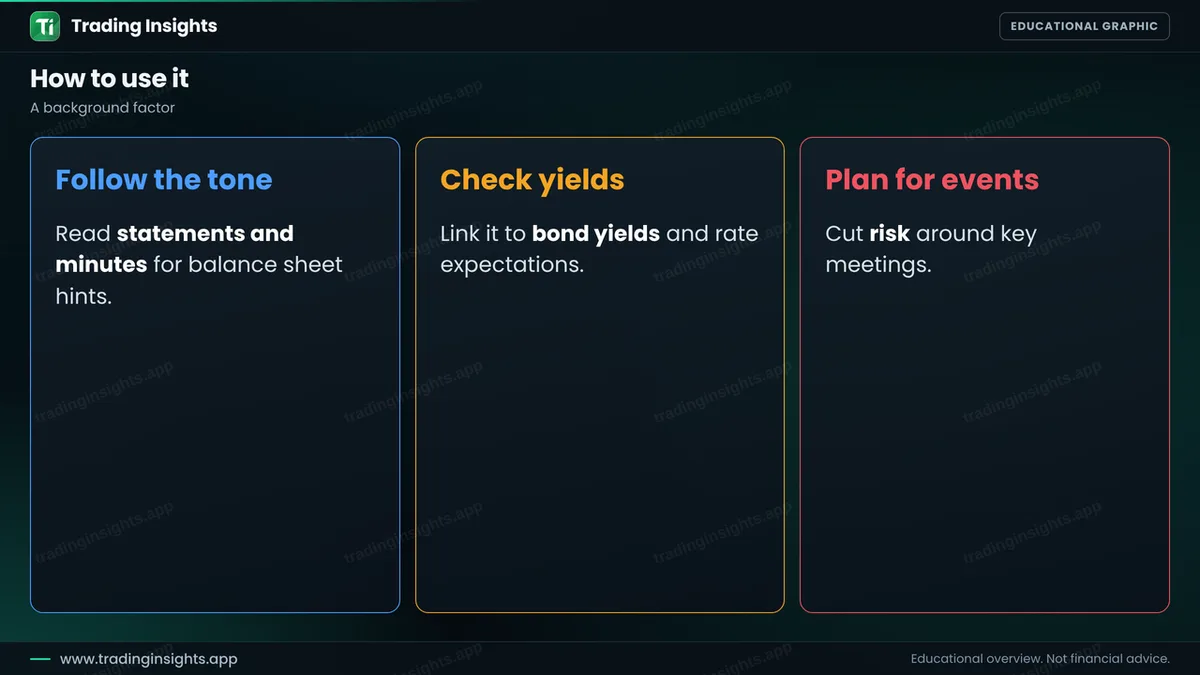
- Follow the tone. Read the statements and the minutes for hints about the balance sheet. See forward guidance.
- Check yields. Link the policy to the bond market and to rate expectations for both currencies in the pair.
- Form a bias, not an entry. Decide whether the policy gap favours one currency, and treat that as background.
- Plan for events. Cut the risk around key meetings. See trading forex news.
- Use the chart. Entry, stop and target come from price. See top-down analysis.
Illustrative example: trading the reaction, not the headline
Suppose a central bank has been buying bonds for two years, and the currency has weakened. Officials then say they are "considering slowing the pace of purchases". The currency jumps, even though no purchase has been cut, because the market expected the policy to continue. Months later, when the bank actually slows the pace as announced, the currency barely moves, since the news was in the price.
A trader who waited for the actual taper to buy missed the move. A trader who bought at the first hint with no stop took a larger risk. A more careful plan uses the chart.
Say EUR/USD falls after a hint that US purchases will slow, breaks support at 1.0800, and pulls back to retest it. You sell at 1.0800, put the stop at 1.0830 (30 pips) above the retest high, and target 1.0740 (60 pips). Check the ratio with the risk reward calculator.
With a $10,000 account risking 1% ($100), the position size is $100 / (30 pips x $10 per pip per lot) = about 0.33 lot. A win pays about $200, and a loss costs about $100.
What weakens a QE or QT view
- A central bank signals it will keep buying or stop shrinking its balance sheet, against what the market priced.
- Inflation or growth data changes the rate outlook, which can outweigh balance-sheet policy.
- Risk mood flips, and safe-haven flows overwhelm the yield effect.
- The other central bank in the pair changes its own tone.
If the story behind your bias changes, the bias goes. Let the stop do its job.
Common mistakes
- Assuming QE always weakens a currency by a fixed amount. The effect depends on expectations and on the other side of the pair. Treat it as a tendency.
- Ignoring the tone of the bank. Hints move prices before actions do. Read statements and minutes.
- Looking at one central bank only. A pair has two currencies. Compare both policies.
- Trading the news without a stop. Moves can be sudden and large. Size by the stop, and reduce size around meetings.
Frequently asked questions
What is quantitative easing?
It is a policy in which a central bank buys bonds with newly created money to add liquidity and lower long-term yields. It is usually used when the policy rate is already low.
What is quantitative tightening?
It is the reverse. The central bank lets bonds mature without reinvesting, or sells them, to shrink its balance sheet and remove money from the system.
How does QE affect currencies?
It tends to weigh on a currency by lowering yields, but expectations matter and the effect varies. Other drivers, such as inflation and risk mood, act at the same time.
Why does the market react before the policy changes?
Traders price in what they expect, so the tone and hints of the central bank often move the currency first. The later action may cause little reaction.
Your next step
Read the latest statement or minutes of one central bank in a pair you trade, and write down whether the tone on bond purchases moved towards more support or less. Compare it with the other bank, then mark the date of the next meeting on your calendar.
This is education, not financial advice. Trading carries risk, and no method guarantees results. The charts are illustrative and not real market data.


