
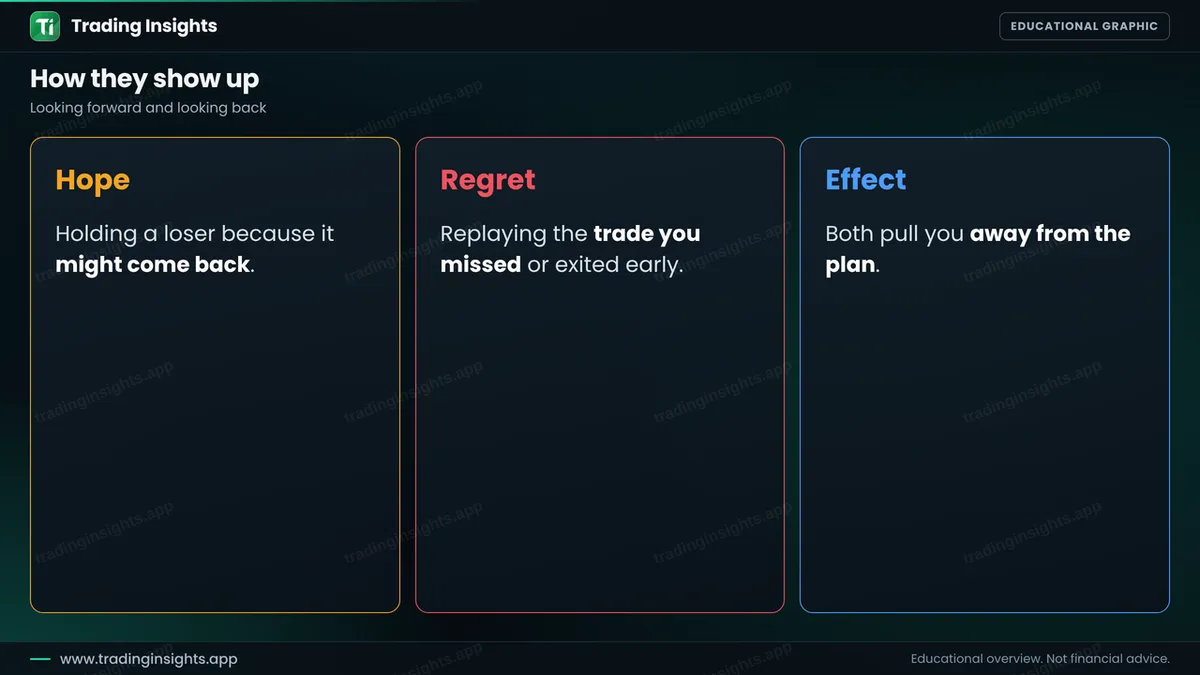
Hope and regret hurt trading decisions in opposite directions. Hope looks forward and says this loser will come back, so you move the stop or remove it. Regret looks back and says you should have taken that trade, or should not have closed so early, so you jump into the next one to make up for it. Both pull you away from the plan. They are different from the fear and greed people often talk about, and they have different fixes: decide your exit before entry for hope, and close each trade mentally for regret.
How hope and regret show up in trading
Hope is the reason people move a stop "just a bit more" or remove it. The trade is losing, but the mind builds a story in which it recovers. Every extra pip of room feels free, until the loss is far larger than the plan.
Regret is the reason people enter the next trade to make up for a miss, which often becomes FOMO or revenge trading. There is also a link with the tendency to hold losers, as explained in loss aversion in trading and the sunk cost fallacy.
Signs you are trading on hope or regret
You do not need a lab test. Look for these patterns in your own behaviour:
- You moved or deleted a stop after entry.
- You added to a losing trade without a plan to do so.
- You think "if it just gets back to my entry, I will close".
- You took a trade that did not fit your rules right after missing a good one.
- You keep replaying a trade from yesterday while a new setup forms.
If two or more fit, write them in your journal with the date. The log shows how often these feelings cost you, and that is what makes you change.
How to stop hoping and regretting: ways to reduce them
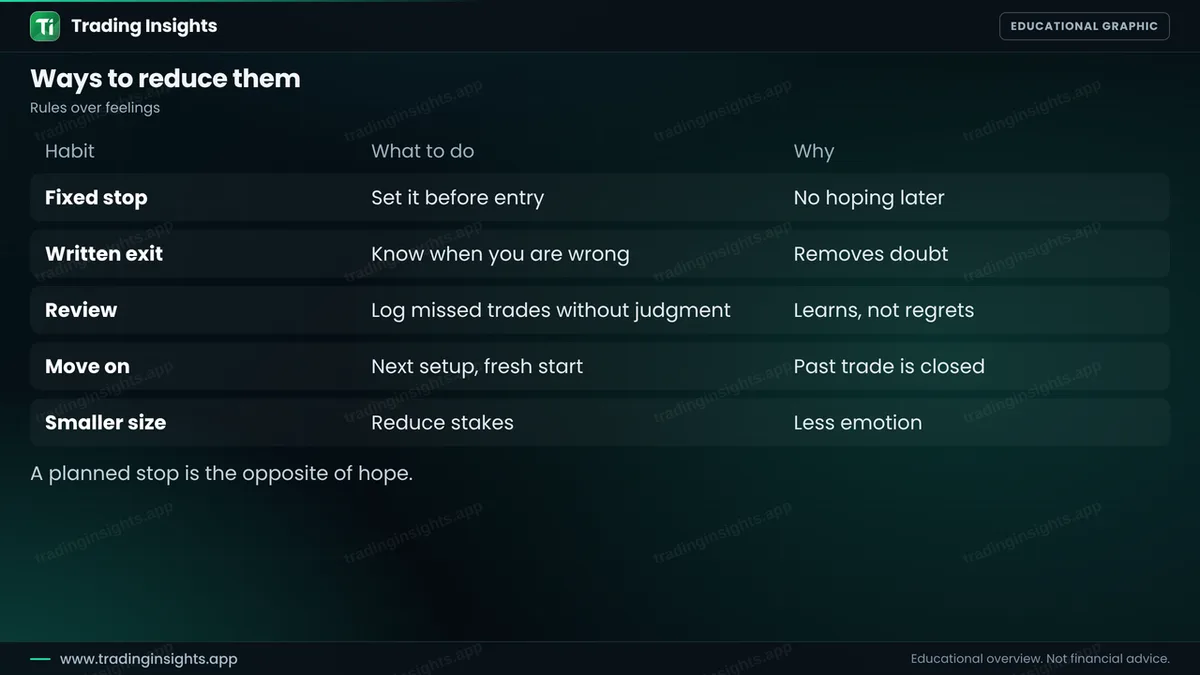
The best fix for hope is to decide before the trade where you are wrong. A stop set before entry leaves no room for "maybe it will come back". Once the order is live on the server, the decision has already been made by the calmer version of you.
The best fix for regret is to treat each trade as closed once it is over. Review missed trades in your journal to see if they fitted the plan. If they did not, there is nothing to regret, because you correctly stayed out. See pre-trade checklist and trading journal metrics.
A simple routine, step by step
- Set the stop first. Never enter without one. See stop loss and take profit.
- Write the exit rule for the trade: where you are wrong, and where you take profit.
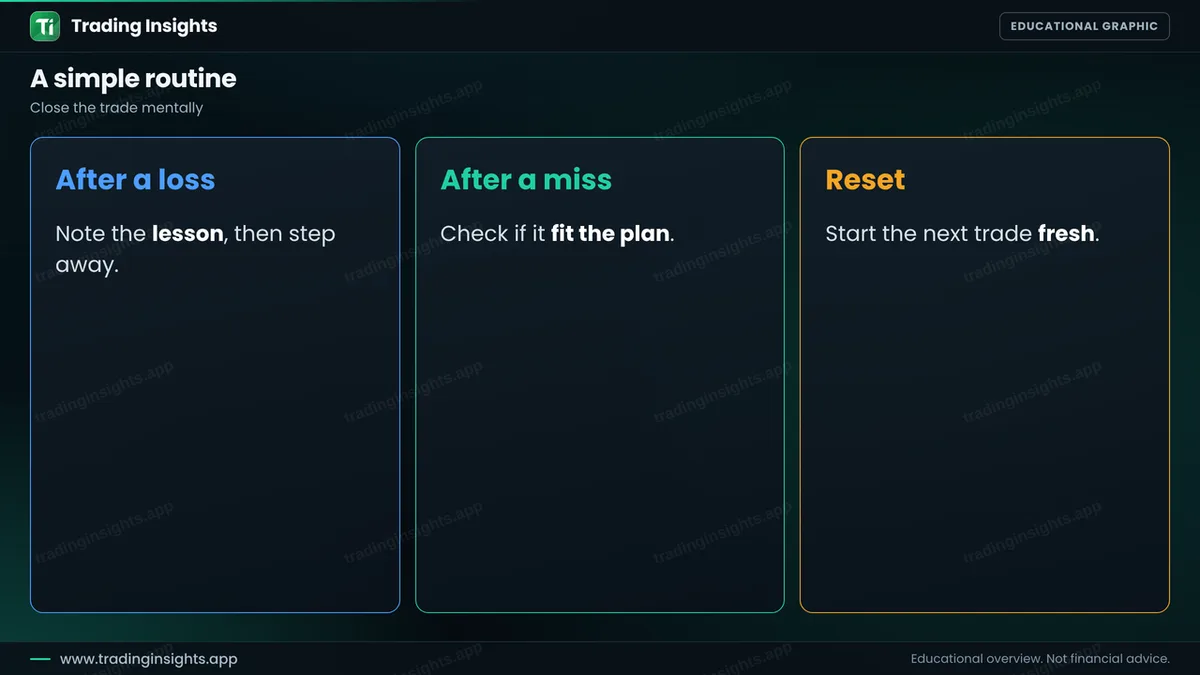
- After a loss, write one lesson and take a short break.
- After a miss, check whether it fitted the plan, and let it go.
- Use a daily limit. See the daily loss limit.
- Start fresh with the next setup.
Illustrative example: following the stop when hope says wait
A trader buys EUR/USD at 1.0800 with a 30-pip stop at 1.0770 and a 60-pip target at 1.0860. With a $10,000 account risking 1% ($100), the position size is $100 / (30 pips x $10 per pip per lot) = about 0.33 lot. A win pays about $200, and a loss costs about $100.
Price falls to the stop. Hope says to move the stop down 20 pips, because the level looks like support. The plan says to take the $100 loss. The trader follows the plan, logs the lesson and waits for the next setup. Moving the stop 20 pips would have turned a 30-pip risk into 50 pips, or about $167 on the same size, which is more than the account rule allows. Check numbers like this with the position size calculator.
What makes these feelings stronger
Both feelings grow when the position is too large. A trade that risks 5% of the account feels personal, so the urge to move the stop is stronger. Smaller size, around 1% risk, keeps each trade a small event.
Tiredness, a recent string of losses and trading without a written plan also increase the pull. If you notice you are checking the chart every minute, that is a sign to step back, not to add more screens.
Common mistakes
- Moving or removing a stop in the hope of a rebound. The loss becomes larger than planned. Set the stop before entry and treat it as final.
- Entering a new trade to make up for a missed one. It is usually a lower-quality setup. Wait for one that fits your checklist.
- Replaying old trades instead of the next setup. Attention on the past makes you miss what is in front of you. Write one lesson, then move on.
- Skipping the review step. Without it, the same feelings repeat. A weekly review takes minutes.
Frequently asked questions
How does hope hurt trading?
It keeps you in a losing trade, or makes you move the stop, because the trade might come back. The loss grows while the plan is ignored.
What is regret in trading?
The feeling after a missed move or an early exit. It can push you into impulsive trades that do not fit your rules.
How can I stop hoping in a trade?
Set the stop before entry and treat it as final. Decide in advance where you are wrong, and keep your position size small enough that the loss is not painful.
Is it normal to feel regret?
Yes. The fix is to review the trade against the plan, learn one lesson, and move on to the next setup.
Your next step
After your next closed trade, win or loss, write one sentence in your journal: did I follow my stop and exit rule? Do that for ten trades and read the pattern.
This is education, not financial advice. Trading carries risk, and no method guarantees results. The charts are illustrative and not real market data.


