
Government debt and fiscal policy can affect a currency, but the link is slow, indirect and not one-way. A growing deficit may hurt confidence in a currency, yet the higher yields that come with heavy borrowing can also attract investors. So treat fiscal news as background that shapes the bigger picture, not as a timing signal for a trade.
What fiscal policy means for forex
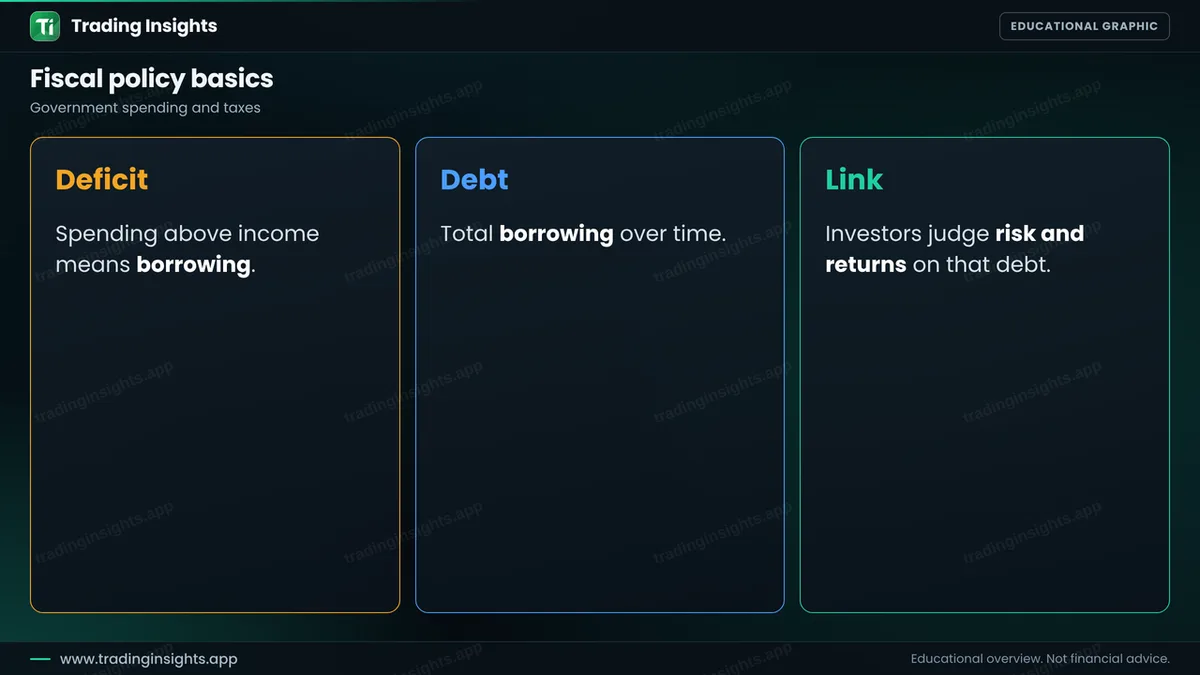
Fiscal policy is what a government does with taxes and spending. When it spends more than it collects, it runs a deficit and borrows by selling bonds. Add up the deficits over the years and you get the national debt.
A deficit is the yearly gap, and debt is the running total. Investors who lend to a government want to be paid for the risk, and that payment shows up as the bond yield. See bond yields and forex.
Fiscal policy also interacts with the central bank. Stimulus can lift growth, but it can also add to inflation, which can push the central bank toward higher rates. See interest rates and forex.
How government debt and budgets can affect a currency
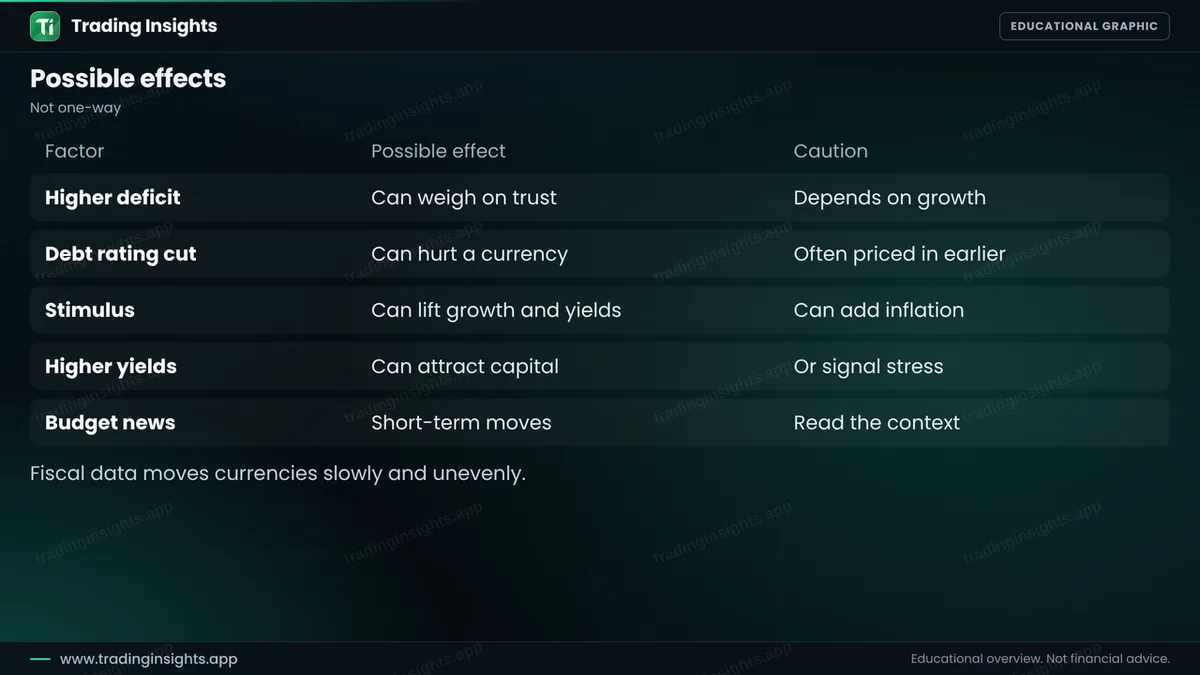
A rising deficit can weigh on a currency if investors start to doubt that the government can manage its debt. A credit rating cut can have the same effect, although markets often price in a downgrade before it is announced.
The opposite can also happen. Heavy borrowing can lift bond yields, and higher yields can attract foreign capital, which supports the currency. Sometimes rising yields instead signal stress, and capital leaves. The same fact can push in either direction.
This is why fiscal news is hard to trade on its own. Whether it matters depends on growth, inflation, interest rates and how much trust investors have in the issuer. Use it as context for the broader picture in what moves forex prices.
Fiscal events to watch
Not every headline is worth your attention. These are the ones that tend to matter most:
- Budget announcements. Look at the size of the deficit and how it will be funded.
- Rating decisions. An outlook change or a downgrade can start a sharp, short-lived move.
- Debt-ceiling or spending talks. Uncertainty can raise volatility until a deal is reached.
- Stimulus plans. These can change expectations for growth, inflation and central bank policy.
Put each event in your economic calendar ahead of time, so it does not catch you with a position open.
How traders use fiscal news
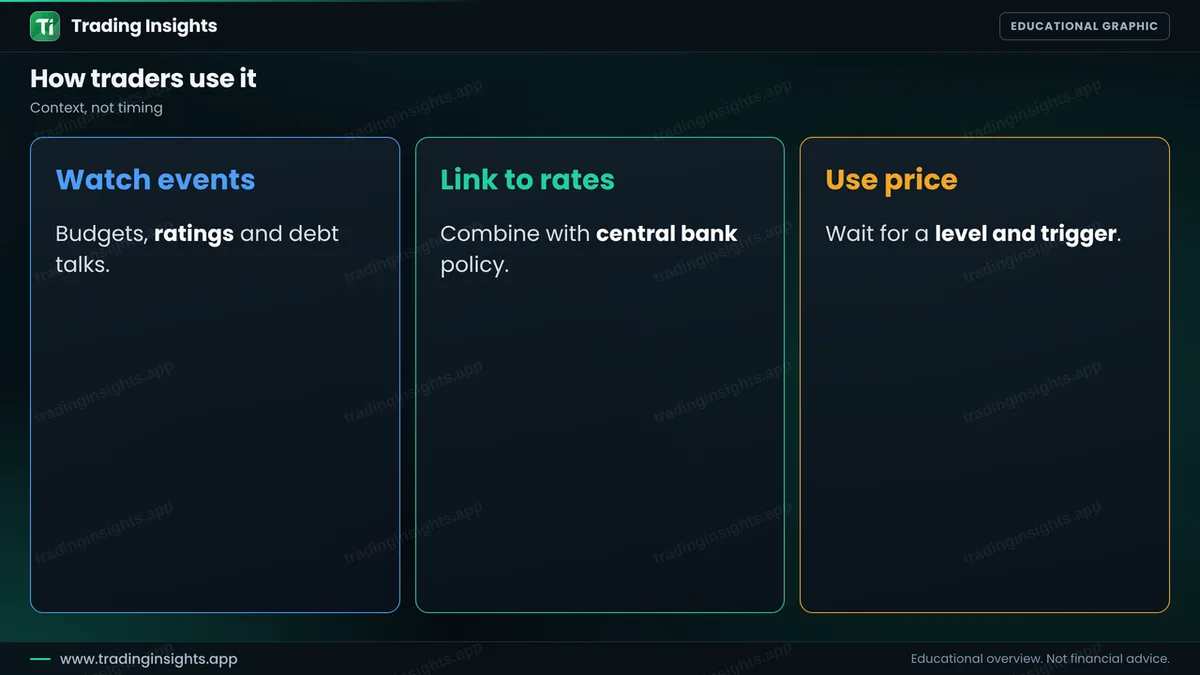
Link the fiscal event to central bank policy first. Ask whether it changes the rate outlook, because that is usually what moves a currency over weeks and months.
Then wait for the chart to give you a level and a trigger. See support and resistance and top-down analysis.
News days can be volatile and spreads can widen, so cut the size. See how to trade forex news.
Fiscal news trading rules, step by step
- Note the fiscal event in your calendar, with its date and time.
- Check how the market reacted to similar news before.
- Decide which way the news may shift rate expectations, if at all.
- Wait for the first move to settle. Do not trade the first spike.
- Enter from a clear level, with a stop beyond it. See stop loss and take profit.
- Place the target at the next level, and aim for at least 1:2.
- Size with the position size calculator, and cut size if volatility is high.
What weakens the fiscal idea
The idea is weaker if the market already expected the news, because the move may be priced in. It is also weaker if the central bank sends a stronger message the same day, since policy usually outweighs the budget.
Finally, if price breaks your level and closes beyond it, the setup is wrong. Exit at your stop and do not argue with the chart.
An illustrative example
A ratings agency changes the outlook on a country to negative. EUR/USD spikes, then drifts back. The trader does not chase the first move.
After a pullback to a level, the trader sells with a 40-pip stop and an 80-pip target (1:2). With a $10,000 account risking 1% ($100), the position size is $100 / (40 pips x $10 per pip per lot) = about 0.25 lot. A win pays about $200, and a loss costs about $100.
Common mistakes
- Expecting high debt to mean a falling currency. The link is not automatic. Check growth, yields and central bank policy before taking a view.
- Trading the first spike. The first move is often noise. Wait for it to settle and for a level to form.
- Ignoring central bank policy. Rate expectations usually matter more than the budget. Read the fiscal news through that lens.
- Treating fiscal data as a timing tool. It is background. Let the chart give the entry and the stop.
Frequently asked questions
Does high government debt weaken a currency?
Not automatically. It depends on growth, interest rates and how much investors trust the government. Some countries carry high debt for years without a currency collapse.
What is a budget deficit?
It is the gap between what a government spends and what it collects in a year. The government covers the gap by borrowing, which adds to its debt.
Can a rating cut move a currency?
It can, but markets often price it in ahead of time, so the reaction varies. A cut that surprises the market tends to matter more than one that was expected.
Is fiscal news good for short-term trading?
It is hard to trade on its own. It works better as background context, with the chart providing the level and the trigger.
Your next step
Open your economic calendar and mark the next budget, rating or debt-related event for a currency you trade. Write down what you expect, then watch how price actually reacts, without placing a trade.
This is education, not financial advice. Trading carries risk, and no method guarantees results. The charts are illustrative and not real market data.


