
Forex signals and copy trading can look like a shortcut, but they do not remove risk, and the results you get can differ from the provider's. Before you follow anyone, check whether the track record is long and verified, how much risk each trade takes, what the costs are and whether the claims are honest. Some providers are honest and some are not, and even honest ones lose. This guide explains how signals and copy trading work and how to judge a provider.
What are forex signals and copy trading?
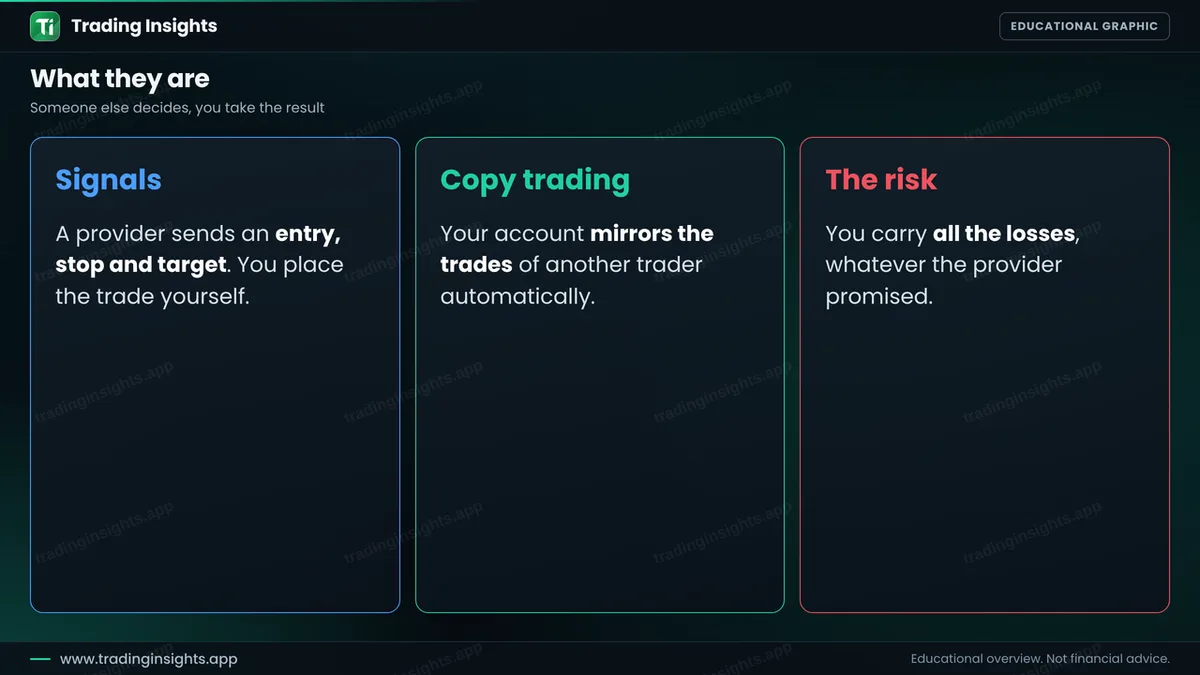
A signal is a trade idea with an entry, a stop and a target, sent by a provider through an app or a chat. You place the trade yourself, and you may be late or the price may differ.
Copy trading connects your account to another trader's, and their trades are repeated in yours, in proportion to your balance. Fees may apply, and the provider may earn a share of your profits or a monthly fee.
The important point is that the provider's results are not your results. Differences in timing, spread and size change the outcome, and the provider's losses are yours as well.
How to judge a signal provider
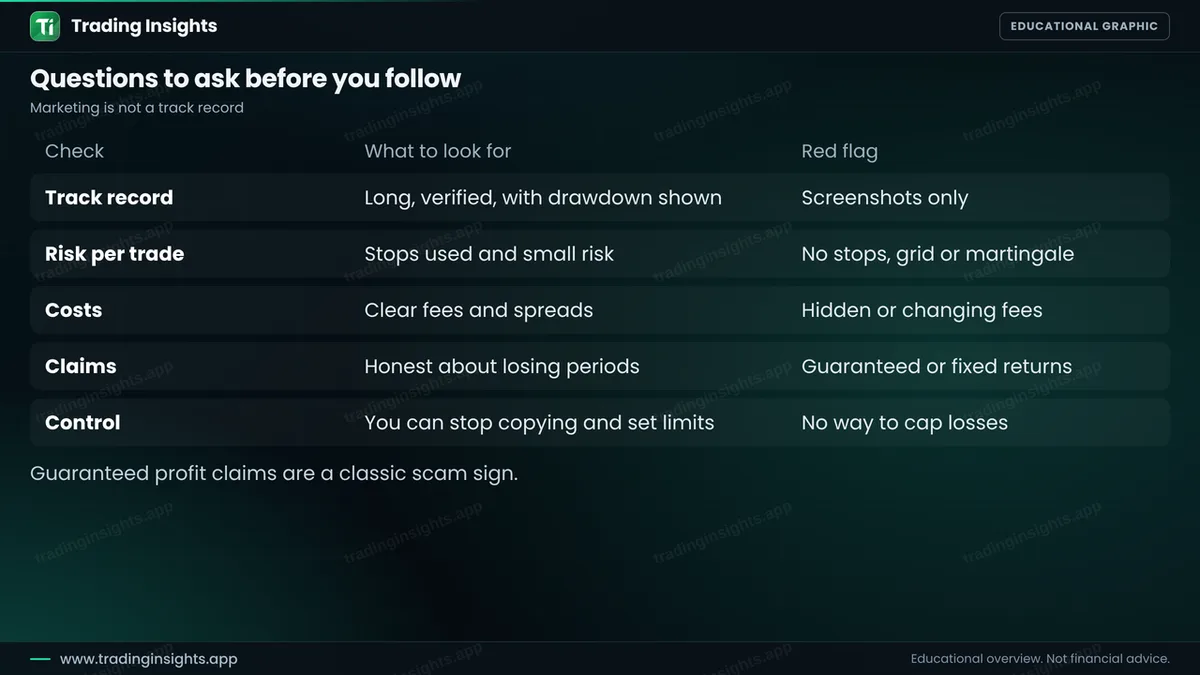
- Is the track record long and verified? Screenshots and edited charts prove nothing. Look for a long record on a neutral platform, with the maximum drawdown shown.
- How much risk per trade? Stops and small positions are good. Grid, martingale or "no stop" systems are dangerous. See the martingale article.
- What are the costs? Subscription, profit share, spreads and slippage all reduce your result. See forex trading costs and slippage.
- Are the claims honest? Guaranteed returns, fixed monthly profits and "no risk" are red flags. See forex scams.
- Can you control it? You should be able to stop copying at any time and to set a limit on the loss.
Illustrative example: how a late entry changes the trade
This is an illustrative example, not a real signal. A provider sends: buy GBP/USD at 1.2700, stop at 1.2670 (30 pips), target at 1.2760 (60 pips), which is a 1 to 2 ratio. You see the message a few minutes late, and the price is already 1.2710.
If you enter at 1.2710 with the same stop and target, your stop is 40 pips away and your target is 50 pips away. The ratio falls from 1 to 2 to about 1 to 1.25. With a $10,000 account risking 1% ($100), the position size is $100 / (40 pips x $10 per pip per lot) = 0.25 lot. A win pays about $125, and a loss costs about $100.
Add a wider spread or slippage, and the edge shrinks further. This is why the provider's reported results are not the results you get.
Safer ways to use signals
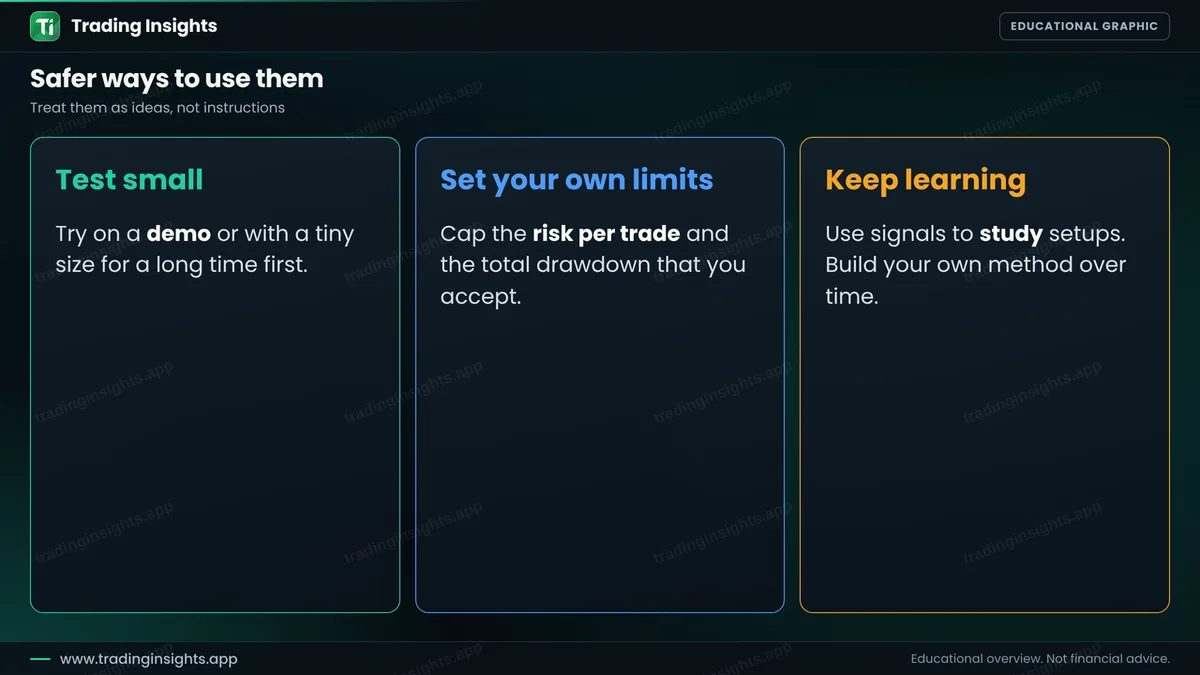
- Test small. Try on a demo account, or with a very small size, for a long time. See demo account vs live account.
- Set your own limits. Decide the risk per trade and the total drawdown that you accept, and stop following if it is reached. See the daily loss limit and position sizing.
- Keep a record. Log the results of the signals in your own journal, so you judge them by your own numbers. See how to build a forex trading plan.
- Keep learning. Use the trades to study how setups work, and try to build your own method over time.
Comparing two providers
Imagine that a provider shows a chart with a 40% gain in a month. You check the details and see that the risk per trade is not stated, no stops are used, and the track record is six weeks long. Those are three warning signs: the gain may come from a high-risk method that has not yet met a bad streak.
Another provider has a 3-year record on a neutral platform, a maximum drawdown of 18%, stops on every trade and an average gain of 2% a month. The numbers are less exciting and more believable. Even then, you would start with a small size and a limit. This second profile is made up for the example, and past results never promise future ones.
Red flags to walk away from
- Promises of guaranteed profit or fixed monthly returns.
- No stop loss, or a method that adds to losing trades.
- Pressure to deposit quickly or to use a specific broker.
- Requests for your account password rather than a normal copy link.
- A record shown only through screenshots.
Common mistakes
- Following the provider with the best last month. One month says little. Prefer a long record with drawdown shown.
- Copying with a large part of your account. Start small and set a total loss limit.
- Ignoring the fees and the delay. Costs and late entries cut your result. Count them.
- Believing that you do not need to learn because someone else trades for you. You carry the losses. Use the trades to learn, and give no one access you do not understand.
Frequently asked questions
What is the difference between signals and copy trading?
Signals are trade ideas that you place yourself. In copy trading, the trades of another trader are copied automatically into your account.
Are forex signals profitable?
Some may be, but many are not, and past results do not guarantee future ones. Check the track record, the risk and the fees.
What are red flags?
Guaranteed profits, fixed monthly returns, no stops, no verified record and pressure to deposit quickly.
How much should I risk when copying?
Start with a small amount that you can afford to lose, and set your own limit on the total loss.
Your next step
Pick one provider you are considering and fill in the five checks: record length, risk per trade, costs, honesty of claims and your ability to stop. If any answer is no or unknown, do not follow yet. Try it on a demo account first.
This is education, not financial advice. Trading carries risk, and copying or following others does not remove it. The charts are illustrative and not real market data.


