
You can spot forex scams by looking for four things: promises of fixed returns or promises of no loss, pressure to deposit quickly, a broker whose licence you cannot verify, and anyone asking for your password or your money "to trade for you". Forex is a real market, but it is also full of people who want to take money from beginners. They use professional websites, friendly messages and impressive screenshots. This article describes the common types of scams, the warning signs, and a few simple habits that protect you. It is general education, not a list of names, so always do your own checks.
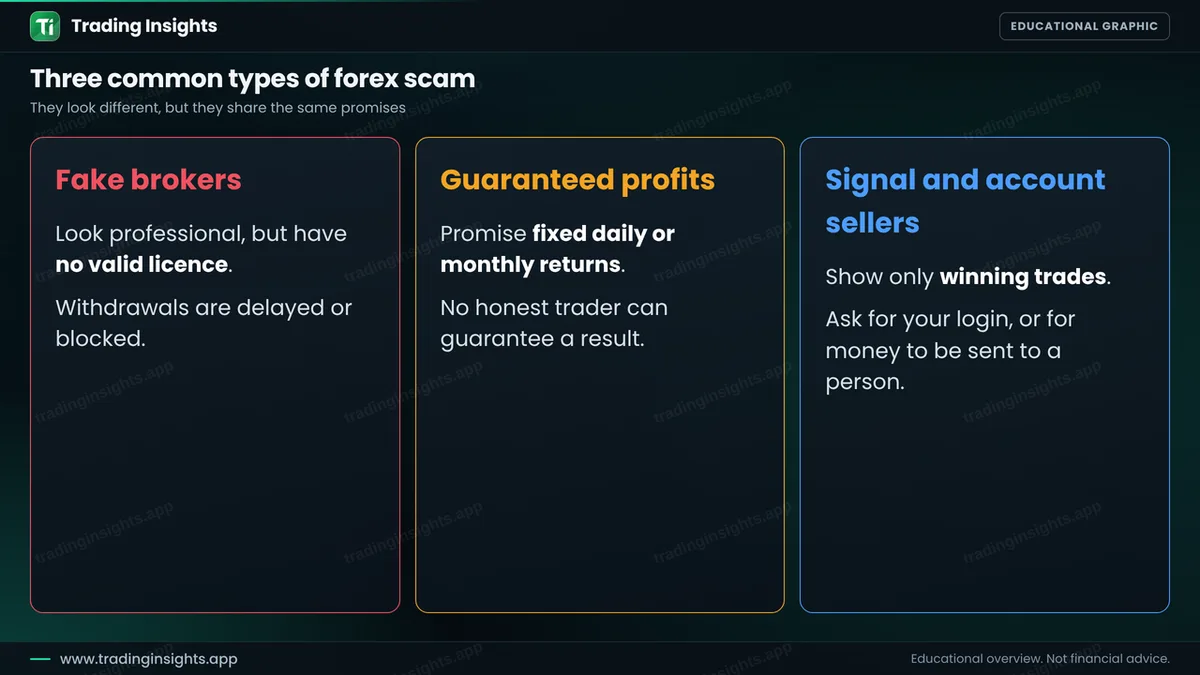
Three common types of forex scams
- Fake or unregulated brokers. The website looks real, but the company has no valid licence, or it uses the name of a real firm. Deposits are easy, but withdrawals are delayed, blocked, or require more fees.
- Fixed-return offers. Someone promises fixed daily or monthly returns, such as "10% a week with no risk". No honest trader can promise this, because trading always includes risk.
- Signal and account-management sellers. They show only winning trades, sell expensive signals or courses, or ask you to give them your login or send money to a person so that they can "trade for you".
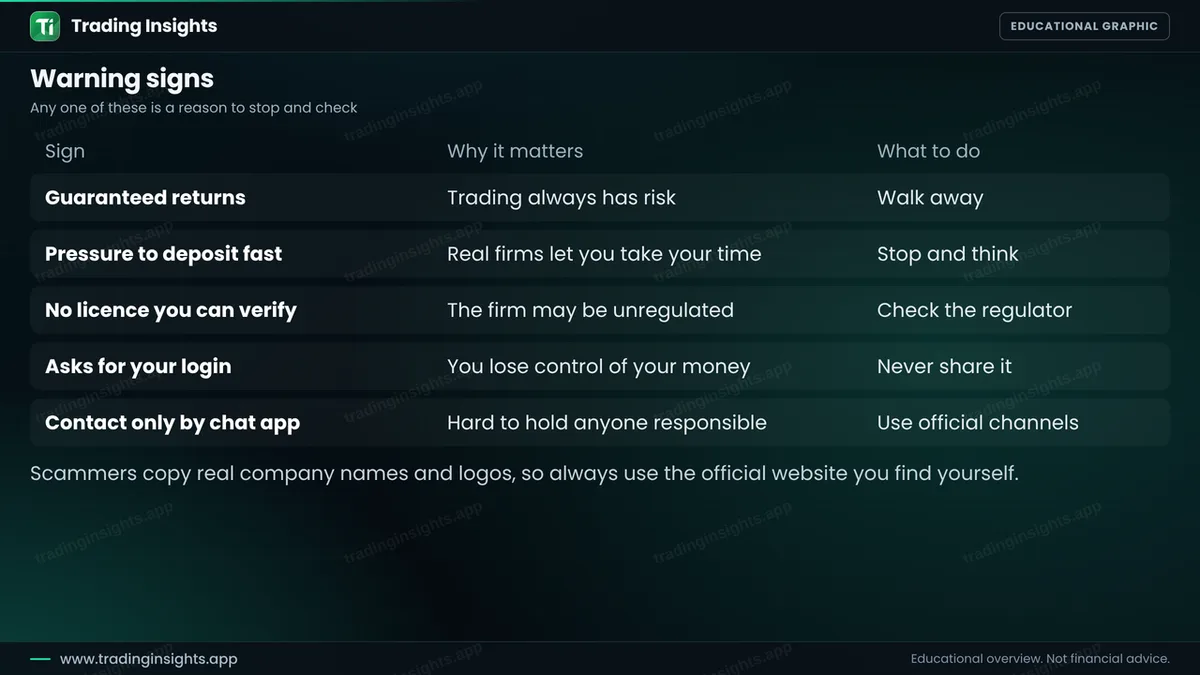
Warning signs of a fake forex broker
The first sign is a promise of certainty. A real trader talks about risk, drawdowns and losing streaks, see drawdown and risk of ruin and losing streaks in trading. A scammer talks about quick, effortless profit.
The second sign is pressure: "the offer ends today", "deposit now to get a bonus". Real firms do not need you to decide in minutes. Other signs are a company that you cannot verify, requests for your login, contact only through chat apps, and payments to personal accounts or unusual methods.
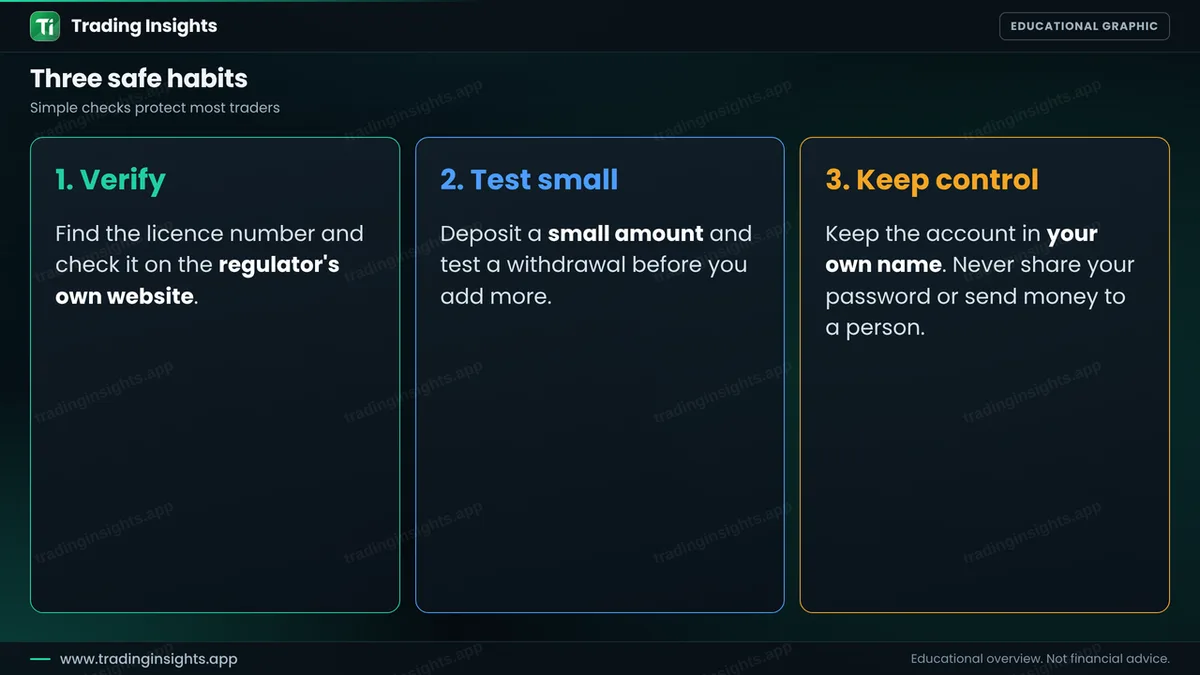
How to check a forex broker: three safe habits
- Verify. Find the licence number of the broker and check it on the website of the regulator, which you reach by your own search, not by a link from the broker. Check that the name, the website and the licence match. For other points to check, see forex broker types.
- Test small. Deposit a small amount and try a withdrawal before you add more. If the withdrawal is slow or the broker asks for new fees, stop.
- Keep control. The account should be in your name. Never share your password, and never send money to a person for trading. Do not give anyone remote access to your computer.
Illustrative example: what "10% a week" really means
This is an illustrative example of why promised returns do not add up. Suppose someone promises 10% a week with no risk, and you start with $1,000. After one week you would have $1,100, and after two weeks $1,210. The growth compounds: 1.10 to the power of 52 is about 142, so after one year you would have roughly $142,000.
No trader or fund in the world produces that on a steady basis, and anyone claiming to is either lying or hiding the losses.
How to think about quick-profit claims
- Real trading results are uneven. If a record looks perfect, it is probably edited.
- Profitable traders do not need your money. Be careful when a stranger offers to trade for you.
- A screenshot is not proof. Real results can be verified, for example through a long, independent track record.
- Be careful with people who contact you first, especially through social media or chat apps, and then become very friendly or romantic and talk about investing.
Protect yourself while learning
Practise on a demo account first, see demo account vs live account, and learn how the market works from independent sources. If you understand the basics, such as leverage and trading costs, it is much harder to be fooled.
Start with an amount you can afford to lose, and be especially careful if you feel pressure to recover earlier losses.
If you think you have been scammed
- Stop sending money, including "fees" to release your funds.
- Keep records: messages, receipts, screenshots and account details.
- Contact your bank or payment provider as soon as possible.
- Report it to the financial regulator and the police in your country.
- Be careful of "recovery" services that ask for an upfront payment. They are often a second scam.
Common mistakes
- Trusting a logo or a licence number without checking it. Scammers copy real names. Check the regulator's own site.
- Depositing a large amount on the first day. Test a withdrawal first.
- Believing a screenshot of profits. Images are easy to edit. Ask for an independent track record.
- Sharing a password or remote access. Keep control of your account.
- Ignoring a delayed withdrawal as "a small problem". Stop depositing and ask for your money.
Frequently asked questions
How can I check if a forex broker is regulated?
Find its licence number, then check it on the official website of the regulator, which you find yourself. Make sure the name and website match.
Can anyone guarantee profits in forex?
No. Trading always has risk, so any guarantee of profit is a warning sign. Honest providers talk about risk first.
Is it safe to let someone trade my account?
It is risky. Never give your password to a person you do not know, and be careful with account-management offers that promise returns.
What should I do if a broker will not let me withdraw?
Stop depositing, keep all records, contact your bank or payment provider, and report it to the regulator.
Your next step
Pick the broker you use or are considering, and spend ten minutes checking its licence on the regulator's own website. Then write down its withdrawal process and fees before you deposit anything. If you want to learn the market safely, you can also look up unfamiliar terms in the glossary.
This is education, not financial advice. Trading carries risk, and no method or provider can remove it. The charts are illustrative and not real market data.


