

The main forex account types are standard, micro, cent and ECN (or raw-spread) accounts. They differ in how they charge you, how small a trade they allow, and how they handle orders. The best one for you depends on your balance, your trade size and how often you trade, not on the name. For the background on brokers, see forex broker types.
Forex account types explained
Most brokers offer more than one type of account, and the names are not standard. One broker may call an account "Standard" and another "Classic". What matters is the specification behind the name.
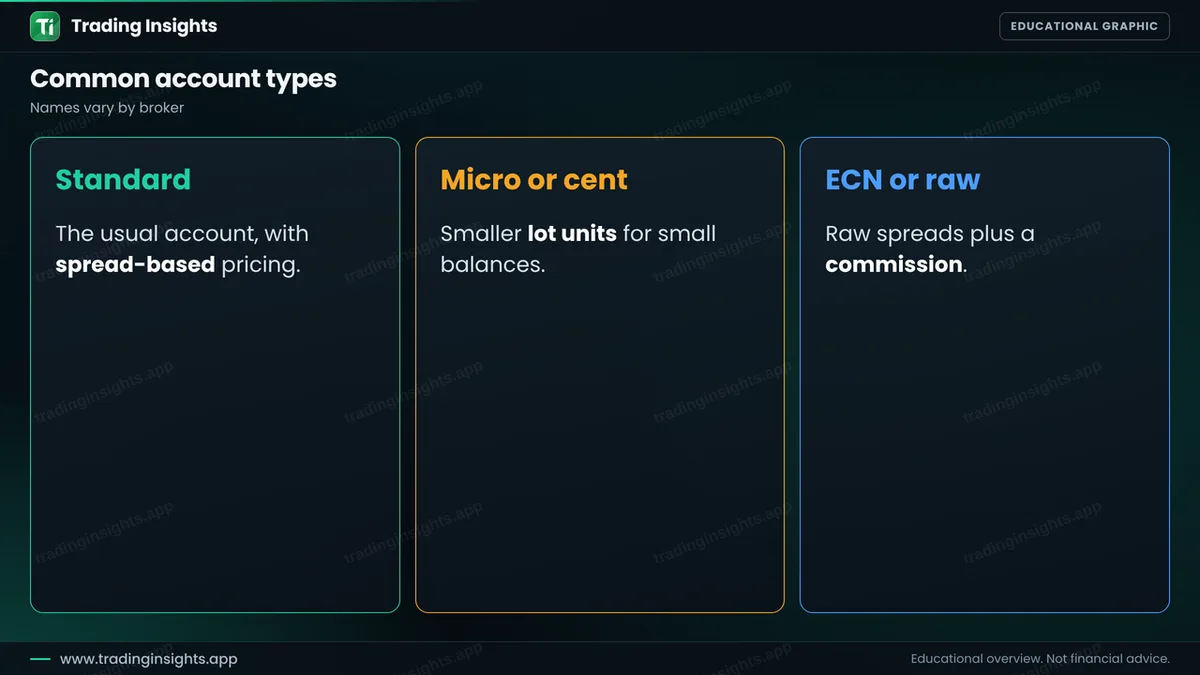
A standard account usually earns the broker through the spread, with no separate commission. Micro and cent accounts allow very small trade sizes, and cent accounts may show the balance in cents. ECN or raw-spread accounts offer tighter spreads, but charge a commission per lot.
Names and details differ, so read the broker's specifications before you decide.
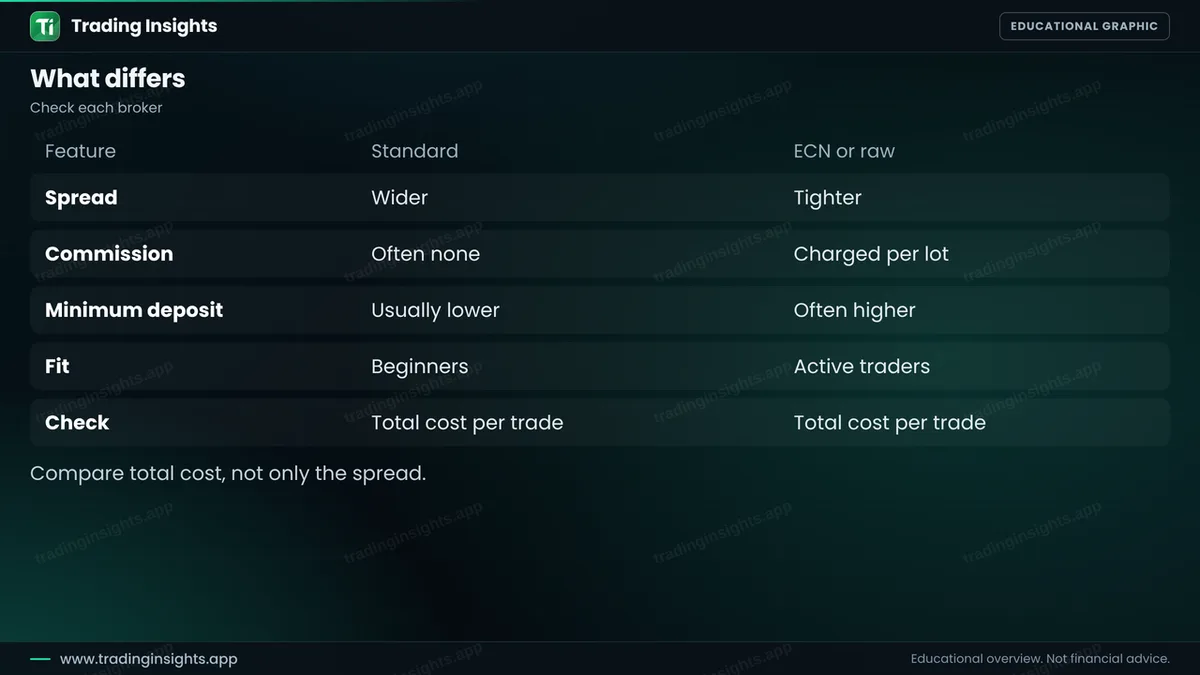
Standard vs ECN accounts: what actually differs
The headline spread is not the whole cost. An account with a tighter spread and a commission can cost more or less than a wider spread with no commission, depending on your trade size and how often you trade.
Add up the total cost per trade, including swap for trades held overnight. See forex trading costs explained and fixed vs variable spreads.
Other points to compare:
- Minimum lot size. Smaller steps give you finer control of risk.
- Minimum deposit. Some account types ask for more.
- Execution. Check how orders are filled and how the platform behaves in fast markets.
- Swap rules. Overnight charges can differ between account types.
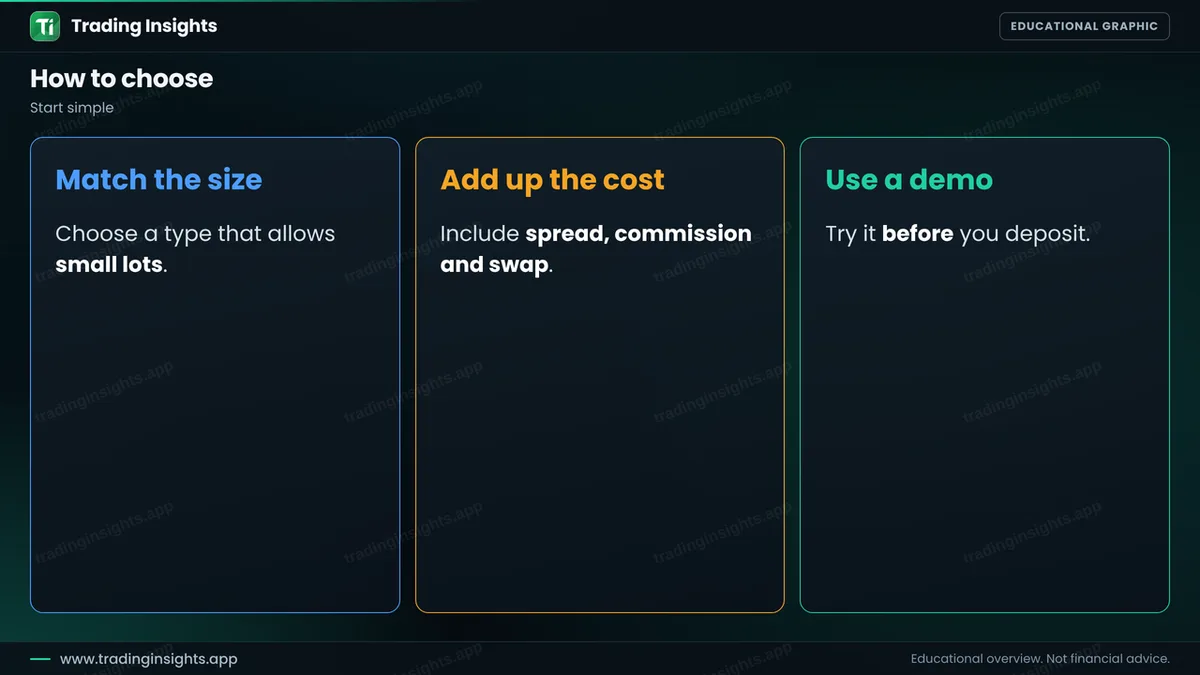
How to choose a forex account, step by step
- Match the size. A small account needs micro lots, so that 1% risk is possible. See trading with a small account.
- Add up the cost per trade, using your own average lot size.
- Check the execution and the platform. See MT4 vs MT5 vs cTrader.
- Use a demo before you deposit. See demo account vs live account.
- Check the regulation and withdrawal rules.
Which account type fits which trader
A beginner with a small balance often does well with a micro account, because small lots keep risk per trade low. A cent account can go further, but check how the broker shows balances and fees.
A trader who places many trades a day may find that a raw-spread account with commission is cheaper in total. A trader who places a few trades a week may find the standard account simpler and just as cheap.
The only way to know is to run your own numbers, as in the example below.
Illustrative example: comparing the cost of two accounts
Suppose two accounts offer EUR/USD at 1.2 pips of spread with no commission, and at 0.2 pips of spread plus a $7 commission per round-turn lot. At $10 per pip per lot, the first costs about $12 per lot, and the second costs about $2 + $7 = $9 per lot. At 0.10 lot the numbers are $1.20 and $0.90.
The gap is small, so frequency and size decide which is cheaper. These figures are examples only, and real costs vary.
Now see how size works. A trade with a 30-pip stop on a $10,000 account: with a $10,000 account risking 1% ($100), the position size is $100 / (30 pips x $10 per pip per lot) = about 0.33 lot. A win pays about $200, and a loss costs about $100. Check that your account allows that lot size in steps small enough.
Warning signs to check before you open an account
- Vague fees, or costs that are hard to find on the broker's site.
- No clear information on regulation and withdrawals. See forex broker regulation.
- Pressure to deposit more than you planned.
- A minimum lot size too large for 1% risk on your balance.
Common mistakes
- Choosing by the lowest spread alone. Commission and swap add to the cost. Compare the total per trade.
- Opening an account with a lot size too big for the balance. You cannot risk 1% if the smallest lot is too large. Pick micro or cent.
- Ignoring commission and swap. They can change which account is cheaper. Add them to your cost sum.
- Assuming the account name means the same at every broker. Read the specification, not the label.
Frequently asked questions
What is the difference between a standard and an ECN account?
A standard account usually charges through the spread. An ECN or raw account has tighter spreads and a commission per lot.
What is a cent account?
It is an account that uses smaller units, so you can trade very small sizes with a small balance. Details vary by broker, so read the terms.
Which account is cheapest?
It depends on your trade size and frequency. Compare the total cost per trade, including spread, commission and swap.
Can I switch account types?
Many brokers let you open another account type, but check the rules at your broker. Some require a new application or a new deposit.
Your next step
Pick two account types at a broker you are considering and calculate the total cost of one typical trade on each. Use your real lot size, and include commission. Then test the better one on a demo. You can also check the lot size with the position size calculator.
This is education, not financial advice. Trading carries risk, and no method guarantees results. The charts are illustrative and not real market data.


