
Cross currency pairs are forex pairs that do not include the US dollar, such as EUR/GBP, EUR/JPY and GBP/JPY. They give you more choice than the majors, but they behave differently, with other costs, volatility and risks. This guide explains what cross pairs are, how the common ones differ and what to check before trading them.
What a cross pair is
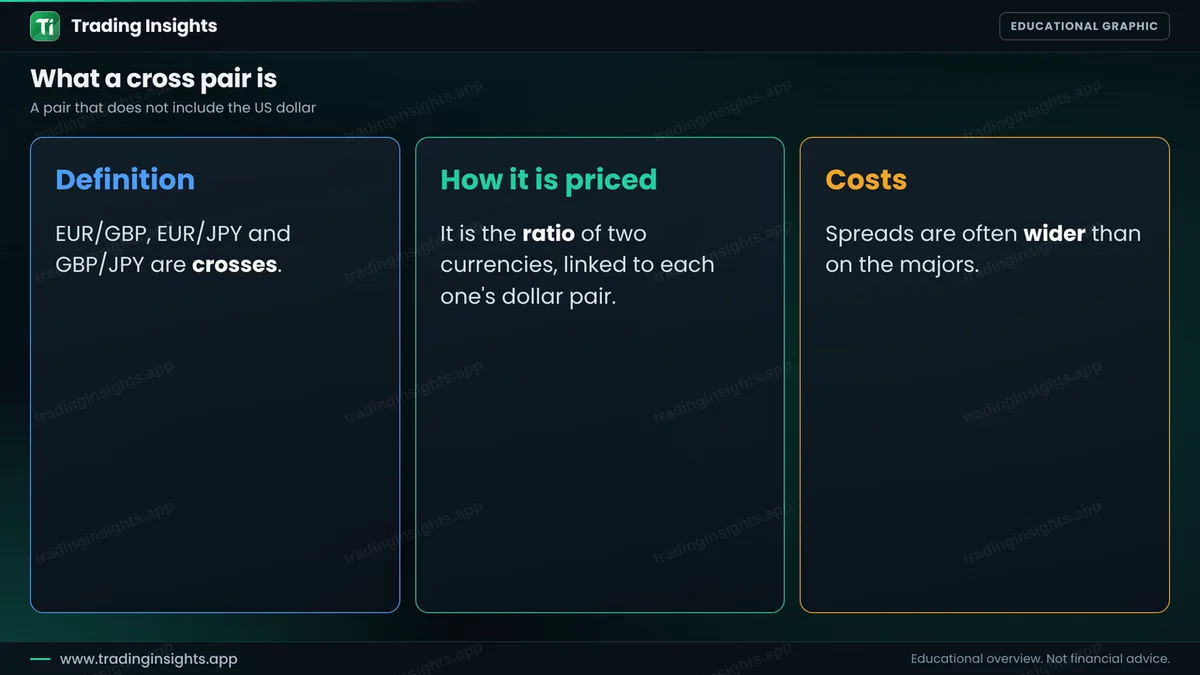
A cross pair has two currencies, and neither is the US dollar. Its price is the ratio of the two, which is linked to each currency's dollar pair. For example, EUR/GBP depends on EUR/USD and GBP/USD. This is why a move in the dollar can move both currencies and leave the cross almost unchanged.
See forex currency pairs explained for majors, minors and exotics. Because crosses trade less than the majors, spreads are often wider. See forex trading costs.
Common cross currency pairs and their character
- EUR/GBP. Often slow, with ranges, because both economies are close. It follows the policy gap between the ECB and the Bank of England. See central banks and forex.
- EUR/JPY. It moves with risk mood and yields. The yen can spike in fear. See safe-haven currencies.
- GBP/JPY. Fast and volatile, which is why traders call it "the Beast". Stops must be wide, and the size small. See the GBP/USD guide for the pound side.
- AUD/JPY. A classic risk-mood pair, often rising with stocks.
- EUR/CHF. Tight and driven by Swiss policy.
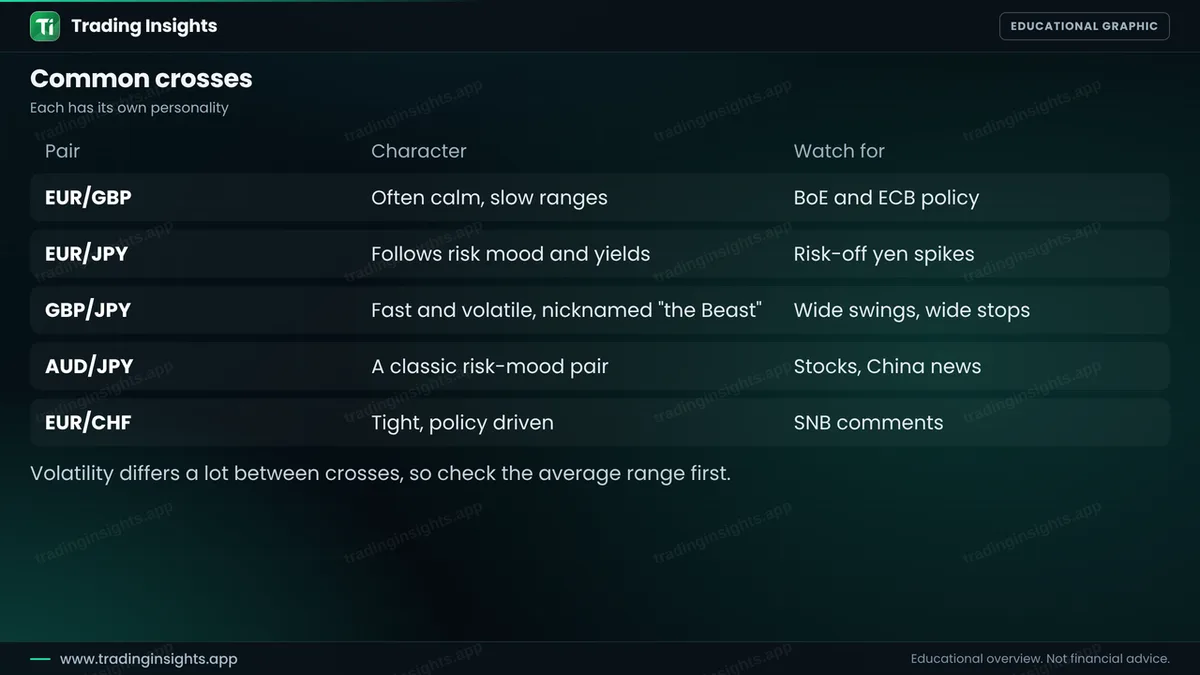
Check the average daily range of a cross before you trade it. A pair that moves 150 pips a day needs a different stop than one that moves 60. See ATR stop loss and forex volatility.
How to trade cross pairs with care
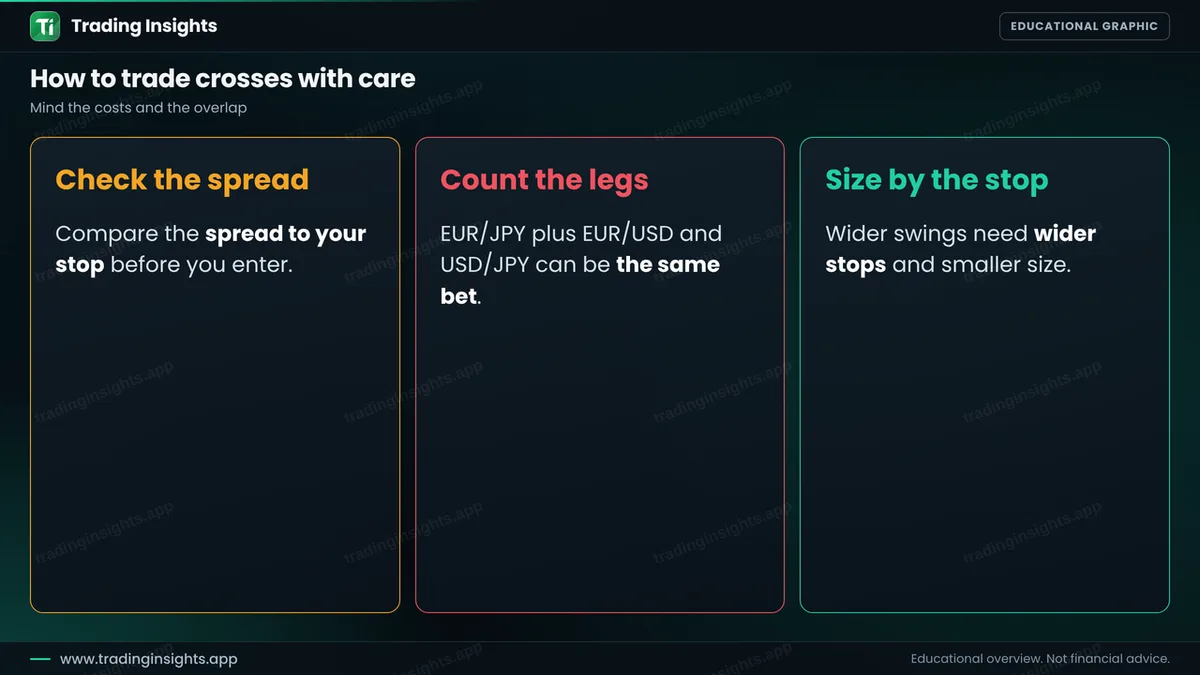
- Check the spread. Compare it with your stop. A wide spread on a tight stop is a hidden cost.
- Count the legs. A trade in EUR/JPY includes a view on EUR and a view on JPY. If you also trade EUR/USD and USD/JPY, you may hold the same idea three times. See currency correlation.
- Size by the stop. See how to calculate position size. Use a calculator and check your platform, because the pip value of a cross depends on the quote currency.
- Use the sessions. A pair is most active when both currencies' markets are open. See forex trading sessions.
Cross pair pip value and position size
On USD-quoted pairs such as EUR/USD, one pip on one standard lot is about $10. On a cross, the pip is worth an amount in the quote currency, which your account converts into its own currency. For EUR/JPY, a pip is 1,000 yen per lot, so the dollar value moves with USD/JPY. For EUR/GBP, a pip is 10 pounds per lot.
That means the $10 rule is only a rough guide. Use your platform's value or a calculator, and see how to calculate pip value.
Illustrative example: sizing a GBP/JPY trade
This is an illustrative example, not a real trade, and the pip value is approximate. Suppose a trader sees a setup on GBP/JPY with a stop of 80 pips because the pair is volatile. Assume one pip on one lot is worth about $6.50 at the current USD/JPY rate (this changes constantly).
With a $10,000 account risking 1% ($100), the position size is $100 / (80 pips x $6.50 per pip per lot) = about 0.19 lot. If the trader had used the $10 rule, the size would be $100 / (80 x $10) = 0.125 lot, which is a different risk than planned in the other direction.
A 160-pip target would pay about 0.19 x 160 x $6.50 = about $198 on a win, and the loss costs about $100. Always confirm the pip value on your own platform before placing the order.
A walk through overlapping risk
A trader wants to buy EUR/JPY because risk mood is improving. She also holds long EUR/USD and long USD/JPY, so the new trade adds a third version of the same view: a stronger euro and a weaker yen. A sudden risk-off event hits the market, and all three trades lose.
Instead, she could have chosen the cleanest chart of the three, or split the risk across them so that the total stays within her limit. See portfolio risk in forex.
Common mistakes
- Using a stop made for a quiet pair on a volatile cross. GBP/JPY can move far more than EUR/GBP. Check the average range and widen the stop, with a smaller size.
- Ignoring the spread. A wide spread on a short stop costs more of your risk. Compare it with the stop first.
- Holding a cross together with its two dollar pairs. The same view gets counted three times. Count the legs and cap the total risk.
- Assuming that the pip value is the same for every pair. It depends on the quote currency. Use a calculator.
Frequently asked questions
What is a cross currency pair?
It is a pair that does not include the US dollar, such as EUR/GBP, EUR/JPY or GBP/JPY.
Are crosses more volatile than majors?
Some are, such as GBP/JPY, and some are calmer, such as EUR/GBP. Check the average range for each pair.
Why are spreads wider on crosses?
They are traded less than the majors, so liquidity is lower, and brokers often charge more. Spreads vary by broker.
Is the pip value the same for all pairs?
No. It depends on the quote currency, so use a calculator and check your platform.
Your next step
Pick one cross you are curious about and note its average daily range, its typical spread on your platform and which two dollar pairs it links to. Then run the numbers in the position size calculator before placing any trade.
This is education, not financial advice. Trading carries risk, and volatile crosses can move fast against you. The charts are illustrative and not real market data.


