

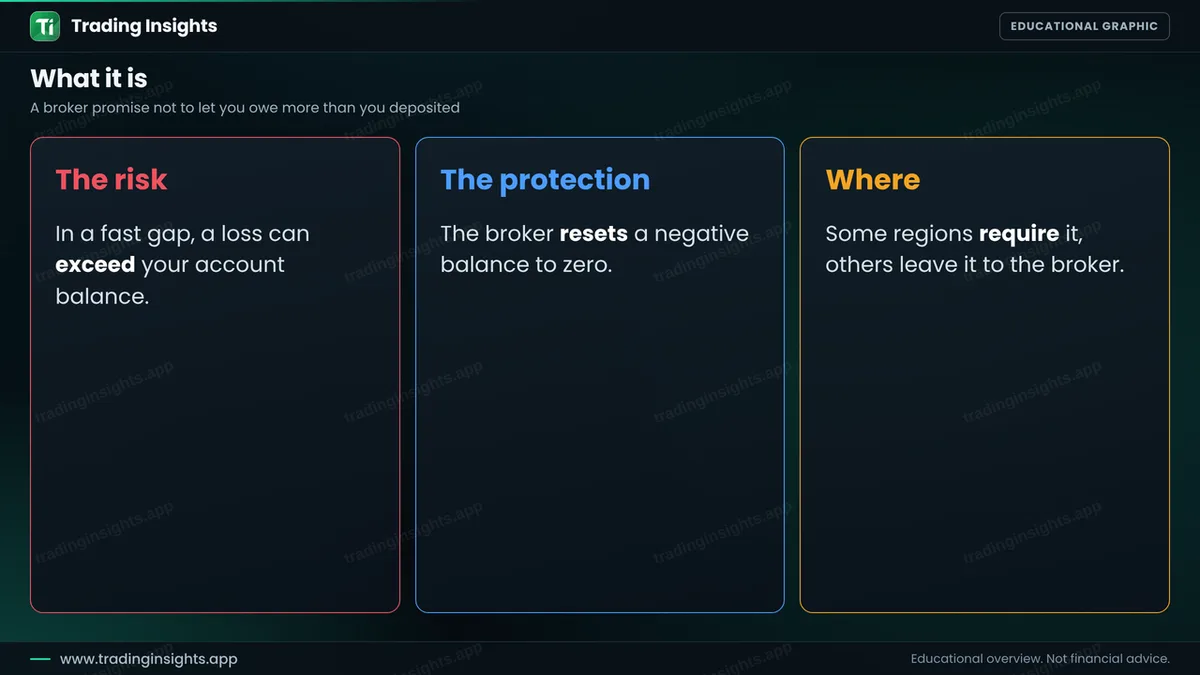
Negative balance protection is a broker policy, or in some regions a regulatory rule, that stops you from owing more than you deposited if a loss pushes your account below zero. With leverage, a fast gap can carry a loss past your whole balance. When that happens, a broker that offers the protection absorbs the excess and resets your account to zero. It covers the debt, not your deposit, and that difference matters.
What negative balance protection is and how it works
Normally, a stop loss closes your trade near your chosen price. In a gap, the market jumps over that price, and the broker may close you out far below it. If the position was large enough, the account can end up negative.
Without protection, a trader in that position could owe the broker the difference. With it, the broker writes off the shortfall and sets the balance back to zero. Some regulators require this for retail clients, and other brokers offer it voluntarily. Because rules differ, always read your own broker's terms. See how to check if a broker is regulated.
How a negative balance happens
Three things usually combine:
- High leverage. A large position relative to the account means small moves create big losses.
- A gap or fast news. Price skips over your stop, so the exit is much worse than planned.
- Slow or late closing. If margin is thin and the market moves quickly, the broker's stop-out may not fill in time.
Weekend openings, central bank surprises and thin holiday markets are the usual places for gaps. See low-liquidity periods.
How to check your broker's negative balance protection
Do not assume it exists. Work through this checklist before you fund an account:
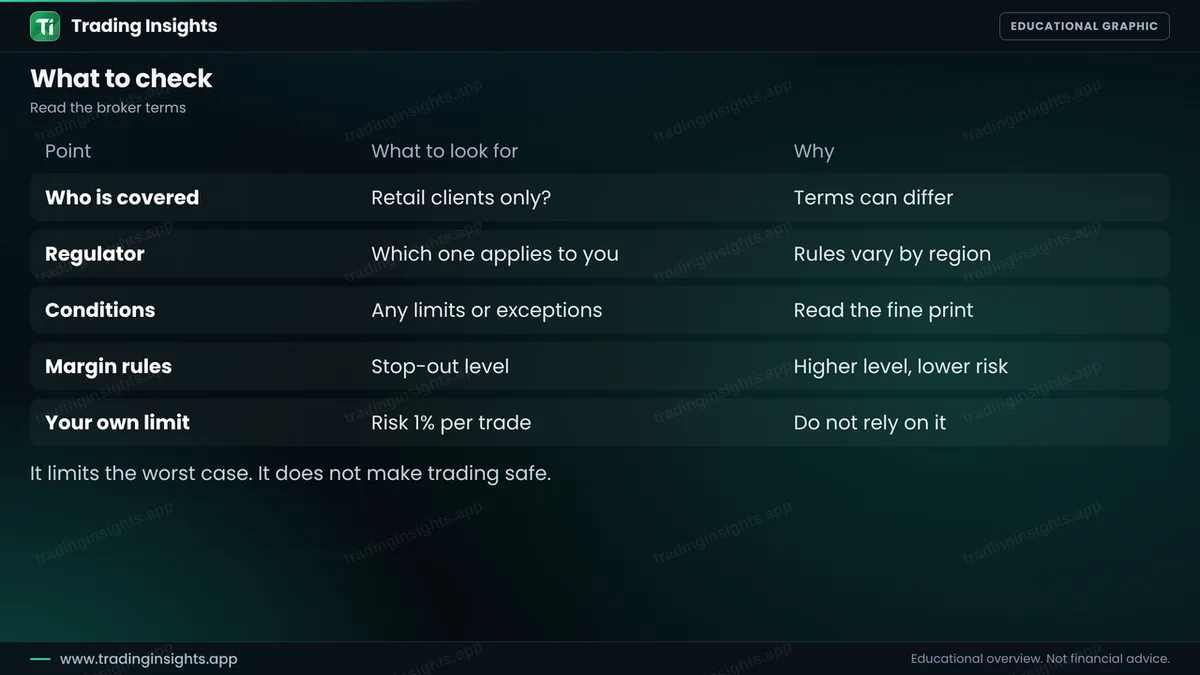
- Find the policy. Look in the client agreement or terms, not just the marketing page.
- Check who is covered. Some brokers limit it to retail clients, and professional accounts may be excluded.
- Check the regulator. Which authority supervises the entity you are signing with, and what does it require?
- Look for conditions. Read any exceptions, such as abuse, fraud or special account types.
- Know the stop-out level. A broker that closes trades earlier lowers the chance of a negative balance. See margin call and stop out.
- Set your own limit. Decide how much you can lose before you place any trade.
What negative balance protection does not cover
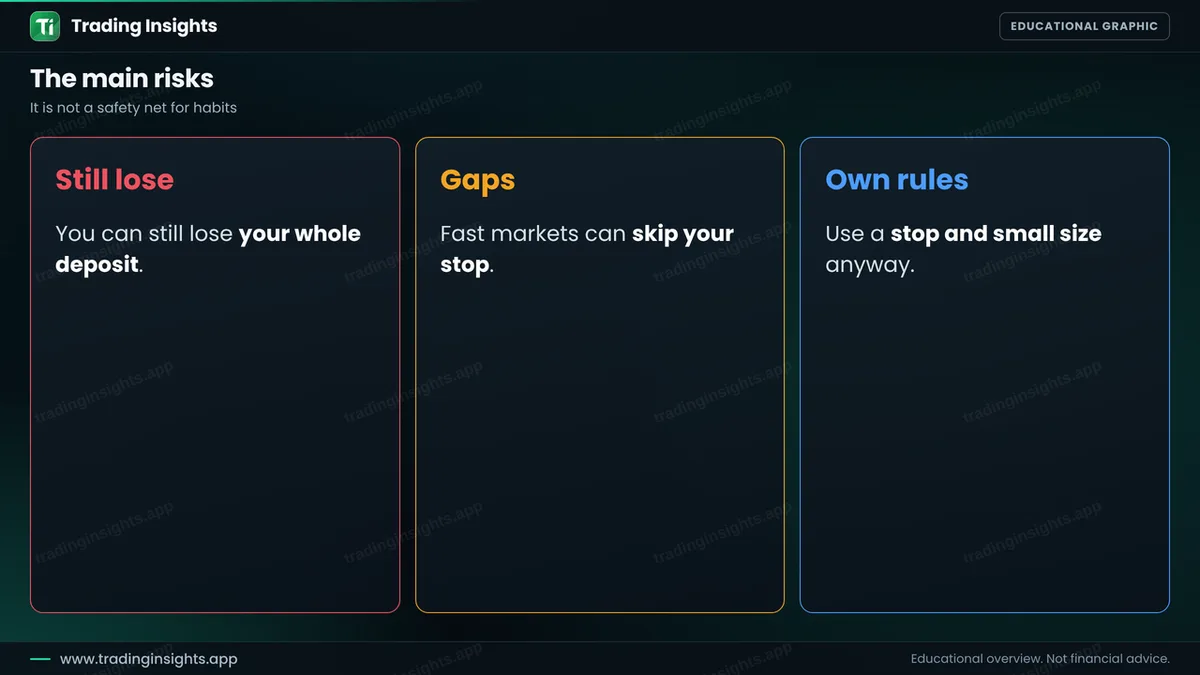
The protection only stops a loss beyond your deposit. You can still lose everything you put in. It does not make a bad trade safe, and it does not stop gaps from skipping your stop. See slippage for how fills differ from your price.
It can also encourage bad habits. Some traders use extra leverage because "the downside is capped", but the cap sits at your entire account. Keep risk per trade small, as in the 1 percent rule.
Illustrative example: big size versus small size
A trader with $1,000 uses too much leverage and holds a position through a major news release. A gap takes the loss to $1,300. With negative balance protection, the account is reset to zero. Without it, the trader might owe $300.
Now compare a trader who risks 1% ($10 on a $1,000 account) with a 30-pip stop on EUR/USD. With a $1,000 account risking 1% ($10), the position size is $10 / (30 pips x $10 per pip per lot) = about 0.03 lot. Even a gap of 100 pips would cost about $30.
On a larger account the same rule works the same way. With a $10,000 account risking 1% ($100), the position size is $100 / (30 pips x $10 per pip per lot) = about 0.33 lot. A win pays about $200, and a loss costs about $100. Size is what keeps you far away from a negative balance in the first place. Try your own numbers in the position size calculator.
Steps to protect yourself beyond the broker's policy
- Read the terms about negative balances before you deposit.
- Use a real stop on every trade, and keep size small.
- Reduce size before major news that can cause gaps.
- Avoid holding full size over the weekend when a Sunday gap would hurt.
- Keep spare funds away from the trading account, so one bad event cannot reach them.
Common mistakes
- Assuming it protects the deposit itself. It only covers losses beyond your balance. Treat the deposit as fully at risk.
- Using high leverage because losses are capped. The cap is your whole account. Size by your risk limit, not by the leverage on offer.
- Skipping the broker terms. Coverage and exceptions vary. Read them before you fund the account.
- Holding full size through major news. Gaps are exactly when stops fail. Cut size or stay out.
Frequently asked questions
What is negative balance protection?
It is a broker policy or regulatory rule that prevents you from owing more than your deposit if a loss takes the account below zero. The broker absorbs the extra loss and resets your balance to zero.
Does it protect my deposit?
No. You can still lose all the money you put in. It only limits losses beyond that point.
Do all brokers offer it?
No. Some regulators require it for retail clients, and other brokers offer it by choice. Check the client agreement and the regulator that applies to your account.
Can I rely on it instead of a stop loss?
No. Use a stop and small size on every trade. The protection is a last resort for extreme events, not a risk plan.
Your next step
Open your broker's client agreement and find the negative balance clause. Write down who is covered, any exceptions, and the stop-out level, then check that your usual position size would survive a large gap.
This is education, not financial advice. Trading carries risk, and you can lose your whole deposit. Broker terms and regulations vary, so read your own. The charts are illustrative and not real market data.


