
Central bank minutes are a written summary of what policymakers discussed at a rate meeting, usually published some weeks after the decision. The decision itself is already known, but the minutes show how members thought about inflation, growth and risks, and whether anyone voted differently. To read them well, compare the tone with the previous set, look for shifts in wording and vote splits, and let the market reaction guide your trade. For the wider picture, read central banks and forex.
What central bank minutes are
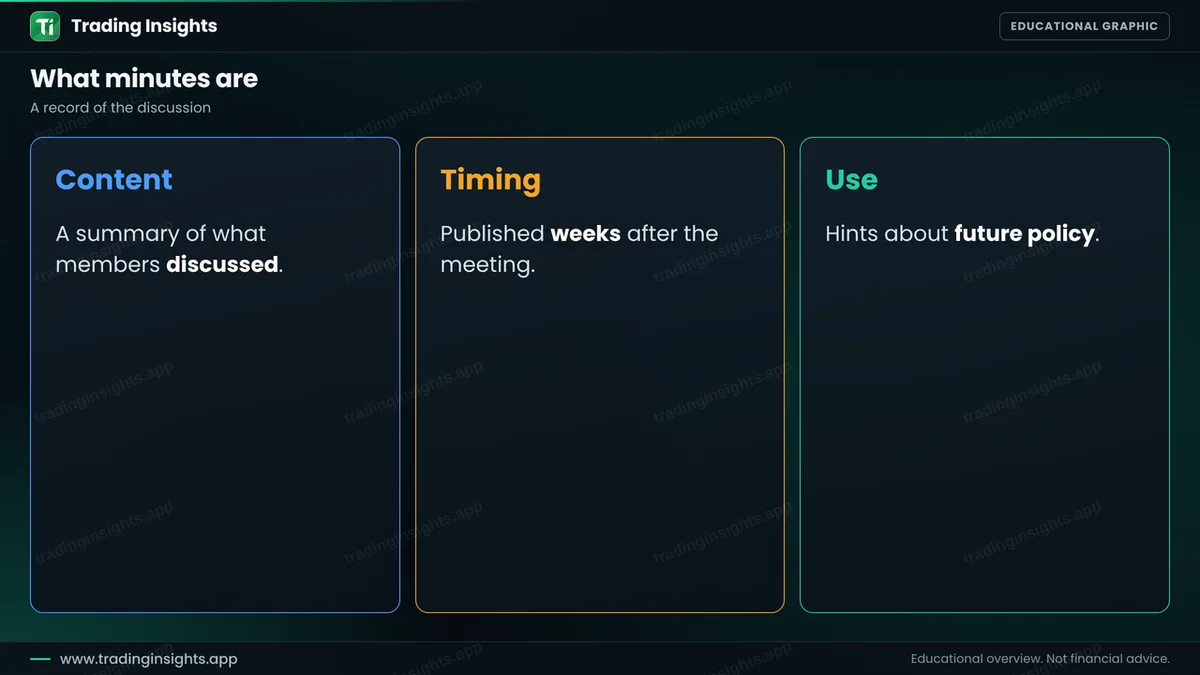
Minutes summarise the debate: how members saw inflation, growth and risks, and whether any voted differently. The exact format and timing differ between central banks, so check the schedule for each bank in your economic calendar.
Some banks publish a full record, others a shorter summary of the meeting. Either way, the document adds detail to the decision, and to forward guidance and speeches. It answers the question of why, which the decision alone does not.
How to read central bank minutes: what to look for
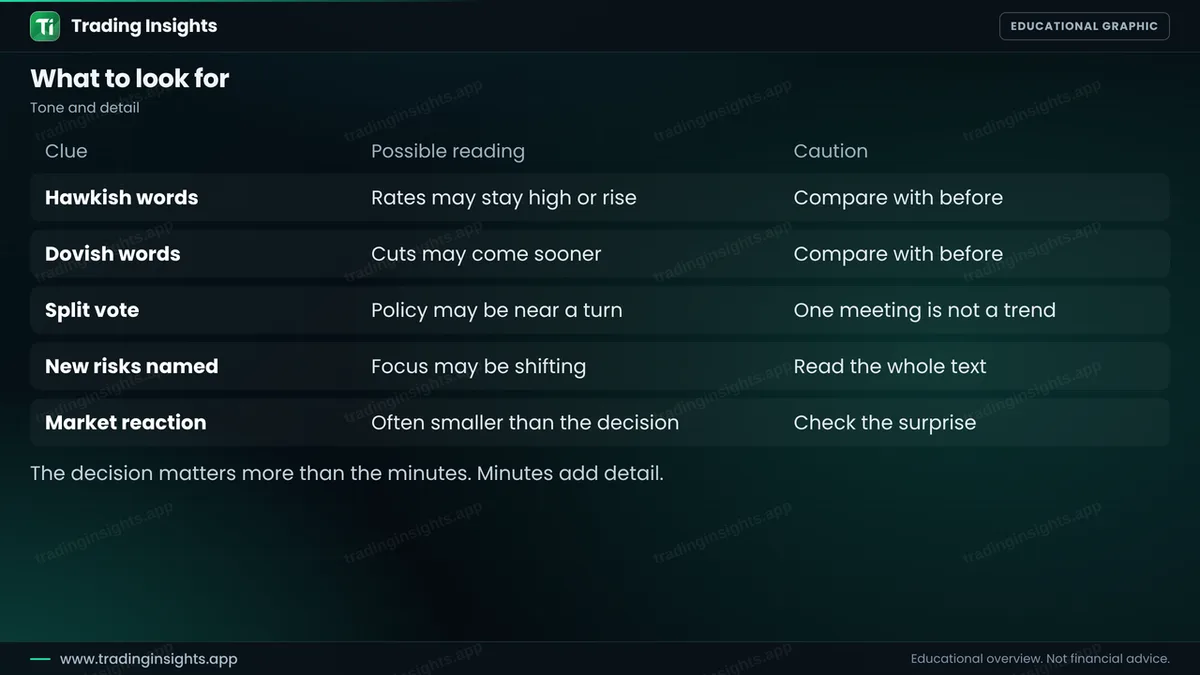
Traders compare the tone with the last set. More members leaning toward higher rates is a hawkish shift, and more talk of risks to growth is a dovish one. A split vote can show that policy is near a turn.
But one meeting is not a trend, and words can be read more than one way. The market often moves less on minutes than on the decision itself, unless the tone is a surprise.
Here is a simple reading list for each release:
- Inflation section. Do members see price pressure rising, steady or fading?
- Growth and jobs. Is the outlook described as stronger or weaker than before?
- Vote detail. How many members wanted a different move, and in which direction?
- New wording. Any new risk, phrase or condition that was not in the last minutes.
- Market expectations. What was priced in before the release?
Minutes vs the decision: why the reaction can be small
The decision and the statement are the main event. By the time minutes appear, traders have had weeks to digest the outcome, and later data and speeches may have changed the picture. If the minutes confirm what everyone expected, the move is usually small.
The reaction grows when the tone differs from expectations, for example when more members than expected leaned toward a cut. That gap between the text and what the market expected is what you are looking for.
Steps to trade central bank minutes
- Note the release time and the previous tone.
- Read the key sections on inflation, growth and policy.
- Compare with the last minutes and with market expectations.
- Wait for the reaction, then trade from a level with a stop. See stop loss and take profit.
- Place the target at the next clear level and check the ratio with the risk reward calculator.
- Use the position size calculator, and reduce size on event days.
Illustrative example: a dovish surprise in the minutes
The minutes of the Reserve Bank show that several members wanted a rate cut, which is more dovish than expected. AUD/USD falls 40 pips, and then rebounds to a resistance level at 0.6600. The trader sells the rebound with a 35-pip stop at 0.6635 and a 70-pip target at 0.6530.
With a $10,000 account risking 1% ($100), the position size is $100 / (35 pips x $10 per pip per lot) = about 0.29 lot. A win pays about $200, and a loss costs about $100. If price instead closes above 0.6635, the stop works as planned and the idea is over.
What can go wrong with minutes trades
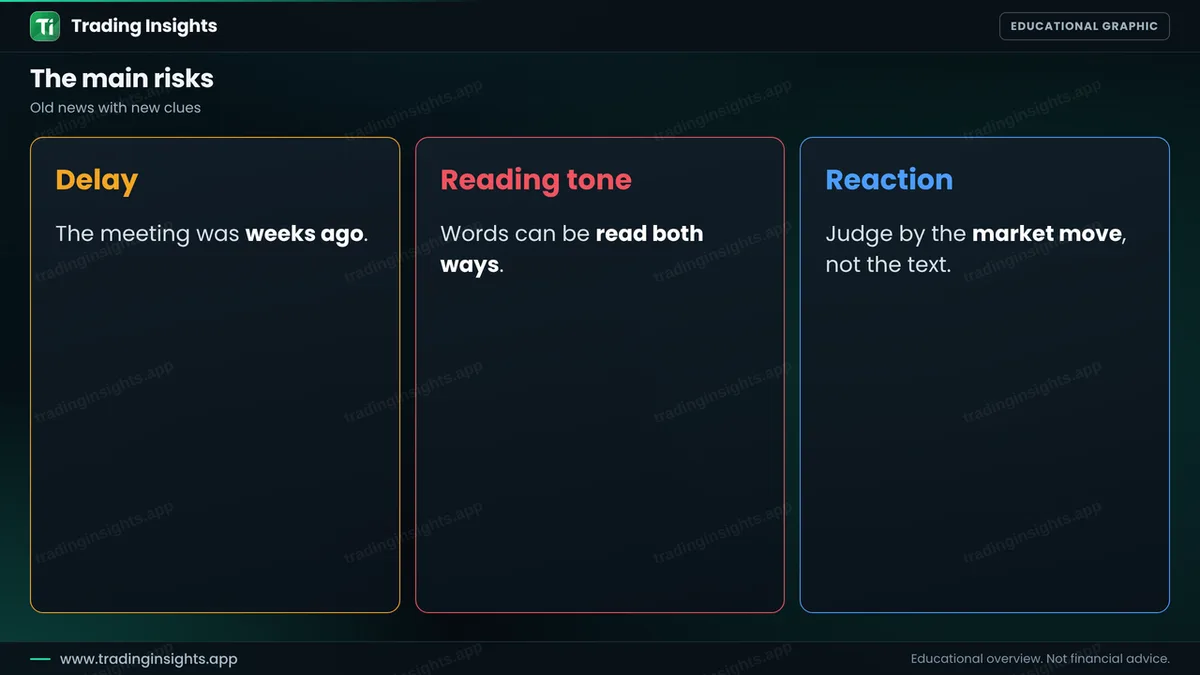
Because the meeting is weeks old, some of the news may already be priced in. Different readers can interpret the same sentence differently, so the same text can lift a currency on one desk and sink it on another.
Let the market reaction guide you, and do not trade the first spike. See how to trade forex news and slippage.
What invalidates the idea
The trade idea is weak if the price move was already complete before the release, if the tone matches what the market expected, or if new data or a central bank speech after the meeting has changed the outlook. It also fails when price reacts the opposite way to your reading, and closes beyond your stop. Take the loss and move on rather than re-reading the text for a better story.
Common mistakes
- Treating minutes as a new decision. The decision was made weeks ago. Look for tone and detail, not a new rate move.
- Reading one sentence out of context. A single line can be balanced by the next. Read the section and compare it with the last release.
- Trading the spike without a level. The first move is often noise. Wait for a clear level and a stop.
- Forgetting that the meeting was weeks ago. Later data may have changed things. Check what happened since.
Frequently asked questions
What are central bank minutes?
A summary of what policymakers discussed at a meeting, published some weeks later. Some banks publish a fuller record, and others a shorter summary.
Do minutes move currencies?
They can, mostly when the tone differs from expectations. Often the move is smaller than for the decision.
What does hawkish mean?
Leaning toward higher interest rates or tighter policy to fight inflation. A hawkish shift in the minutes can support a currency.
What does dovish mean?
Leaning toward lower rates or looser policy to support growth. A dovish shift can weigh on a currency.
Your next step
Pick one central bank that drives your main pair, open its last two sets of minutes, and write three lines on how the tone changed. Then mark the next release date in your calendar.
This is education, not financial advice. Trading carries risk, and no method guarantees results. The charts are illustrative and not real market data.


