

A withdrawal plan is a written rule that decides when you take money out of your trading account, how much you take, and when you stop taking it. Without one, most traders drift to one of two extremes: they never withdraw because the balance "is working", or they pull out so much that the account is too small to trade properly. A rule set in advance fixes both. This article is general education, and tax and legal rules differ by country, so check your own.
Why you need a forex profit withdrawal plan
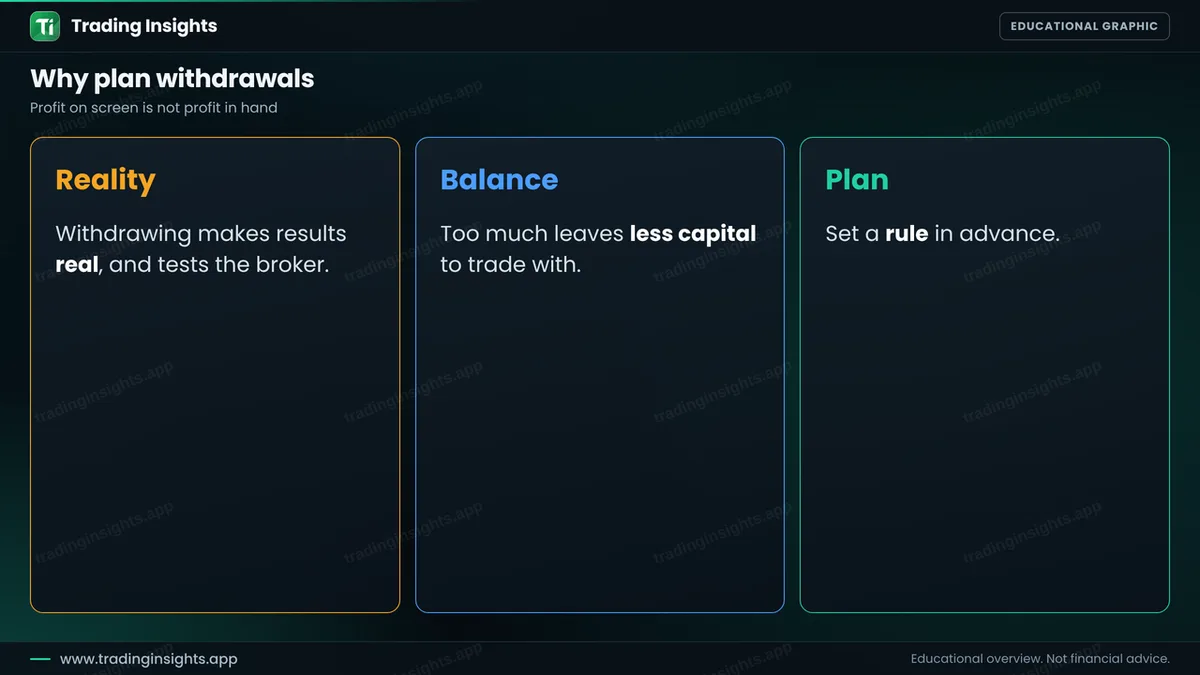
Profit on the screen is only a number until it reaches your bank. Taking money out proves that your results are real and that your broker pays on time. It also stops the balance from quietly pushing you to risk more just because the figure has grown.
The other side is that every withdrawal shrinks the account. If you risk a percentage per trade, a smaller balance means a smaller position size. The aim is balance between the two, decided by a rule and not by a mood after a good or bad week.
Withdrawal plan examples: three common rules
Most plans are a version of one of these:
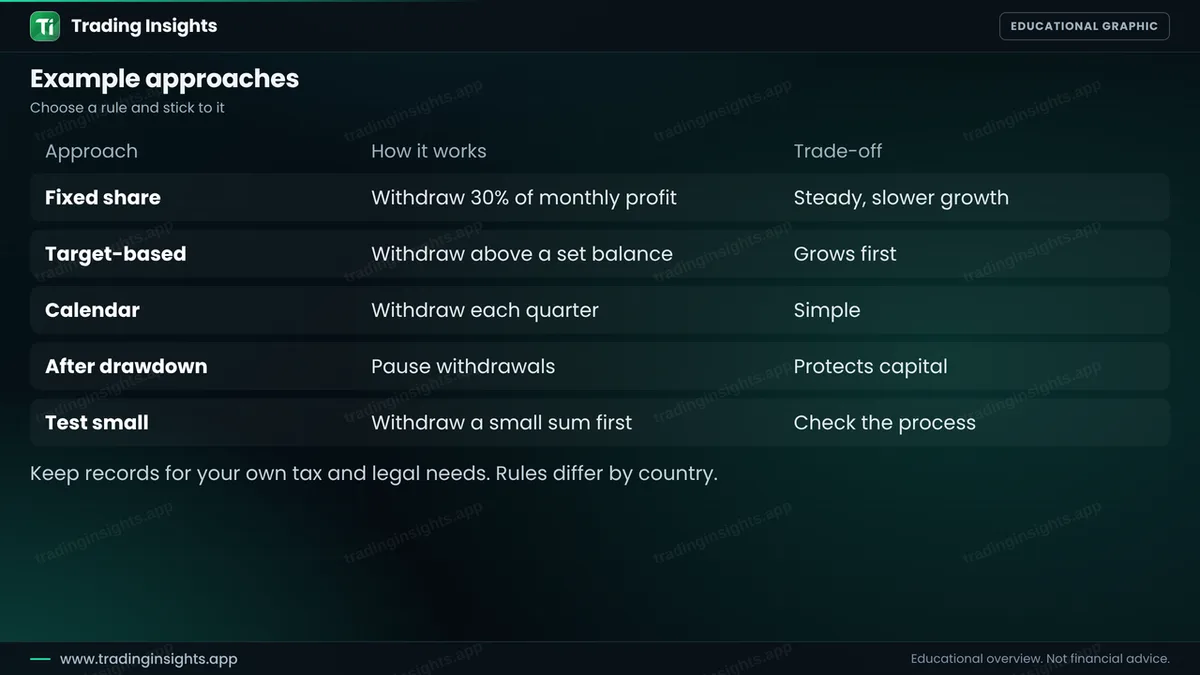
- Fixed share. Withdraw a set part of each month's net profit, such as 30%. It is simple and easy to track.
- Target balance. Let the account grow to a level you chose, then withdraw only what sits above it. This protects capital while the account is small.
- Calendar. Withdraw on a schedule, for example once a quarter, and only if the period was profitable.
Whichever you choose, add a pause rule. After a drawdown beyond your limit, stop withdrawing until the account recovers, so capital is rebuilt first. See compounding in forex and realistic trading goals for how growth and targets fit together.
How to build your withdrawal plan step by step
- Choose one rule. Fixed share, target balance or calendar. Do not mix three at once.
- Set a floor. Decide the minimum balance you need to keep your normal position size. Never withdraw below it.
- Count only closed profit. Use realised profit from closed trades, never open floating gains.
- Write it into your plan. Put the rule, the floor and the pause condition on paper. See how to build a trading plan.
- Test with a small withdrawal. This shows you the real fees, methods and processing time before you rely on them.
- Keep records. Log every deposit, withdrawal and profit figure, and save the broker statements.
- Review quarterly. Adjust the share only on a schedule, never in the middle of a winning or losing streak.
What invalidates the plan
A plan only works if you follow it. Treat these as signs that it needs to pause or change:
- The account is in a drawdown beyond your limit. Stop withdrawing.
- The balance is near or below your floor. Stop withdrawing.
- You catch yourself taking bigger risks to hit a withdrawal figure. Stop and reset.
- Your broker delays or refuses a test withdrawal. Do not add more funds, and look into why.
What to watch with fees, records and your broker
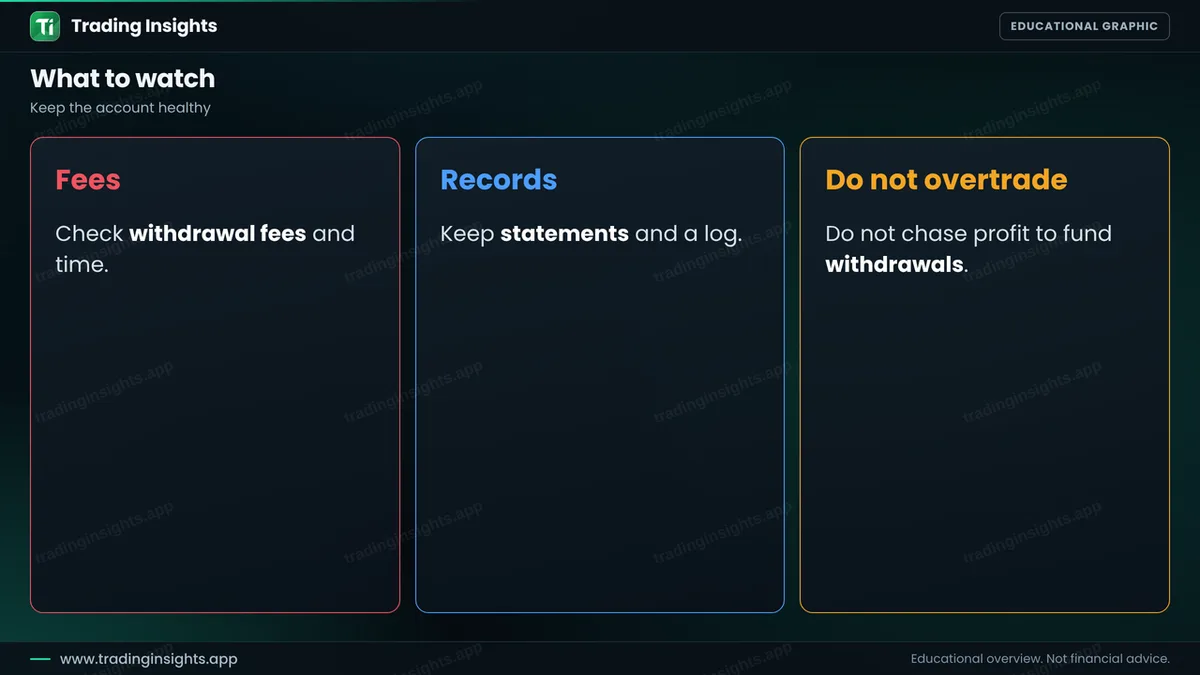
Check the withdrawal methods, fees and processing time, and keep statements for your own records and any tax needs. Do not trade more just to fund a withdrawal, since that is a direct route to overtrading. Pick a broker you can verify, as covered in how to check if a broker is regulated.
Illustrative example: a 30% monthly withdrawal
A trader has a $10,000 account and risks 1% ($100) per trade with a 30-pip stop on EUR/USD. With a $10,000 account risking 1% ($100), the position size is $100 / (30 pips x $10 per pip per lot) = about 0.33 lot. A win pays about $200, and a loss costs about $100.
Over the month the account grows by $600. The plan says to withdraw 30% of net profit, which is $180. The balance becomes $10,000 + $600 - $180 = $10,420, and 1% risk is now about $104 per trade. In a month with a net loss, the plan withdraws nothing and the trader simply keeps trading. You can test your own numbers with the position size calculator.
Common mistakes
- Withdrawing profit that is still open. A floating gain can disappear before the trade closes. Count only closed profit.
- Taking so much that size shrinks too far. A small account cannot hold normal risk. Set a floor and respect it.
- Skipping records. You will struggle to reconcile statements or report to tax authorities. Log every movement of money.
- Trading harder to fund a withdrawal. Pressure leads to forced setups. Withdraw only what the plan allows.
Frequently asked questions
Should I withdraw profits regularly?
It depends on your goals and the size of your account. A rule set in advance, such as a share of monthly profit, removes emotion from the decision. Regular withdrawals also confirm that your broker pays without problems.
How much should I withdraw?
There is no single answer. Many traders first decide the balance needed to keep proper position size, then take a share of the profit above that level. Start with a modest share and adjust at your quarterly review.
Do I need to keep records of withdrawals?
Yes. Keep statements and a log of deposits, withdrawals and profits. Tax and legal rules differ by country, so check your local requirements or ask a qualified professional.
Should I withdraw after a drawdown?
Many traders pause withdrawals until the account recovers. Rebuilding capital first protects your position size and keeps the plan from forcing you to take extra risk.
Your next step
Write a one-page withdrawal rule today: your chosen method, your minimum balance floor, and the drawdown level that pauses withdrawals. Then make one small test withdrawal to see the real fees and timing.
This is education, not financial advice. Trading carries risk, and no method guarantees results. Tax and legal rules differ by country. The charts are illustrative and not real market data.


