

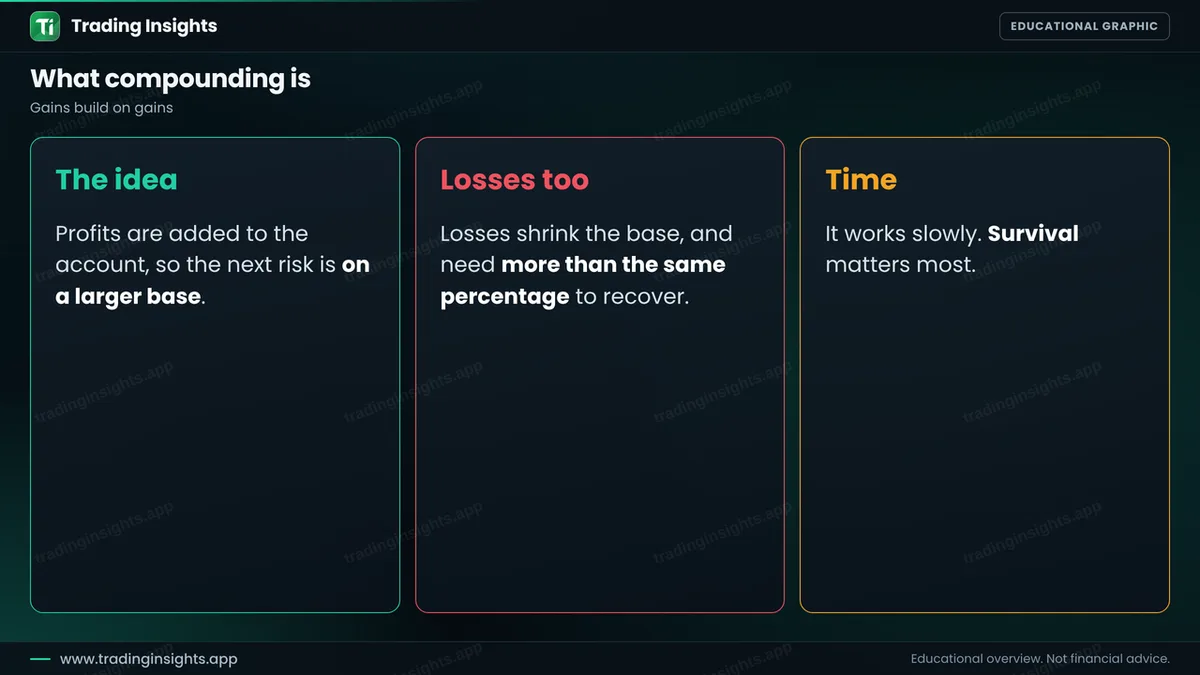
Compounding means that profits stay in the account, so the next trade risks a percentage of a larger balance. The arithmetic is real, but it is slow, it needs a positive average result, and it works in reverse during losing periods. Advertisements that use compounding tables to suggest that a small account can become large in months are selling the formula and hiding the risk.
How the mechanics work
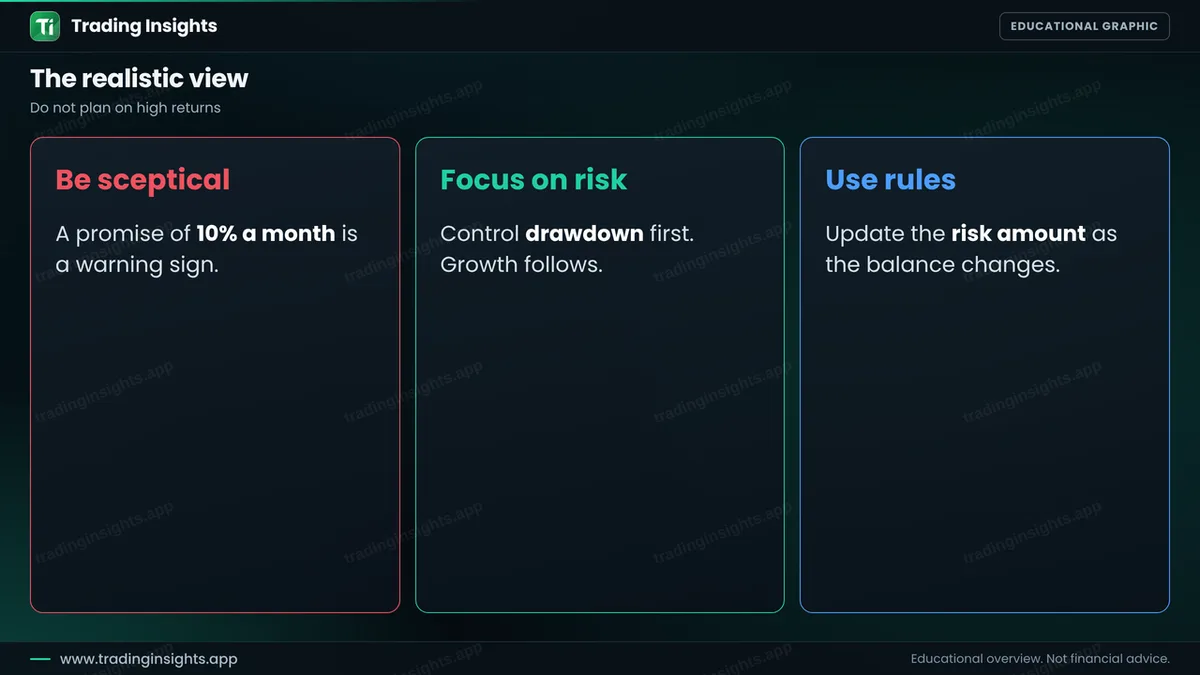
Suppose you risk 1.5% per trade on a $3,000 account. The first trade risks $45. If the account grows to $3,300, the same rule risks about $49.50. If it shrinks to $2,700, the rule risks about $40.50. Risk rises with the balance and falls with it, which is the main reason fixed-percentage sizing is used. It slows losses automatically and lets gains build.
The effect is the same as compound interest. A gain of 1% a month does not add 12% over a year, it adds about 12.7%, because each month's gain is earned on a slightly larger base. The table below shows the pure arithmetic for steady monthly returns. It is an illustration and not a forecast.
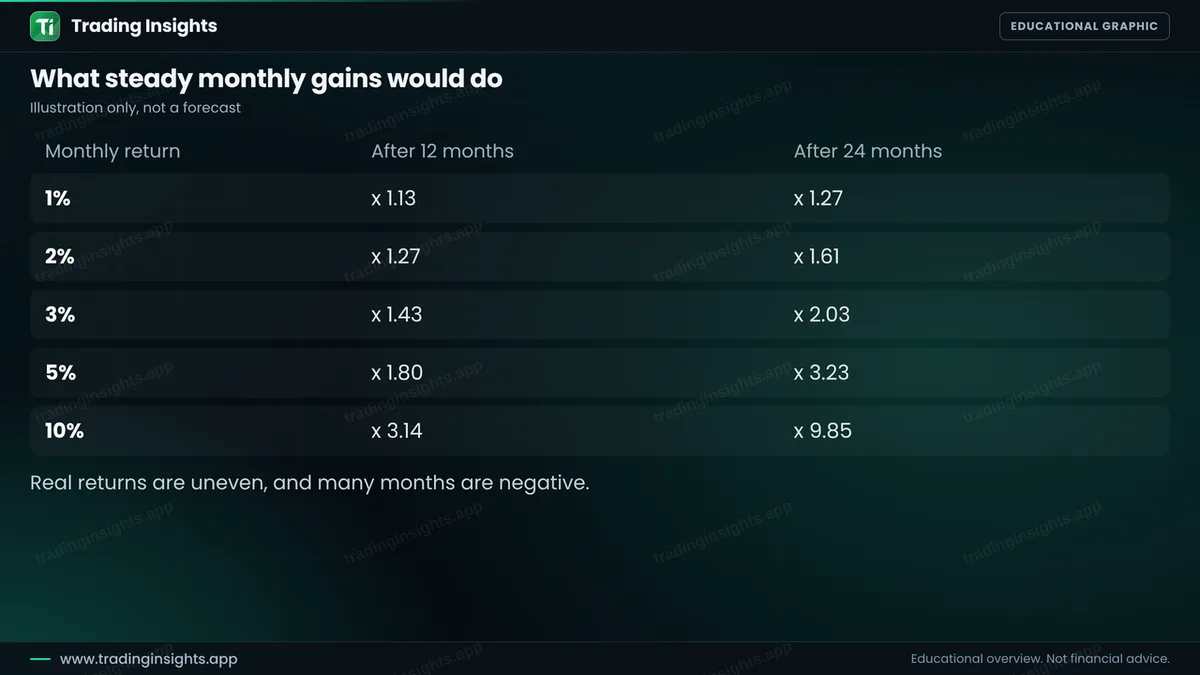
At 1% a month, a $10,000 account becomes about $11,270 after twelve months. At 5% a month, it becomes about $17,960. At 10% a month, it becomes about $31,400. These last two figures are what appear in advertisements, and they require a steady return that no one can promise. A useful shortcut is the rule of 72: divide 72 by the percentage return per period to estimate how long doubling takes. At 2% a month, doubling takes about 36 months.
What advertisements leave out
Losses compound too, and they need a larger gain to repair. A 10% loss needs an 11.1% gain. A 20% loss needs 25%. A 50% loss needs 100%. This is why controlling drawdown matters more than chasing high returns. See why a 50 percent loss needs a 100 percent gain for the full table.
Fixed-percentage risk also shows a gentle floor. After ten losses in a row at 1.5% risk, a $3,000 account is about $2,580, down roughly 14%, not wiped out. After twenty losses in a row it is about $2,220. A streak that long is very unlikely with a reasonable system, but the numbers show why small risk per trade keeps you in the game while compounding does its slow work.
When compounding does not help
- When the average trade is not positive. Compounding multiplies results, including negative ones. A system with no edge only compounds toward a smaller account.
- When returns are uneven. A volatile result of +20%, -15%, +25%, -20% compounds to less than the average suggests, because losses are taken from a larger base.
- When the account is tiny. A 1.5% risk on $3,000 is $45, which may force a lot size below the broker's minimum, or stops that are too tight. Growth in the first months is mostly about learning, not about money.
- When risk is raised to hurry. Doubling the risk per trade does not double the return. It raises the chance of a deep drawdown by far more.
Step-by-step: a sensible compounding plan
- Choose a fixed risk per trade, such as 1% to 1.5% for a small account. Write it down.
- Recalculate the risk amount from the current balance at a regular interval, for example once a week, not before every trade.
- Decide a maximum drawdown that makes you pause, such as 10% from the peak, and what you will do when it is reached.
- Plan withdrawals in advance. A fixed share of profits each quarter makes gains real, but reduces the base.
- Judge the plan over a large number of trades, not over a month. See how to size positions to keep each trade consistent.
- Do not raise the percentage after a winning streak. Raise the balance, and let the percentage stay.
Illustrative example: a small win at 1.5% risk
This is an illustrative example. A trader with $3,000 buys NZD/USD after a pullback to support, with a stop 34 pips below the entry and a target 68 pips above.
With a $3,000 account risking 1.5% ($45), the position size is $45 / (34 pips x $10 per pip per lot) = about 0.13 lot. A win of 68 pips pays about $88; a loss costs about $45.
The trade hits the target and the account becomes about $3,088. The next trade risks 1.5% of that, about $46. The change is tiny, which is the point: compounding is a slow effect, and it is most visible over hundreds of trades.
Illustrative example: a loss and the road back
In this second illustrative example, the same trader sells GBP/USD at resistance, with a 46-pip stop and a 92-pip target.
With a $3,000 account risking 1.5% ($45), the position size is $45 / (46 pips x $10 per pip per lot) = about 0.10 lot. A win of 92 pips pays about $92; a loss costs about $45.
Price rises and the stop is hit. The loss is about $46 because the lot size was rounded up to 0.10. The balance falls to about $2,954. Recovering needs a gain of about 1.6%, and the next trade now risks about $44. Two or three such losses are normal. What matters is that none of them threatens the account.
Withdrawing or reinvesting
Taking money out reduces the base and slows growth, but it also turns paper gains into real ones. Some traders keep everything in until the account reaches a size that suits their goals, then withdraw a fixed share. Others set a monthly or quarterly rule. There is no correct answer, only a rule that you will actually follow. See drawdown throttling for a related way to reduce risk when the account is down, rather than after a loss streak has hurt.
Common mistakes
- Planning with a high monthly return as if it were certain. A table is arithmetic, not a forecast. Plan around a range of outcomes, including flat and negative months.
- Ignoring that losses need larger gains. A 30% drawdown requires about a 43% gain to recover. Protect the base first.
- Raising the risk to speed up growth. Extra risk adds drawdown more than it adds return. Keep the percentage fixed.
- Judging a strategy by its best months. Winning streaks are part of normal variance. Look at the whole record.
- Believing compounding tables as proof. A promised monthly percentage is a warning sign, not evidence. Test claims against realistic results.
Compounding checklist
- Is my risk per trade a fixed percentage, written down?
- Do I update the risk amount on a set schedule?
- Have I set a drawdown level at which I reduce size or pause?
- Is my plan based on realistic returns, not on a table?
- Do I know what I will do with profits: withdraw, reinvest or both?
- Have I tested my method on enough trades to trust the average result?
Frequently asked questions
What is compounding in forex?
It is the effect of leaving profits in the account, so future risk and gains are measured on a larger balance.
Is a steady 10% a month realistic?
No. It is extremely hard to sustain, and claims of that kind are a warning sign.
Why are losses harder to recover than gains?
Because a loss shrinks the base. After a 20% loss you need a 25% gain to get back, and after a 50% loss you need a 100% gain.
Should I withdraw profits?
It is a personal choice. Decide in advance and write the rule in your trading plan.
This is educational only, not financial advice. Trading carries risk of loss, and the tables and examples here are arithmetic illustrations, not forecasts. Only trade with money you can afford to lose.


