
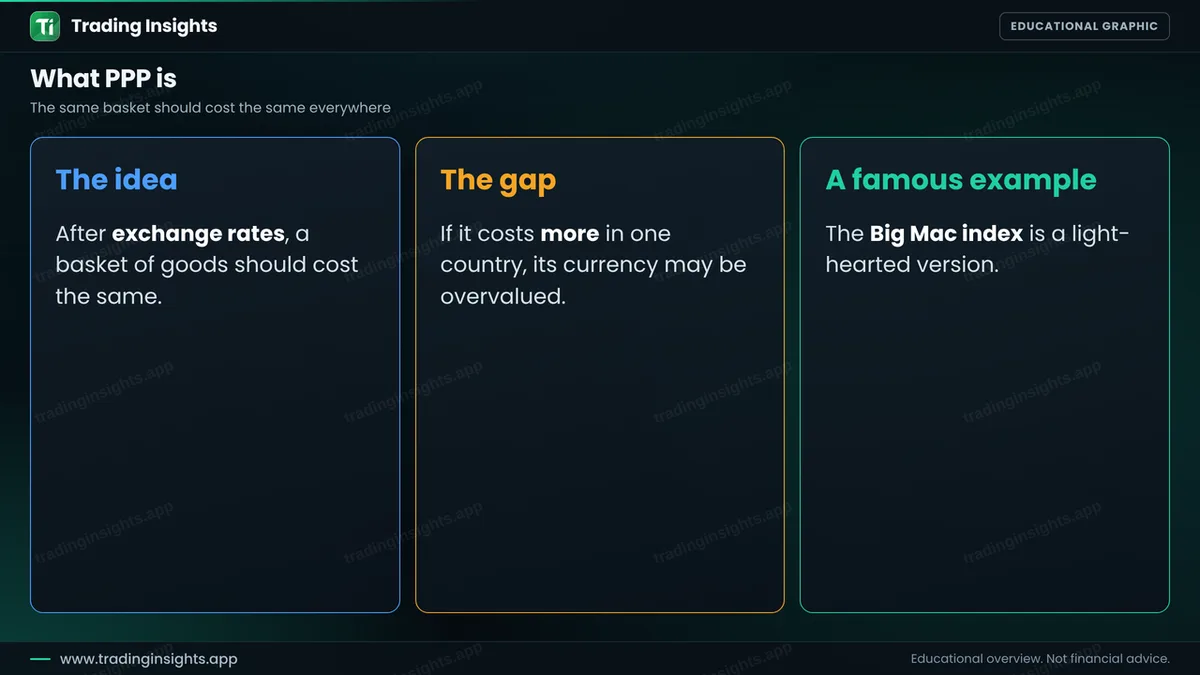
Purchasing power parity (PPP) is the idea that a basket of goods should cost about the same in every country once you convert prices at the exchange rate. If it does not, the currency of the more expensive country may be overvalued, and the other may be undervalued. For forex traders, PPP is a slow, long-term gauge of how stretched a currency is. It is not a short-term entry signal.
What purchasing power parity means
The logic is simple. Say a basket of goods costs $100 in the US and the same basket costs 120 euros in the euro zone. The "fair" EUR/USD rate would then be about 0.83 dollars per euro, which is $100 / 120.
If the actual rate is 1.10, the euro buys less at home than its exchange rate suggests, so it looks expensive. PPP says it may drift lower over time. If the actual rate were 0.70, the euro would look cheap. These numbers are examples, not current data.
A light-hearted version is the Big Mac index, which compares the price of one burger across countries. For what moves rates in the short term, see what moves forex prices and interest rates and forex.
Why PPP works over years, not weeks
Over very long periods, exchange rates tend to move toward their PPP levels, because persistent price gaps encourage trade that pushes rates back. But "long" means years, sometimes a decade or more. A currency that is expensive can become much more expensive first.
In the short run, PPP fails for good reasons:
- Many goods are not traded. Housing, haircuts and local services do not cross borders, so their prices cannot be arbitraged.
- Frictions matter. Transport costs, taxes and trade barriers keep prices apart.
- Capital flows are larger than trade flows. Money chasing yield can hold a currency far from its PPP value. See the carry trade.
How to read a PPP gap
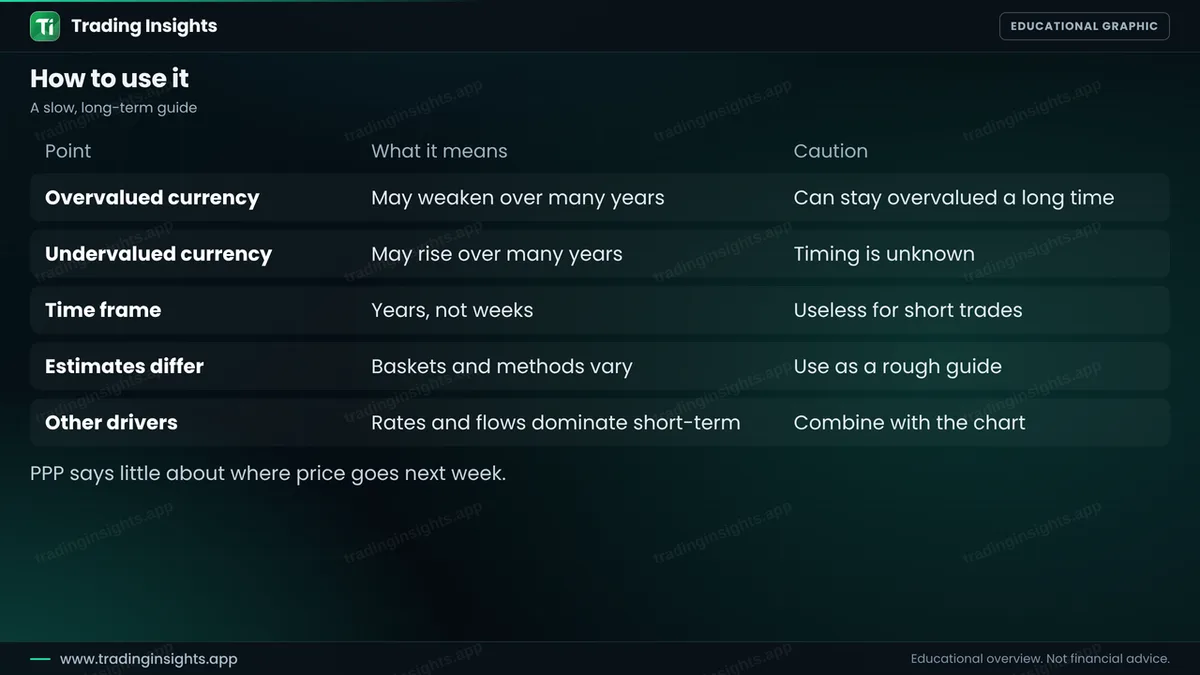
- Overvalued. The currency may weaken over many years, but it can stay overvalued, or become more so.
- Undervalued. The currency may rise over time, but the timing is unknown.
- The time frame. Years, not weeks. Traders who sell a currency only because it is "expensive" can lose for a long time.
- Other drivers dominate. Rates, yields, capital flows and risk mood explain most short-term moves. See bond yields and forex, risk-on and risk-off and the trade balance and current account.
How to use PPP in practice: step by step
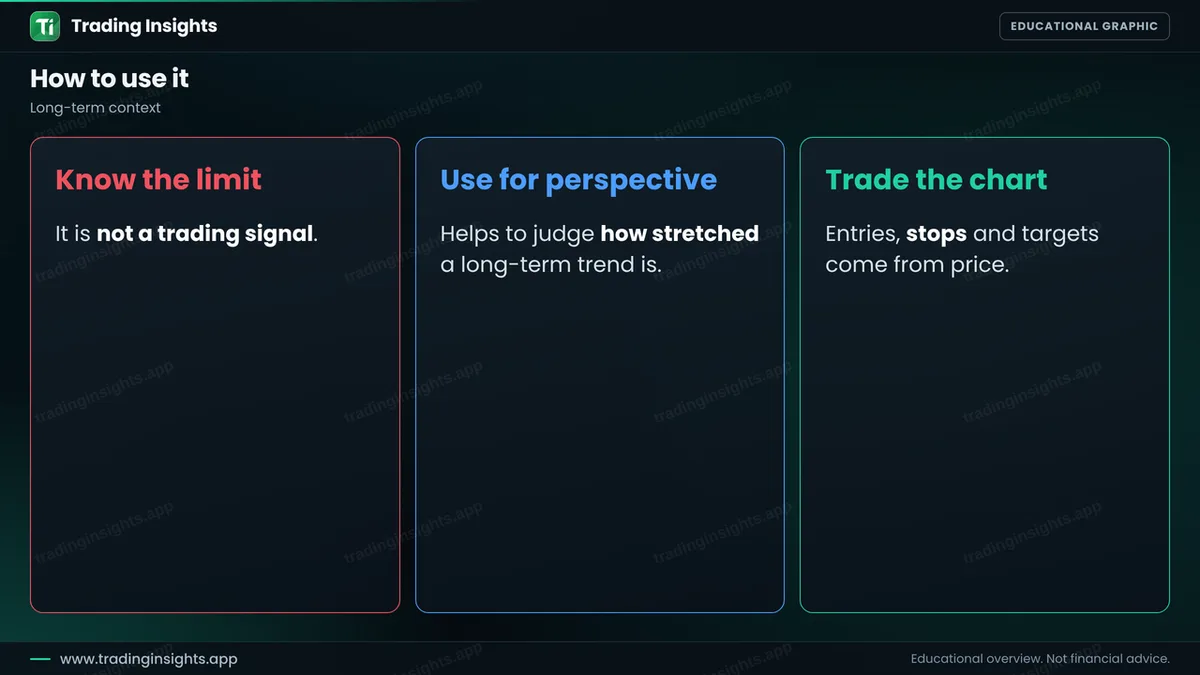
- Know the limit. PPP is a context tool, not a trading signal. Write that down.
- Find an estimate. Look at a published PPP estimate for the pair, and note that other sources may differ. Treat the result as a rough range, not a single number.
- Measure the gap. Compare the market rate with the estimate. A gap of a few percent is noise. A gap of 20% or more is a long-term warning.
- Set your bias for risk, not direction. If a currency is far above its PPP estimate, treat long positions with more caution and keep stops honest. If it is far below, treat shorts the same way.
- Trade the chart. Entries, stops and targets come from price. See stop loss and take profit and fundamental vs technical analysis.
What invalidates a PPP view
A PPP view is wrong, or at least useless for timing, when a stronger force overrides it. A wide interest-rate gap can keep a currency "expensive" for years. A shift in risk mood can send money into a currency regardless of its price level.
If two or three estimates disagree widely, treat the signal as weak.
Illustrative example: PPP as context for an H4 trade
Imagine EUR/USD has risen for five years and one PPP estimate says it is 15% above fair value. A long-term investor may decide to hold less of it, because the starting point is expensive. That is a decision on a time scale of years.
A short-term trader sees a bullish pullback setup on the H4 chart. She buys EUR/USD at 1.0850, places the stop at 1.0820 (30 pips) below a support, and sets the target at 1.0910 (60 pips), a 1:2 ratio. The PPP gap tells her to keep the position modest and not to hold it for months. It does not stop her from taking a setup that lasts days.
With a $10,000 account risking 1% ($100), the position size is $100 / (30 pips x $10 per pip per lot) = about 0.33 lot. A win pays about $200, and a loss costs about $100. You can check your own numbers with the position size calculator.
Another trader sells the euro only because it is "overvalued", with no stop. If it rises another 10%, he faces a large loss on a view that may be right in five years but is wrong now.
Common mistakes
- Using PPP as a short-term signal. It works over years, so a PPP gap says little about next week. Use the chart for timing.
- Shorting an "expensive" currency with no stop. Fair value can stay wrong for a long time. Always define where the idea is wrong.
- Treating one estimate as exact. Methods differ, so use a range and compare sources.
- Ignoring rates and capital flows. They often explain why the gap exists. Check them before you lean on PPP.
Frequently asked questions
What is purchasing power parity?
It is the idea that a basket of goods should cost the same everywhere after converting at the exchange rate. Price gaps hint that a currency may be over- or undervalued.
Can I trade on PPP?
Not on its own. It works over years and gives perspective on how stretched a trend is, not entry or exit points. Use it as background and take your trades from price.
Why does PPP not work in the short term?
Capital flows, interest rates and risk mood move currencies far more than goods prices over weeks or months. Many goods are also not traded across borders.
What is the Big Mac index?
It is an informal measure that compares the price of a burger in different countries as a simple version of PPP. It is useful as an illustration, not as a trading tool.
Your next step
Pick one pair you trade, find a published PPP estimate, and note whether the market rate is far above or below it. Write one line in your journal on what that means for risk over the coming years, then go back to your chart for the actual trade.
This is education, not financial advice. Trading carries risk, and no method guarantees results. The charts are illustrative and not real market data.


