
Risk-on and risk-off describe the mood of the market. In a risk-on mood, investors are confident and buy stocks and higher-yielding assets. In a risk-off mood, they are fearful and move money to safer ones, such as government bonds, gold and certain currencies. Because this mood moves many markets at once, one news event can push several currency pairs the same way within minutes.
What do risk-on and risk-off mean?
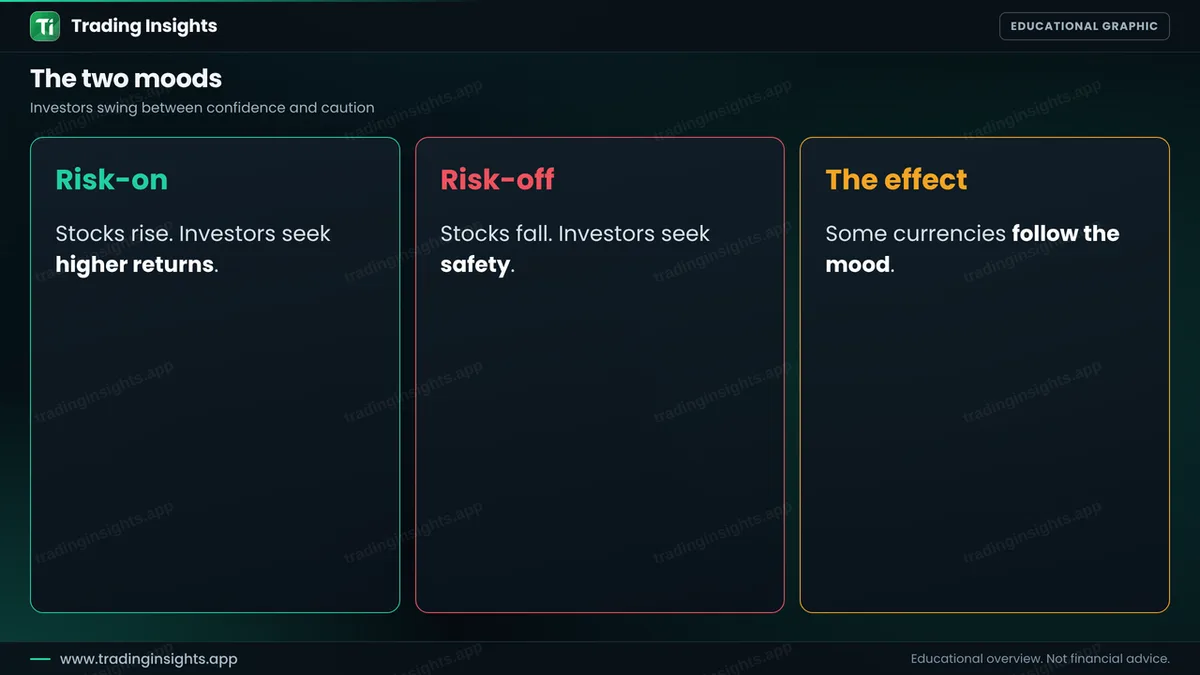
In a risk-on mood, investors expect growth. They buy stocks and assets with higher returns, and they often borrow in low-yield currencies to invest in high-yield ones. In a risk-off mood, they fear losses. They sell risky assets and look for safety.
The mood can change fast, sometimes within hours, after a shock or a surprise. That speed is why it matters for currency traders: a position that looked fine in the morning can be on the wrong side of the whole market by the afternoon. See safe-haven currencies for why some currencies attract money in fear.
How risk sentiment moves currencies
Some currencies tend to follow the mood. These are tendencies, not rules:
- Risk-on. The Australian, New Zealand and Canadian dollars often gain, since they are tied to growth and commodities. The yen and the franc often lose, as investors do not need safety. See commodity currencies.
- Risk-off. The yen, the franc and often the US dollar gain. The commodity currencies often fall.
- Cross pairs. AUD/JPY and NZD/JPY are classic mood pairs, because one side is a risk currency and the other a safe haven.
- Gold. It often rises in risk-off, but the link is not constant.
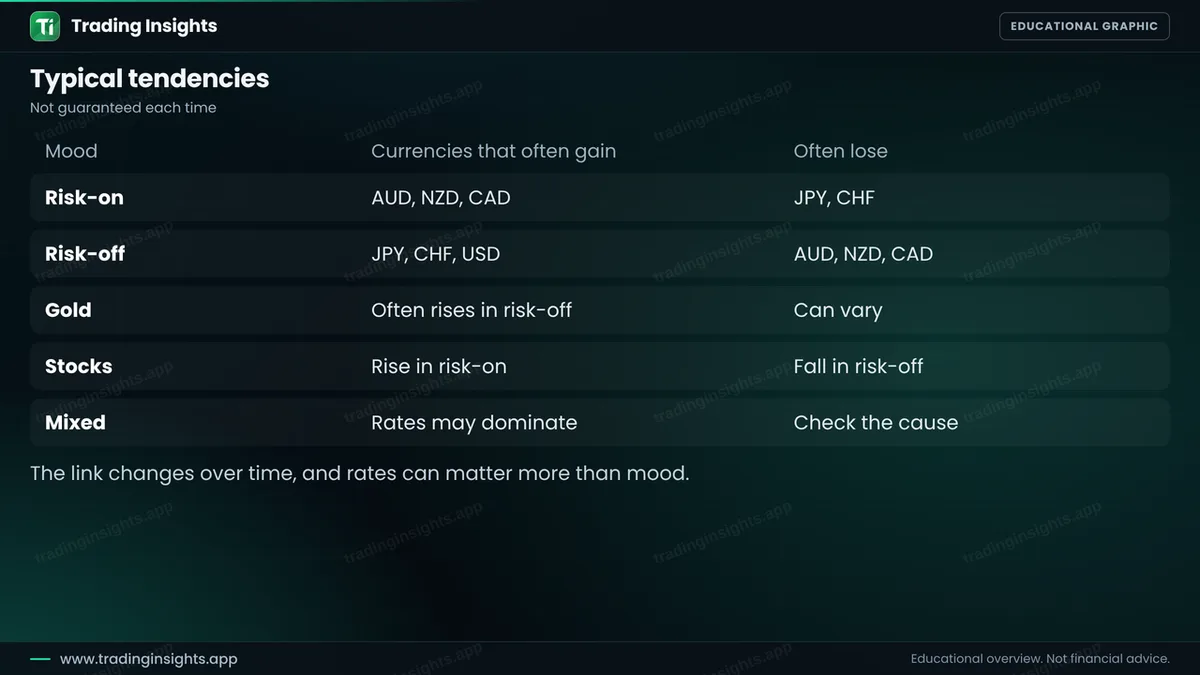
The links change over time. In some periods, interest rates and central bank decisions matter more than the mood, and a "safe" currency may fall even during fear. Use the table as a starting point for questions, not as a signal to trade.
How to read market sentiment step by step
You do not need special tools. A short routine is enough:
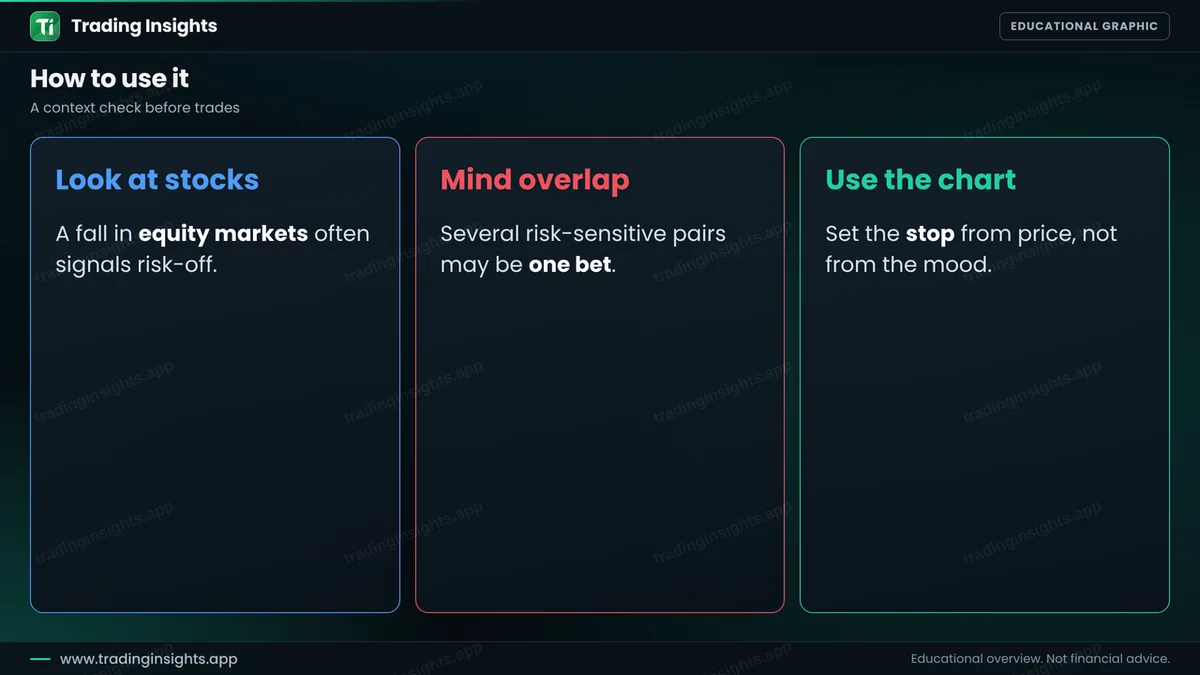
- Look at stock indices. A sharp fall in major equity indices often signals risk-off, and a steady climb suggests risk-on. Check them before you trade a risk-sensitive pair.
- Look at the safe havens. If the yen and the franc are rising against most currencies at once, fear is probably driving the move.
- Check the calendar. Mood shifts often come with news. See trading forex news.
- Count your exposure. List your open trades and ask which of them depend on the same mood.
- Use the chart. Entry, stop and target come from price levels, not from the mood.
The mood is a context check. It tells you which way the wind is blowing, but it does not give you an entry.
An illustrative example with numbers
A trader holds long AUD/USD and long NZD/USD, each with a 40-pip stop and 1% risk on a $10,000 account. She thinks of them as two trades. With a $10,000 account risking 1% ($100), the position size is $100 / (40 pips x $10 per pip per lot) = about 0.25 lot. A win of 80 pips pays about $200, and a loss costs about $100 for each pair.
A surprise banking scare hits stock markets and risk-off takes over. Both pairs fall together, and both stops are hit within the hour. The account is down about $200, or 2%, from what felt like two separate bets.
If she had seen the trades as one risk-on idea, she could have kept total risk at 1% by splitting it. With a $10,000 account risking $50 on each trade, the position size is $50 / (40 pips x $10 per pip per lot) = about 0.13 lot. The same event would have cost about $100 in total, half the damage. See currency correlation for how to spot overlap.
What invalidates a risk-on or risk-off view
The view is wrong, or at least weaker, when:
- Stocks and the usual safe havens move in the same direction, which breaks the pattern.
- A local driver, such as a central bank decision, dominates one currency.
- The mood reverses quickly after a headline, so yesterday's reading no longer applies.
- The chart shows price ignoring the mood, for example a "safe" currency falling in a sell-off.
If the market stops behaving as the mood suggests, trust the price and reduce size or stay out.
Common mistakes
- Ignoring stock markets when trading risk currencies. A fall in equities can drag AUD, NZD and CAD down. Check the indices first.
- Holding several pairs that share the same mood at full risk each. It is one bet in several trades. Split the risk between them.
- Assuming that the yen always rises in fear. Rates and the source of the fear can change the result. Confirm on the chart.
- Trading the mood without a chart setup and a stop. A story is not an entry. Wait for a level, then place a stop.
Frequently asked questions
What does risk-off mean?
It means investors are fearful, sell risky assets and move to safer ones, such as government bonds, gold and safe-haven currencies.
Which currencies are risk currencies?
The Australian, New Zealand and Canadian dollars are often seen as risk currencies, since they tend to rise when markets are confident.
Do safe havens always rise in risk-off?
Often, but not always. Interest rates and the cause of the fear can change the result, so check the chart as well.
How do I avoid doubling a risk bet?
Check how your pairs move together and treat pairs with the same driver as one idea. Then split your total risk across them, for example with the position size calculator.
Your next step
List your open or planned trades and mark each one as risk-on, risk-off or neutral. If three or more share the same label, cut the size so the total risk stays within your limit.
This is education, not financial advice. Trading carries risk, and market mood can reverse in minutes. The charts are illustrative and not real market data.


