
Hedging in forex means opening a second position that moves against the first, so that a loss on one is offset by a gain on the other. Businesses use it to protect against currency swings. In retail forex, traders use it to protect a trade through a risky period. It can be useful, but it is often misused as a way to avoid taking a loss, and it has its own costs.
What hedging means in forex
A direct hedge means holding a buy and a sell on the same pair at the same time, where the broker allows it. The two positions cancel each other's price movement, and the net exposure is close to zero.
An indirect hedge uses a different, related instrument: for example, a trader who is long EUR/USD might sell a pair that tends to move with it. This only works as far as the pairs stay correlated. See currency correlation.
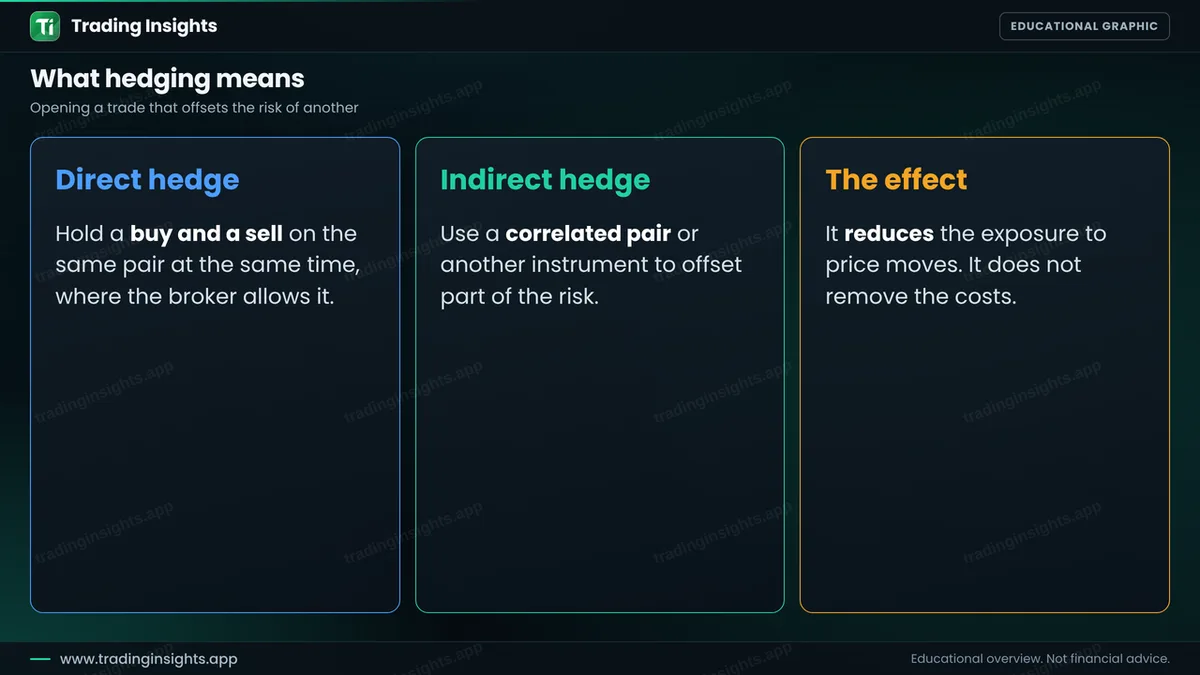
Not every broker or country allows direct hedging. Some regulators require that opposite positions on the same pair are netted. Check the rules of your broker before you plan a hedge.
Pros and cons of hedging
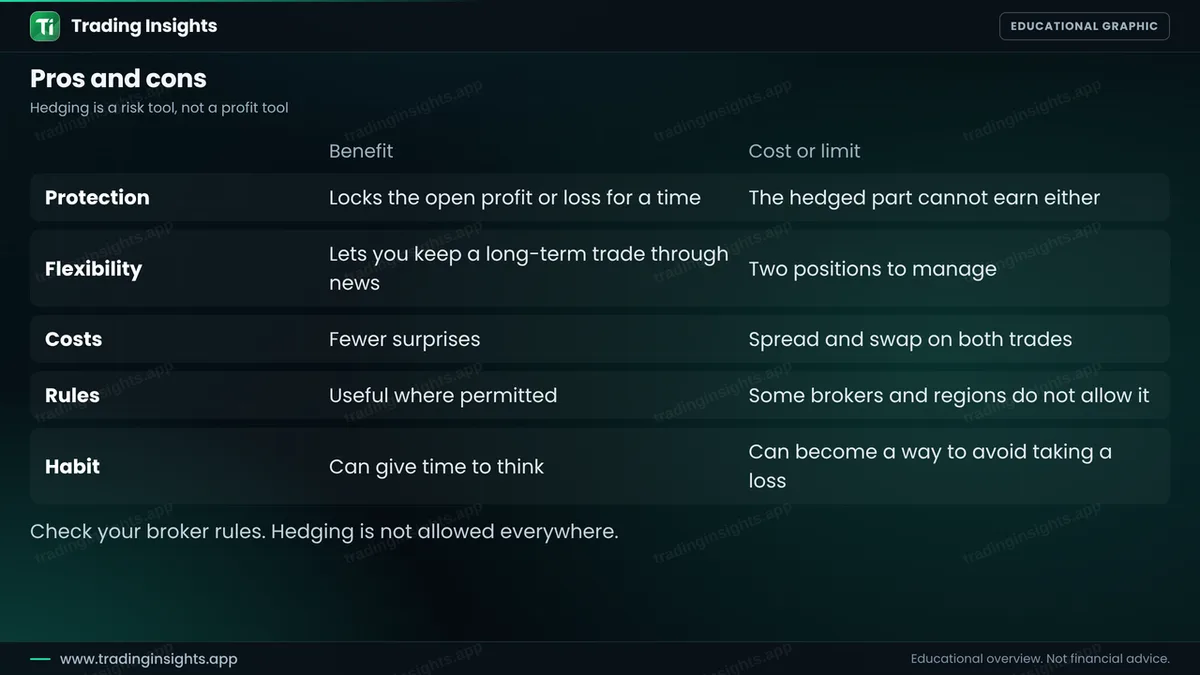
A hedge does not remove the risk, it freezes it. If you hold a buy that is in profit and hedge with a sell, the profit is locked for the moment, but you still have two open trades, two spreads, and swap on both.
When you close the hedge, you must decide which side to keep, and that is a new trading decision. A hedge also ties up margin. See margin call and stop out.
When hedging can help
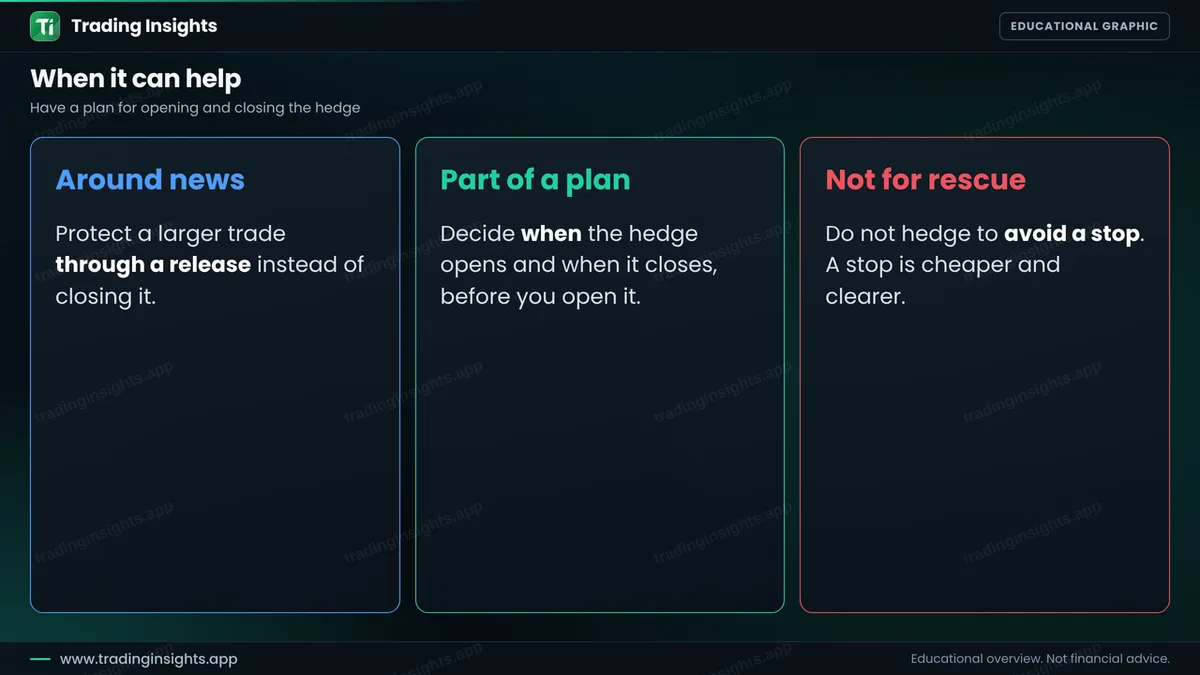
- Around news. If you hold a long-term trade and a major release is coming, a hedge can protect it while you wait, instead of closing and re-entering. See trading forex news.
- As part of a plan. Decide in advance when the hedge opens, when it closes and what you do after.
- Not for rescue. A hedge is not a reason to ignore a stop. Closing a losing trade is usually cheaper and clearer than keeping two trades open for weeks. See stop loss and take profit.
How to hedge a forex trade step by step
- Confirm your broker allows it. Ask whether opposite positions on the same pair are kept separate or netted.
- Write the plan first. State the reason, the time the hedge will close and the rule for which side stays.
- Match the size. Open the opposite position with the same lot size for a full hedge, or a smaller one for a partial hedge.
- Watch the margin. Check free margin so that two open trades do not cause a stop out.
- Close with a decision. When the risky period ends, close one side on purpose, and keep a stop on the side that remains.
Illustrative example: hedging through a rate decision
This is an illustrative example, not a real trade. You are long 0.30 lot on EUR/USD from 1.0800, now at 1.0900, a profit of 100 pips. At about $10 per pip per lot, that is 100 pips x $10 x 0.30 = $300.
A major rate decision is due in an hour, and you do not want to close the trade, because the trend is strong. You sell 0.30 lot on the same pair, where permitted. For the next hour, the net exposure is zero. After the news, you close the sell or the buy, depending on what happened.
The cost is the spread on the second trade and a small swap, perhaps a few dollars. With a spread of 1 pip, the extra spread is 1 pip x $10 x 0.30 = $3.
The alternative was to move the stop to break-even, which is free. See trailing and break-even stops. With a $10,000 account, a stop at break-even risks nothing of the open profit except the chance of being stopped out by a spike. For many traders, that is simpler and just as protective.
Better questions before you hedge
- Would a stop loss or a smaller size do the same job at a lower cost?
- Does my broker allow it, and how is margin handled?
- When will I close it, and which side will I keep?
- Am I hedging because of a plan, or because I do not want to accept a loss?
If you cannot answer all four, close the trade or use a stop.
Common mistakes
- Hedging a losing trade and then forgetting about it. Two open trades keep paying costs. Set a closing date, or just exit the loser.
- Assuming a correlated pair will always move as expected. Correlation changes. Treat an indirect hedge as a partial offset only.
- Ignoring spread and swap on both positions. The costs add up over days. Count them before you open the hedge.
- Using a hedge as an excuse to avoid a stop. A hedge delays the decision. Accept the loss when your plan says so.
Frequently asked questions
What is hedging in forex?
It means opening a position that offsets the risk of another position, so that losses on one are balanced by gains on the other. It reduces exposure but does not remove costs.
Is hedging allowed with every broker?
No. Some brokers and regulators do not allow opposite positions on the same pair. Check your broker rules before you rely on it.
Does hedging remove risk?
It reduces or freezes the exposure, but it adds costs and the need to manage two positions. You also face the decision of which side to close.
Is a hedge better than a stop loss?
Not usually. A stop loss is simpler and cheaper. A hedge can help in special cases, such as protecting a trade through a news event.
Your next step
Look at your last five trades and ask, for each one, whether a stop, a smaller size or a break-even move would have done the job of a hedge at lower cost. Only plan a hedge when the answer is no.
This is education, not financial advice. Trading carries risk, and hedging adds costs and complexity. The charts are illustrative and not real market data.


