
A forex VPS is a virtual private server, a remote computer in a data centre that stays on all day, which some traders rent to run their platform without relying on a home computer or internet connection. Do you need one? Usually not. Manual traders with a few trades a day can get by with a reliable computer, while people who run expert advisors (EAs) or care about execution speed may benefit.
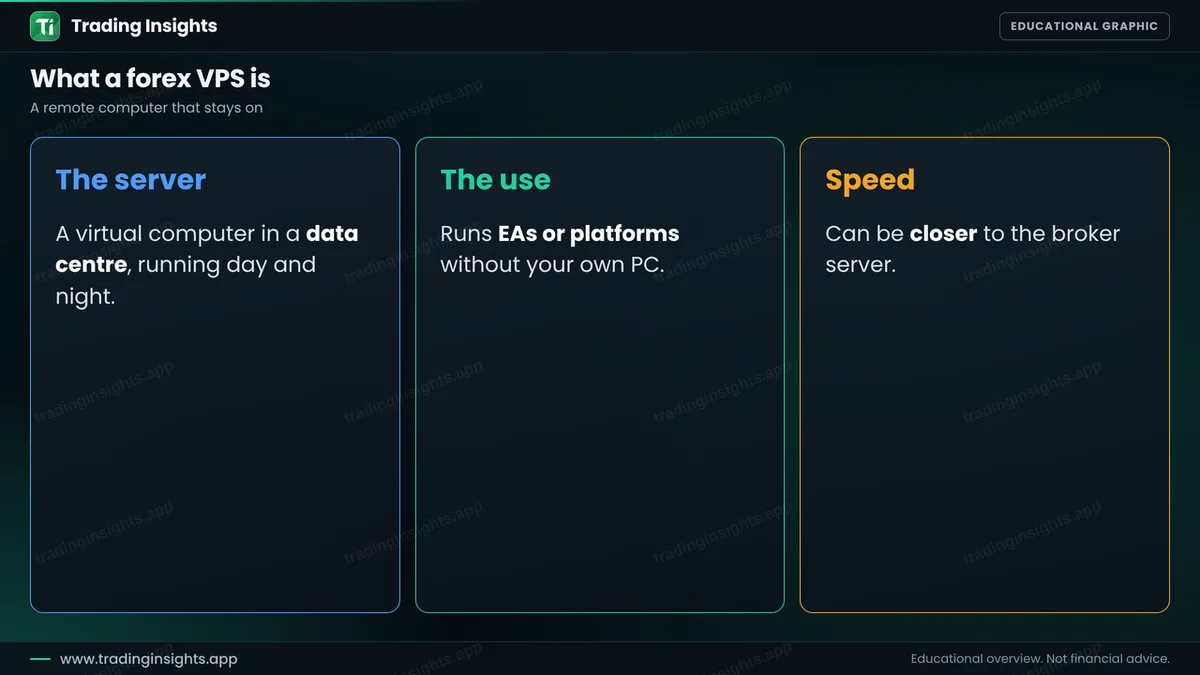
What a forex VPS is
You connect to the VPS from your own computer or phone, and the platform keeps running there even when your device is off. It behaves like a second computer you control remotely.
A VPS in a data centre close to your broker can also reduce the time orders take to reach the server, which is called latency. See MT4 vs MT5 vs cTrader for platforms that run on a VPS.
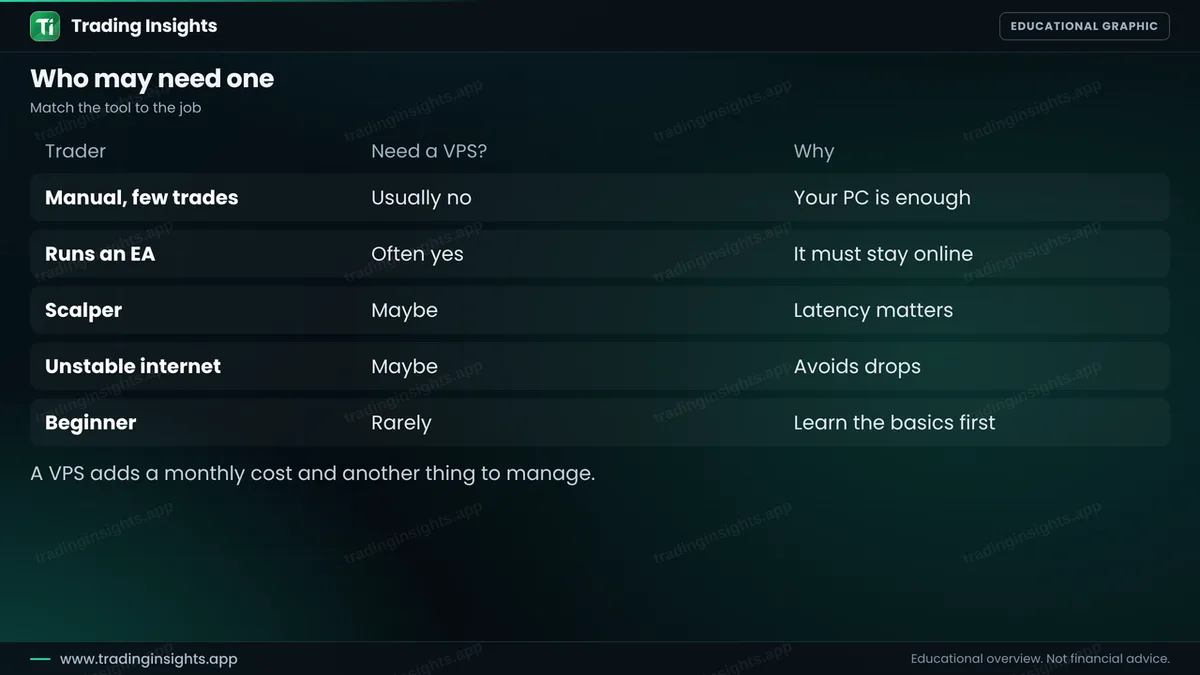
Who needs a forex VPS
If you trade by hand a few times a day, your own computer is usually enough. If you run an EA that must stay online, a VPS keeps it running. Scalpers who care about fill speed may also use one. See slippage.
Traders with an unstable connection can use it to avoid drops that leave a trade unmanaged. Beginners rarely need one, because the first job is to learn a tested method on a demo account.
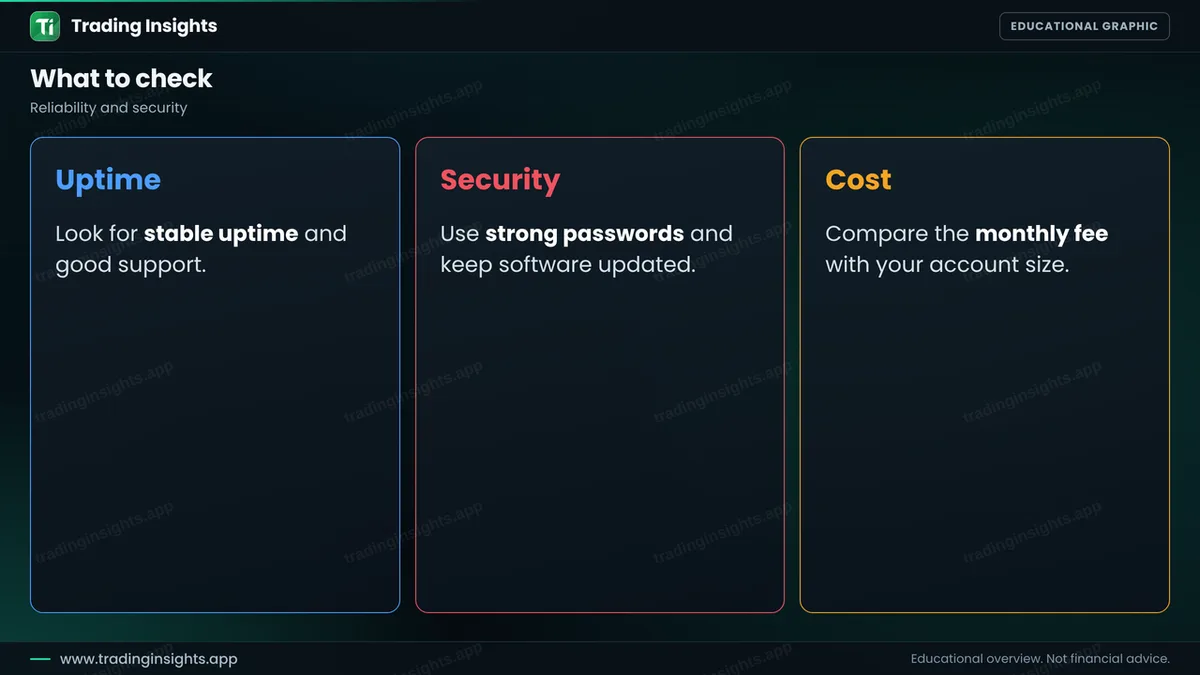
How to choose a forex VPS
Look at the provider's uptime record, the server location, and the quality of support. Use strong passwords, since the server holds your trading account. Keep the operating system and platform updated.
Compare the monthly fee with your account size. Some brokers offer a free VPS for clients with a certain balance or volume, so check your broker. Terms vary by broker.
Illustrative example: is the fee worth it?
This is an illustrative example. Suppose a VPS costs $20 a month. On a $500 account, that is 4% of the account every month before a single trade, which is a heavy drag. On a $10,000 account, the same fee is 0.2% a month, which is far easier to justify if you run an EA.
Now picture an EA on EUR/USD that risks 1% per trade with a 30-pip stop. With a $10,000 account risking 1% ($100), the position size is $100 / (30 pips x $10 per pip per lot) = about 0.33 lot. A win of 60 pips pays about $200, and a loss costs about $100.
A VPS keeps the EA running so it can manage the trade, but it does not change the risk or the odds. The stop and the size still do that job.
A simple decision
- List your needs. Do you run an EA, scalp or have an unstable connection?
- Test on a demo. See demo account vs live account.
- Compare costs with your account size and trading costs. See forex trading costs.
- Secure it with strong passwords and updates.
- Keep stops in place. A VPS does not remove the need for risk rules.
Do you need a VPS for an EA?
An EA only trades while the platform is running and connected. If your PC sleeps, restarts for an update or loses internet, the EA stops and open trades may go unmanaged. A VPS removes that gap.
Even so, test the EA on a demo account first, and set a daily loss limit and a stop on every trade. A server that runs 24 hours a day also runs a flawed strategy 24 hours a day. You can check your sizing with the position size calculator.
Does a VPS make trading faster?
It can reduce latency if the server is near your broker's, and that matters mostly to scalpers who aim for small gains per trade. For a swing trader holding for days, a few milliseconds make no practical difference.
A VPS does not fix a wide spread, a slow broker or a weak strategy. Treat it as plumbing, not as an edge.
Common mistakes
- Paying for a VPS before having a tested strategy. The fee is a cost with no benefit yet. Test on a demo first and add a VPS only when you have a clear need.
- Choosing a provider far from the broker server. The latency benefit is lost. Ask where your broker's servers sit and pick a nearby location.
- Using a weak password on the remote connection. The server holds your account. Use a long unique password and keep updates on.
- Leaving an EA running without a stop or a daily limit. It can keep losing while you sleep. Set both before you go live.
Frequently asked questions
What is a forex VPS?
A remote virtual computer that stays online, used to run a trading platform or EA without your own PC.
Do I need a VPS to trade manually?
Usually not. A reliable home computer and connection is often enough, and you can watch the platform yourself.
Does a VPS make trades faster?
It can reduce latency if located near the broker server, but the gain matters mainly for scalpers.
Is a VPS safe?
It can be, if you use strong passwords, updates and a reputable provider. Never share the login, and do not reuse passwords.
Your next step
Write down what you would run on a VPS and what it would cost per month as a percentage of your account. If you cannot name a clear need, such as an EA that must stay online, keep trading from your own computer for now. Add a link to the glossary to your notes for terms like latency and slippage.
This is education, not financial advice. Trading carries risk, and a VPS does not reduce market risk. The charts are illustrative and not real market data.


