
Decision fatigue in trading is the drop in judgment that can follow many decisions in a row, and the best fix is to make fewer decisions live. Trading means choosing again and again: which pair, which level, enter or wait, move the stop or leave it. After many of these, quality can slip. The result is not dramatic. It is rushed entries, skipped checks and rules that quietly get broken late in the day.
What decision fatigue is and how it shows up
The research on how strong this effect is has been debated, so do not treat it as a law. But most traders know the feeling: after hours of watching charts, discipline fades.
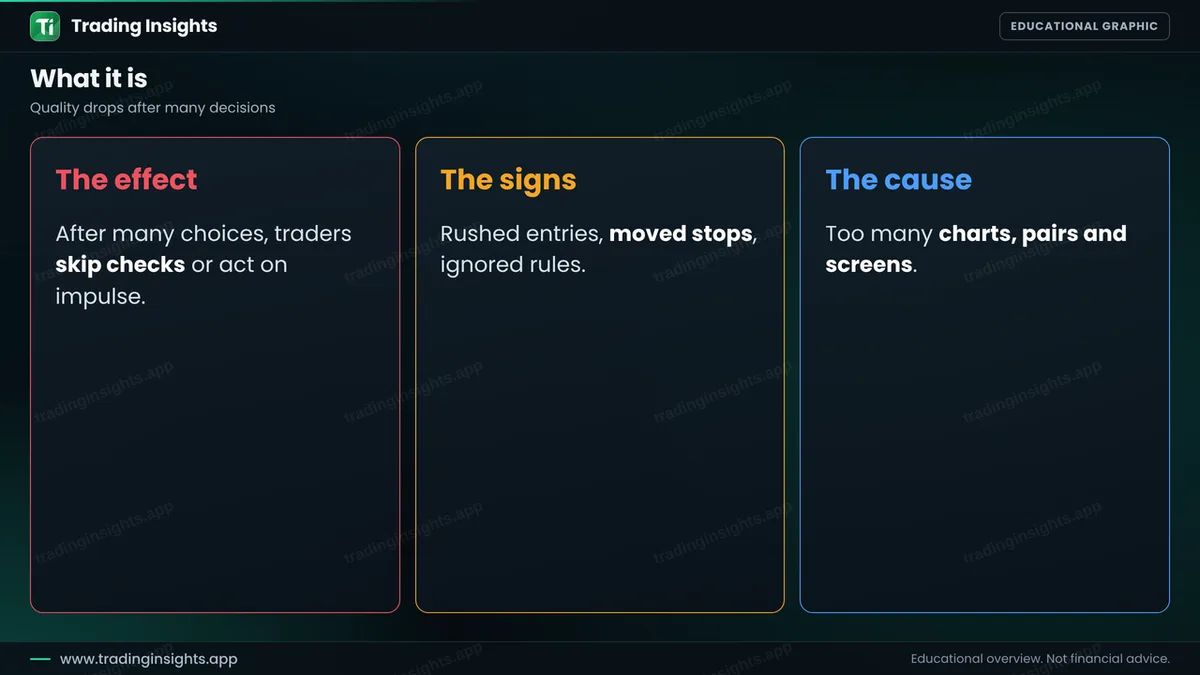
Common signs include trades that were not in the plan, stops moved without a reason, and revenge trades. A trader who followed every rule at 9 am may break three of them by 3 pm. See overtrading in forex and revenge trading.
What causes decision fatigue in trading
The cause is usually load. Too many pairs, too many timeframes, too many screens and too many open choices all demand attention. Every flicker of price asks a small question: is this a setup, should I act, should I wait?
Unplanned decisions are the expensive ones. A choice made in advance, with a clear rule, costs almost nothing in the moment. A choice made on the fly, with money moving, costs much more.
How to reduce decision fatigue
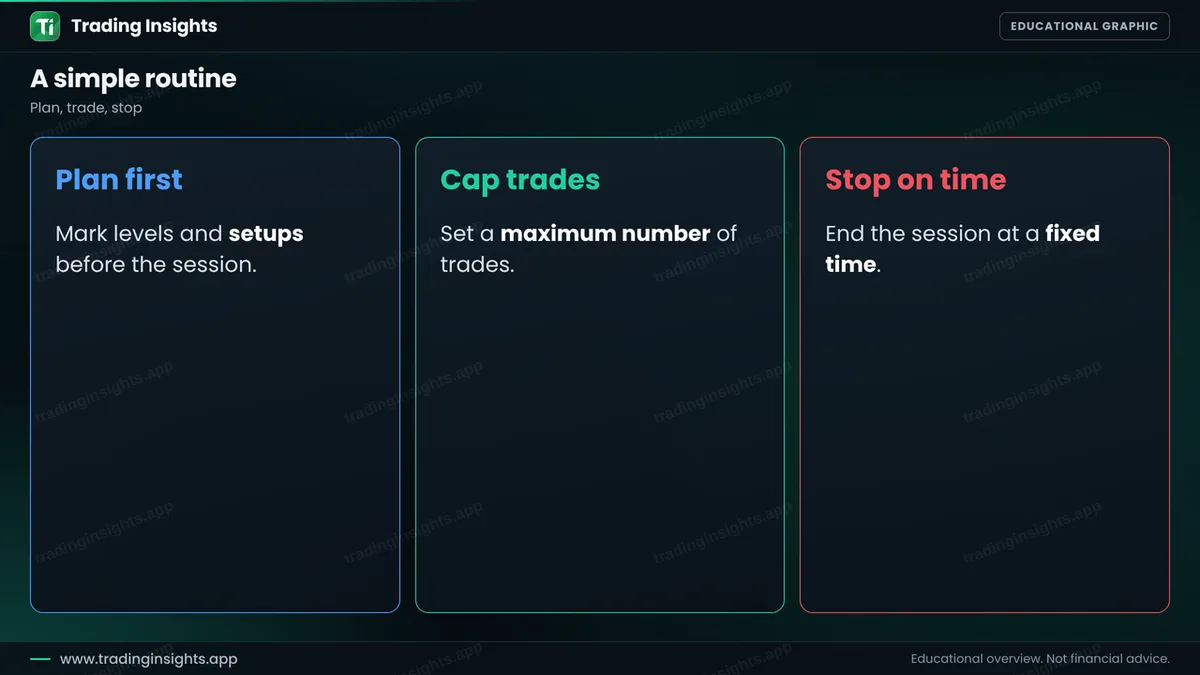
The fix is to make fewer decisions live. Trade two to four pairs, not twenty. Decide levels and setups before the session. Set alerts at the prices you care about, instead of staring at the chart.
A pre-trade checklist turns a judgement into a yes or no. For a daily structure, see a daily forex trading routine.
A simple routine to protect your judgment, step by step
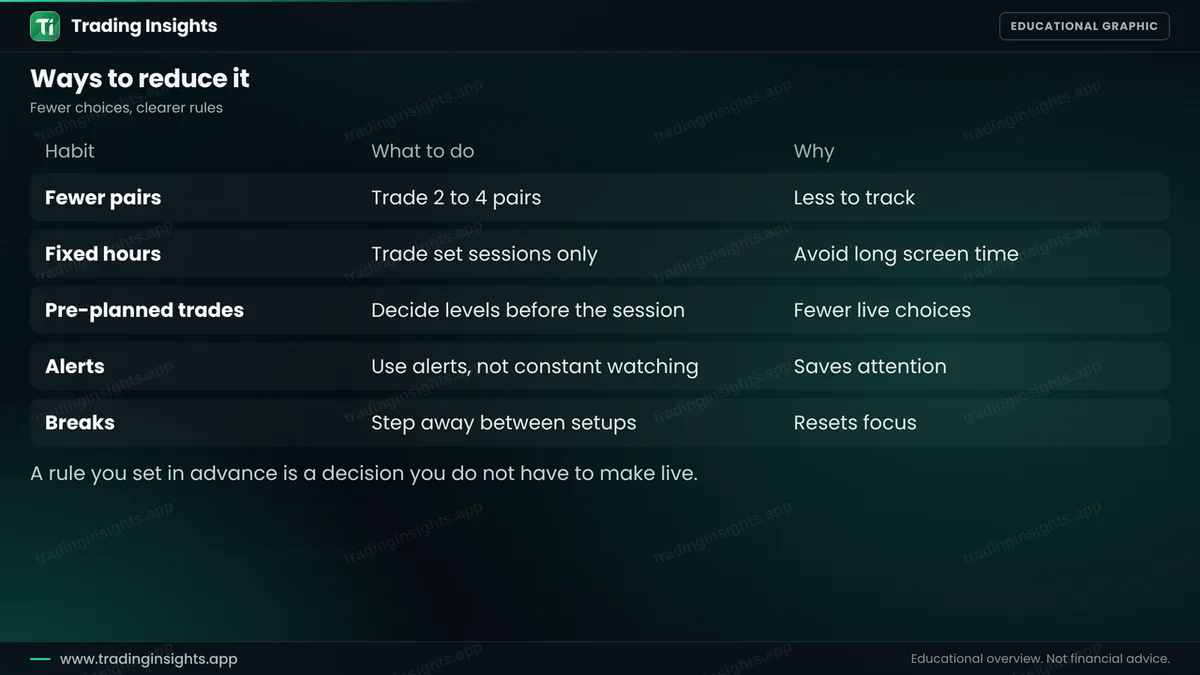
- Plan first. Mark levels and possible setups before the session begins.
- Limit the list. Watch only a few pairs.
- Cap the trades. For example, a maximum of three trades a day.
- Stop on time. End the session at a fixed time, or after a daily loss. See the daily loss limit.
- Review later. Look back in the journal, not in the heat of the moment.
Set the stop and target before the session
The stop and target are the decisions most likely to be changed under pressure, so fix them in advance. Place the stop where the setup is proven wrong, work out the position size from that distance, and write both down. Then the only live decision is whether price reached your level.
Pre-set orders and alerts help here. If the trade is already defined, there is less room to improvise.
Signs that your judgment has faded
Watch for these warning signs: you take a trade you would have skipped in the morning, you widen a stop, you stop writing notes, or you feel irritated by small moves. Any one of them is a cue to stop for the day, not to push harder.
Illustrative example: one planned setup
A trader plans one setup in advance on EUR/USD, with a 30-pip stop and a 60-pip target. With a $10,000 account risking 1% ($100), the position size is $100 / (30 pips x $10 per pip per lot) = about 0.33 lot. A win pays about $200, and a loss costs about $100.
Because the plan is set before the session, the trader does not need to decide on the stop or the size under pressure. An alert at the entry level lets them step away until it triggers. You can run the same numbers in the position size calculator.
Common mistakes
- Watching every pair and every timeframe. More charts mean more decisions. Trim the list to a few pairs.
- Trading for hours without a break. Attention fades with long sessions. Schedule breaks away from the screen.
- Making new rules in the middle of a session. Rules written under stress tend to be poor ones. Change rules only during review.
- Continuing after a clear sign of tiredness. Pushing on raises the chance of an avoidable loss. End the session.
If trading leaves you exhausted or stressed on a regular basis, consider shortening your hours or talking to a professional about it.
Frequently asked questions
What is decision fatigue?
It is a drop in the quality of decisions after making many of them, often showing as rushed or impulsive choices. In trading it tends to appear late in long sessions.
Is decision fatigue proven?
The evidence is debated, but many traders notice that discipline fades after long sessions. Whatever the exact science, planning ahead costs little and helps.
How many pairs should I watch?
Many traders find two to four manageable. Choose a number you can follow with care.
How do alerts help?
They let you step away from the screen and act only when price reaches a level in your plan. That removes the constant small decisions that wear you down.
Your next step
Tomorrow, before you open a chart, write down one setup, the entry level, the stop, the target and the lot size. Set an alert and close the platform until it fires. Note at the end of the day how the session felt compared with a normal one.
This is education, not financial advice. Trading carries risk, and no method guarantees results. This article is not medical advice, and if stress affects your health, speak to a professional. The charts are illustrative and not real market data.


