
Oil moves some currencies more than others: the Canadian dollar and the Norwegian krone tend to rise and fall with crude because both countries export a lot of it, while the Japanese yen can come under pressure when oil gets expensive because Japan imports almost all it uses. For forex traders, oil is best used as context for a trade, not as a signal on its own. This article covers the main links, the pairs involved and how to use crude without over-trusting it.
Why oil prices matter to currencies
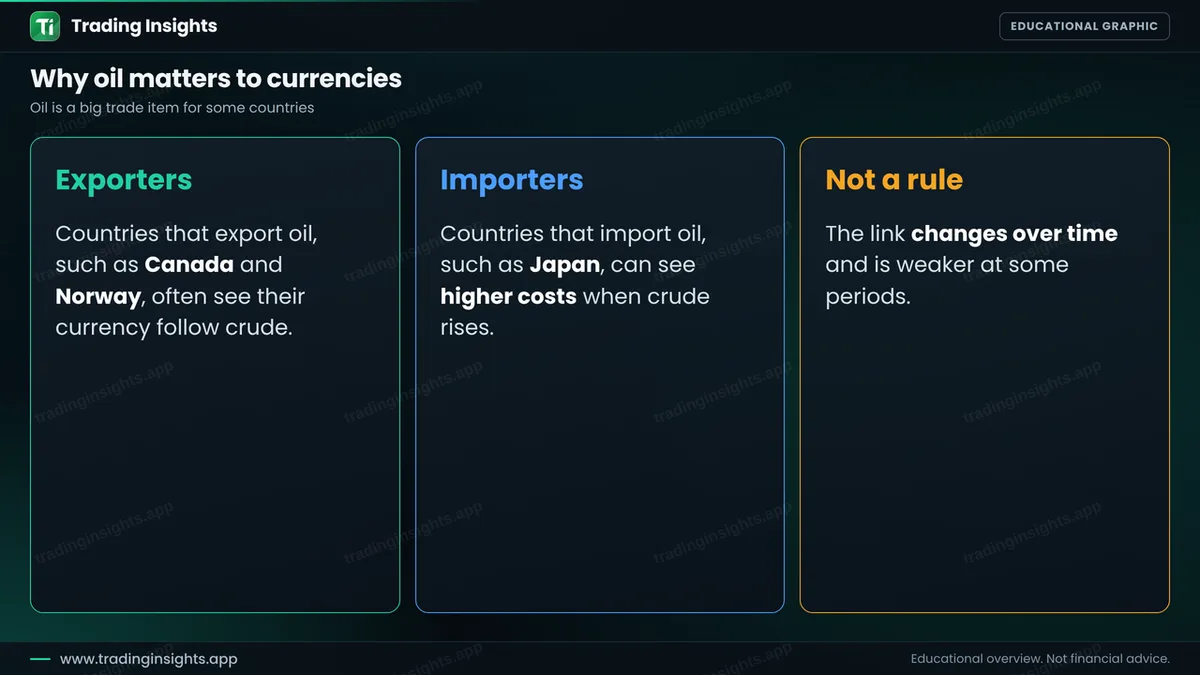
Countries that export a lot of oil earn more foreign currency when the price rises, which can support their currency. Countries that import oil pay more, which can weigh on theirs. This is part of commodity currencies and of what moves forex prices.
The link is not fixed. In some periods the dollar, interest rates or risk mood matter more than oil, and a currency can ignore crude for months. Treat the relationship as a tendency that comes and goes.
Which currency pairs follow oil?
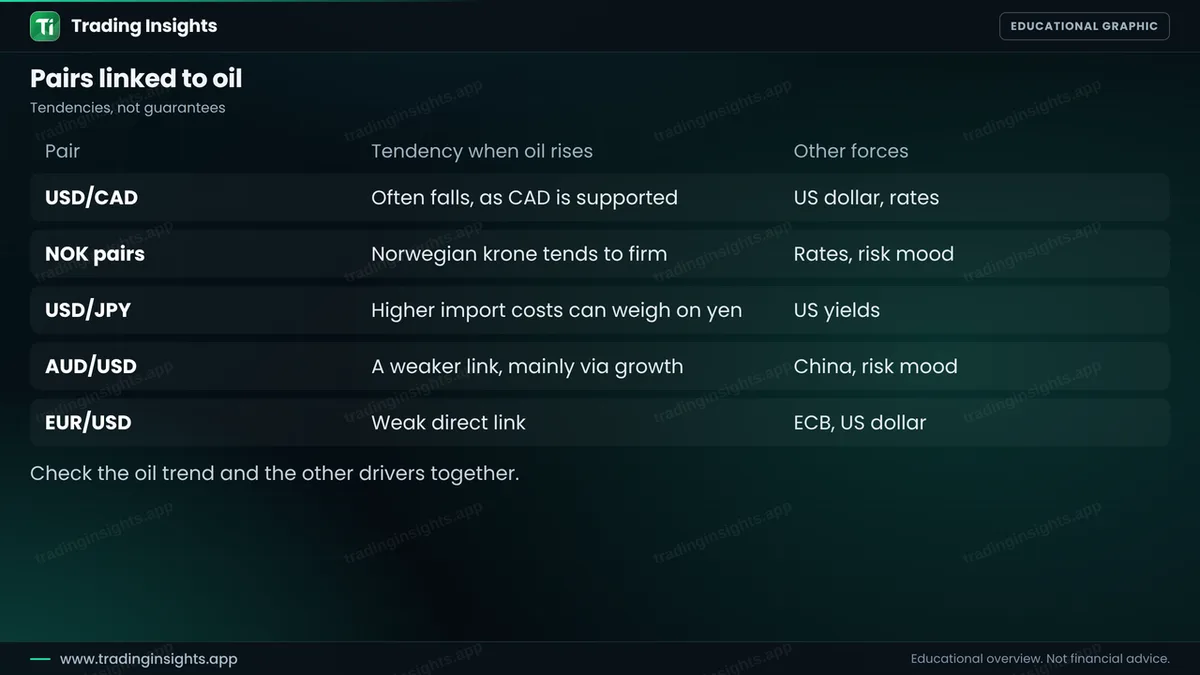
USD/CAD is the pair most traders connect with oil. When crude rises, the Canadian dollar often firms and USD/CAD often falls. See the USD/CAD guide.
Norwegian krone pairs also follow crude in many periods, since oil and gas are a major part of Norway's exports.
USD/JPY can be affected the other way. Japan imports almost all its oil, so higher prices raise its import bill and can weigh on the yen. See the USD/JPY guide.
AUD/USD has a weaker link, and EUR/USD has little direct link, though energy prices can still matter for Europe.
Why the oil link is not reliable
Oil is priced in US dollars, so a strong dollar can weigh on oil and on CAD together. Interest rate decisions can overpower the oil effect. Risk-off moves can push both oil and commodity currencies down at once, even when the oil supply story has not changed. If you only watch oil, you will miss these other drivers.
Oil events to know about
Weekly US inventory reports and OPEC meetings can move crude quickly, and the move can spill over into CAD and NOK within minutes. Plan around them, and do not enter a trade seconds before a release. See how to trade forex news.
How to use oil as context for a trade
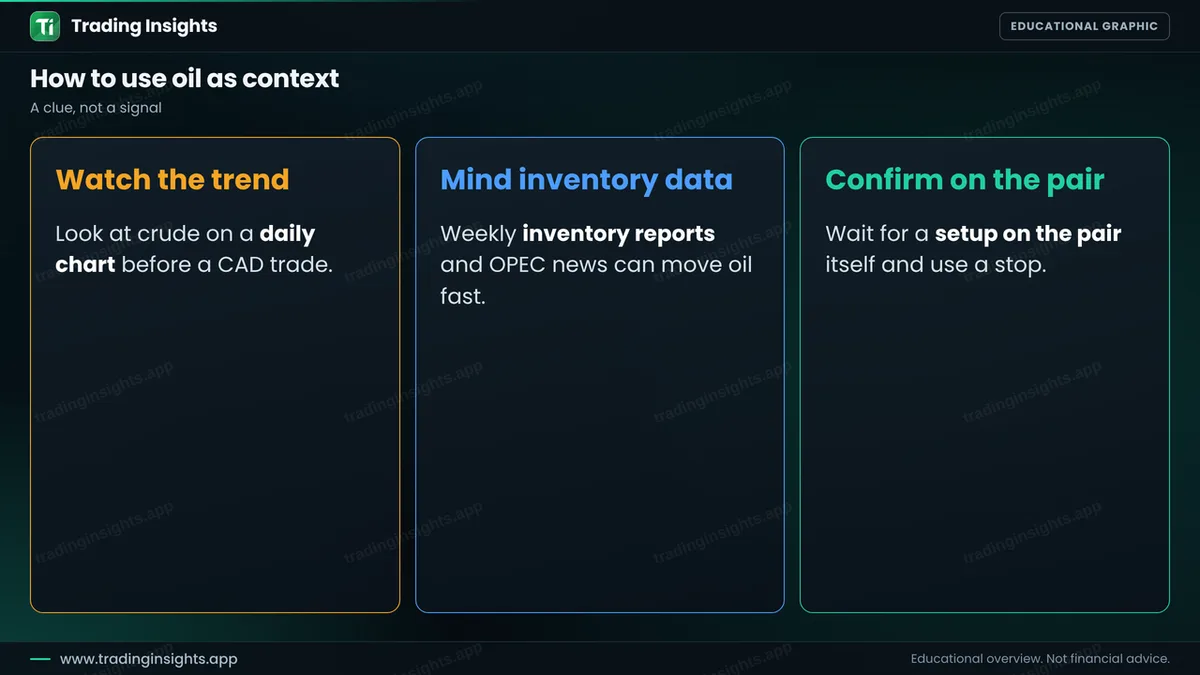
- Watch the trend. Look at crude on the daily chart before a CAD or NOK trade.
- Mind the events. Inventory data and OPEC news can move oil quickly.
- Confirm on the pair. Wait for a setup on the currency pair itself, with a stop. See top-down analysis.
- Check the dollar. If the dollar is the main mover, oil may not matter much that day.
Illustrative example: oil supports a USD/CAD sell
This is an illustrative example, not a real trade. Crude has been rising for a month, and USD/CAD is in a downtrend. Price pulls back to resistance at 1.3650 and prints a bearish candle that closes below the level. The oil trend supports the view, so a trader sells at 1.3650 with a stop above the resistance at 1.3690 (40 pips) and a target at 1.3570 (80 pips), a 1 to 2 reward-to-risk ratio.
With a $10,000 account risking 1% ($100), the position size is $100 / (40 pips x $10 per pip per lot) = about 0.25 lot. A win pays about $200, and a loss costs about $100. The exact pip value for USD/CAD differs a little from $10 depending on the exchange rate, so use a calculator for the real figure.
If crude had been falling while the pair pulled back, the picture would be mixed, and the trader would skip the trade or cut the size.
A quick daily routine for oil-linked pairs
Before you trade USD/CAD or a krone pair, spend two minutes on three questions. Is crude trending up, down or sideways on the daily chart? Is the dollar strong or weak across the board? Is there an oil event, such as an inventory report or an OPEC meeting, in the next few hours? If crude and the dollar point in the same direction as your setup, the trade has support. If they disagree, cut the size or wait.
Common mistakes
- Assuming that oil always leads the currency. Sometimes the currency moves first or ignores crude. Confirm on the pair's own chart.
- Ignoring the dollar and interest rates. These can outweigh oil. Check them before you trade.
- Trading around inventory data without a plan. Spreads widen and prices jump. Wait for the market to settle.
- Using oil without a chart setup and a stop. An idea about oil is not an entry. Use a level and define your risk.
Frequently asked questions
Which currencies follow oil?
The Canadian dollar and the Norwegian krone are the most common examples, as both countries export a lot of oil.
Does the yen fall when oil rises?
It can, because Japan imports oil and pays more, but other drivers such as yields and risk mood also matter.
Is oil a good trading signal?
No. It is context. Use it with a chart setup and a stop.
Why does the link change?
The dollar, interest rates, risk mood and policy can matter more in some periods.
Your next step
Put a daily crude chart next to USD/CAD for the last three months and note when they moved together and when they did not. That record will show you how much weight oil deserves right now.
This is education, not financial advice. Trading carries risk, and oil-linked moves can reverse quickly. The charts are illustrative and not real market data.


