
For most traders, a normal stop order placed in the market is the best everyday protection, a stop that carries a price guarantee is worth considering before major events if your broker offers it, and a mental stop is the weakest choice. The difference comes down to what happens when price moves fast or gaps through your level. For the basics of stops and targets, see stop loss and take profit.
Normal stop, price-guarantee stop and mental stop explained
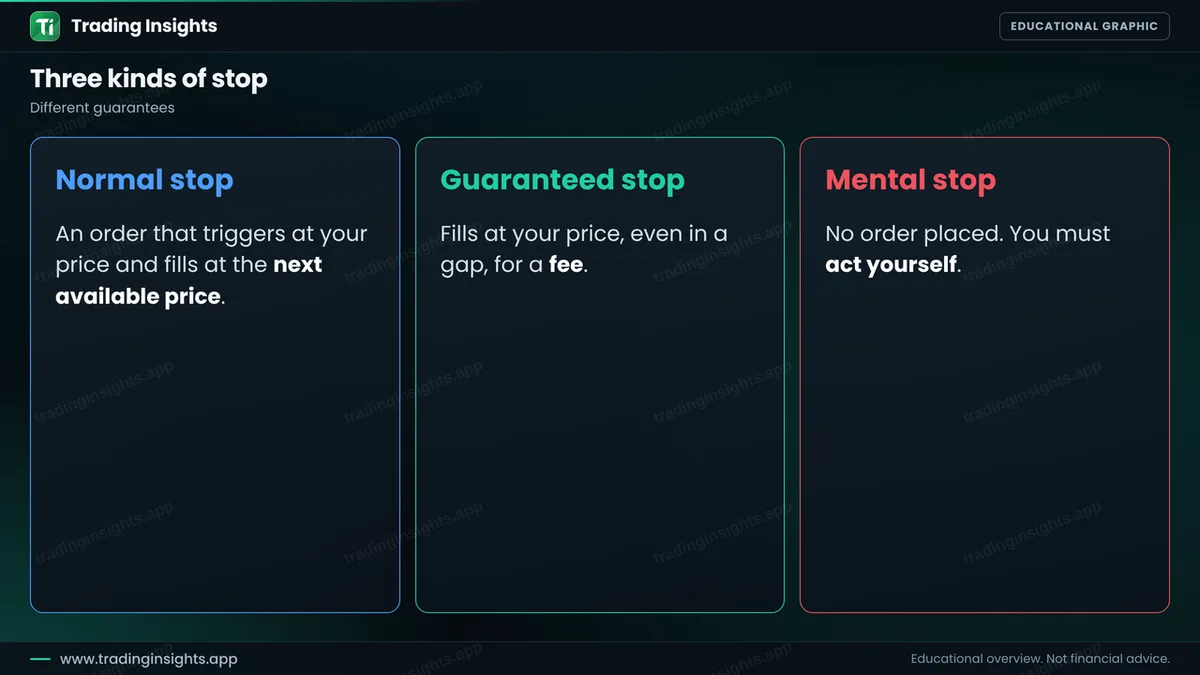
A normal stop is an order that waits at your level. When price touches it, it becomes a market order and fills at the next available price. In calm conditions that is very close to your level. In a gap or a fast move, it can be much worse.
A stop with a price guarantee closes the trade at exactly your level, even if the market jumps over it. Some brokers offer this for a fee, a wider spread, or both, and often with conditions such as a minimum distance from the current price.
A mental stop is not an order at all. You decide on a level and plan to close the trade by hand if price reaches it. The broker knows nothing about it.
Which stop protects you best?
| Feature | Normal stop | Price-guarantee stop | Mental stop |
|---|---|---|---|
| Sits with the broker | Yes | Yes | No |
| Fill price in a gap | Next available, may be worse | Your level | Whatever you manage |
| Extra cost | None | Fee or wider spread, varies | None |
| Depends on your reaction | No | No | Completely |
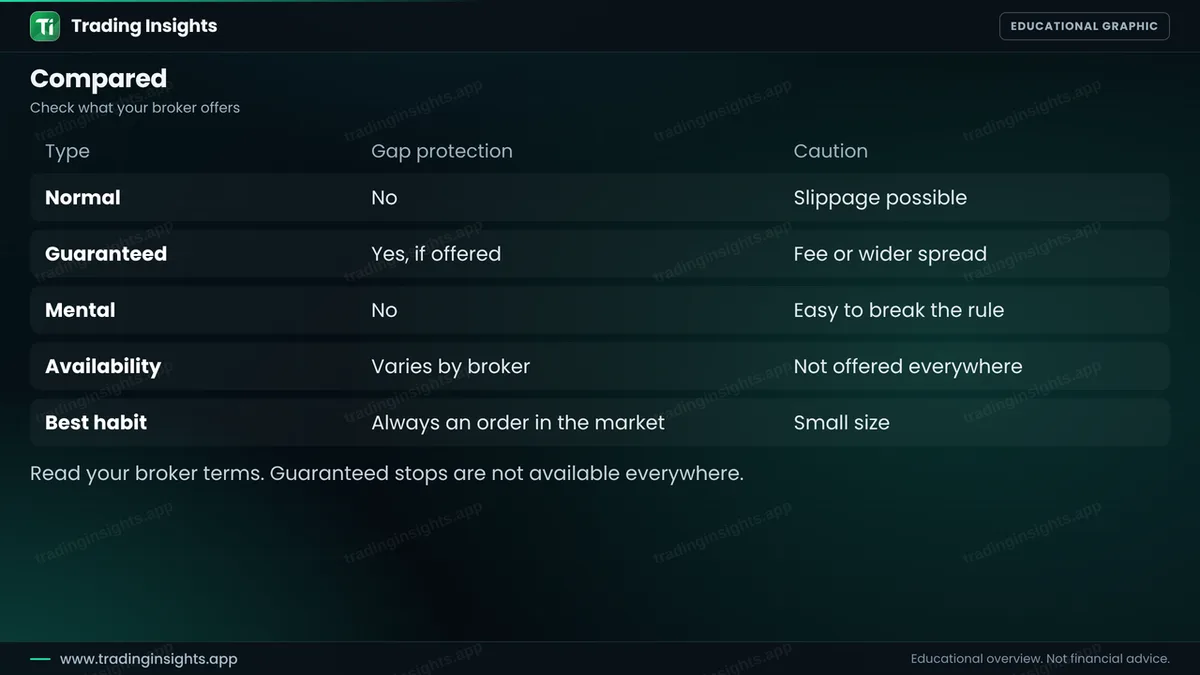
A normal stop gives no protection against slippage. See slippage for what causes it and how to reduce it. The price-guarantee version protects the exit price, but it costs more, is not offered everywhere and has terms you must read.
The mental stop is the weakest because it fails in exactly the moment you need it. When price hits the level, hope and hesitation are strongest, and the chart is moving fast. You may move the level, wait for one more candle or simply be away from the screen.
How to choose and place the right stop
Use this as a simple rule set:
- Check which stop types your broker offers, and what each one costs.
- Place a real stop order as soon as you enter, every time.
- Put the stop where the trade idea is wrong, such as beyond a swing low or high, not where the loss feels comfortable.
- Size the position from the stop distance, so the loss is a fixed percentage of the account.
- Before major scheduled events or weekends, decide whether to reduce size, stay out or use a price-guarantee stop, if available and the cost is acceptable.
- Never move the stop further away once the trade is open.
The stop type changes the exit price in a gap. Position size is what limits the damage. See how to calculate position size and use the position size calculator before you enter.
An illustrative example with numbers
A trader buys EUR/USD with a 30-pip stop and risks 1% of a $10,000 account. With a $10,000 account risking 1% ($100), the position size is $100 / (30 pips x $10 per pip per lot) = about 0.33 lot. A win pays about $200, and a loss costs about $100.
A news gap fills the normal stop 20 pips beyond the level, so the trade closes 50 pips from entry. The loss is about 0.33 lot x 50 pips x $10 = about $167 instead of $100, which is 1.7% of the account instead of 1%.
A stop with a price guarantee would have limited the loss to about $100, though the trader paid a fee for it. A mental stop would have depended on the trader acting in time, and it could have ended with a bigger loss than the normal stop.
What can go wrong with each type
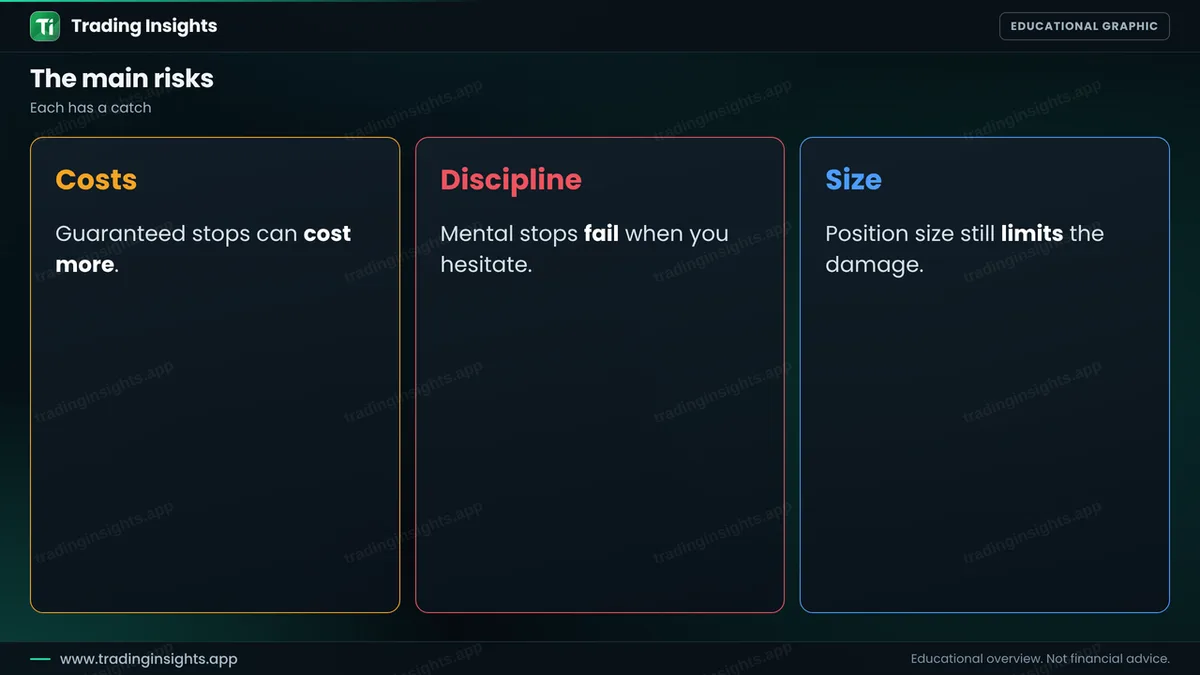
No type removes risk. A normal stop can slip. A price-guarantee stop adds a cost that eats into every trade where you use it, so using it on every position can turn into a drag. Brokers may also set conditions on when it applies, so read the terms.
A mental stop can fail completely if you freeze, get distracted or lose your connection. Even a normal stop depends on your platform and broker working, so see low-liquidity periods for the times when fills are worst.
Common mistakes
- Trading with a mental stop. It depends on you acting in a stressful moment. Place a real order every time.
- Assuming a normal stop always fills at its price. It does not, especially in gaps and news spikes. Plan your size for the worst case, not the average one.
- Ignoring the cost of a price-guarantee stop. The fee adds up over many trades. Use it selectively around events.
- Using full size through major news. A gap can turn a planned 1% loss into a larger one. Reduce size or stay out.
Frequently asked questions
What is a stop with a price guarantee?
It is a stop that closes your trade at your chosen price even when the market gaps past it. Some brokers offer it for a fee or a wider spread.
Does a normal stop always fill at my price?
No. It triggers at your price but fills at the next available price, which can be worse in a fast market or a gap.
Is a mental stop a good idea?
Rarely. It depends on you acting at the right moment, and emotions or distance from the screen can get in the way.
Are price-guarantee stops available everywhere?
No. Availability varies by broker and region, so check the terms before you rely on one.
Your next step
Open your broker's help pages tonight and find out which stop types it offers, what each costs and when they apply. Then make a rule that every trade gets a real stop order the moment you enter.
This is education, not financial advice. Trading carries risk, and no stop type removes it. The charts are illustrative and not real market data.


