
In a floating exchange rate system, supply and demand set the price of a currency, while in a fixed or pegged system the central bank commits to holding the rate against another currency. The US dollar, euro, yen and pound float. Many smaller economies peg to a stronger currency instead. For a trader, the difference matters because a pegged pair can look calm for years and then jump, so the regime tells you what kind of risk you are really taking.
Fixed vs floating exchange rates: the two main systems
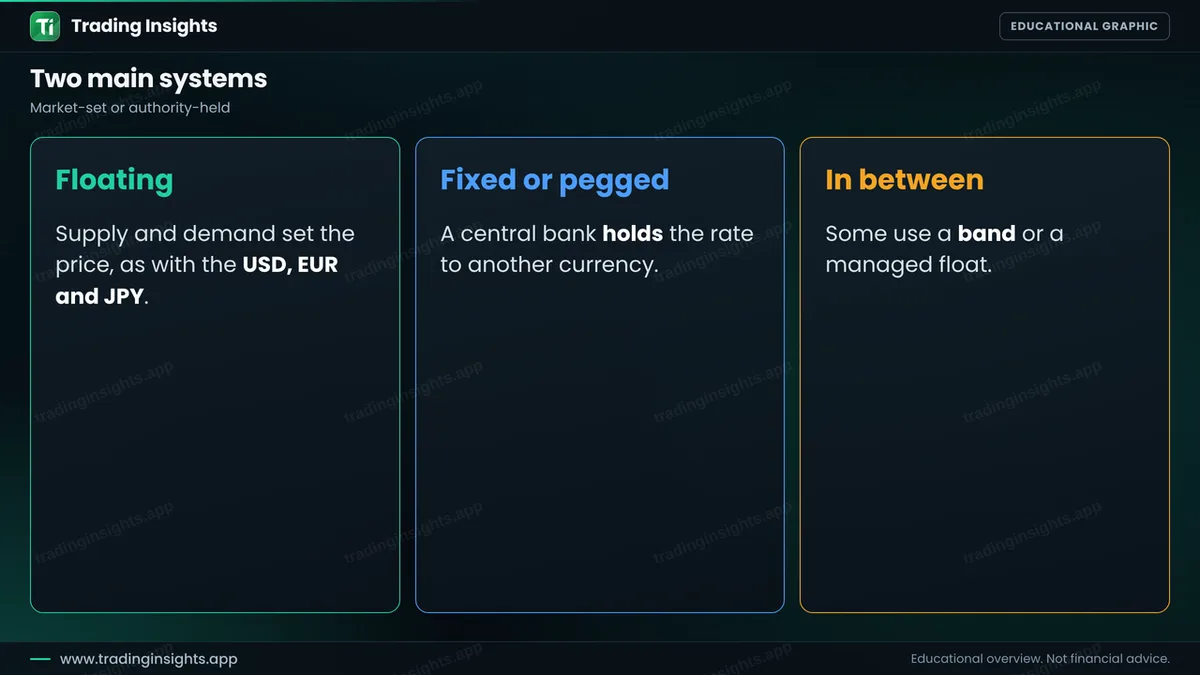
In a floating system, the market sets the price all day. Central banks influence it mainly through interest rates and what they signal about future policy. See interest rates and forex.
In a fixed system, the central bank commits to a rate against an anchor currency, often the US dollar. It buys or sells its own currency to hold that rate. Some systems sit in between, with a band in which the rate may move, or a managed float where the central bank steps in at times. See central bank intervention.
How a currency peg works
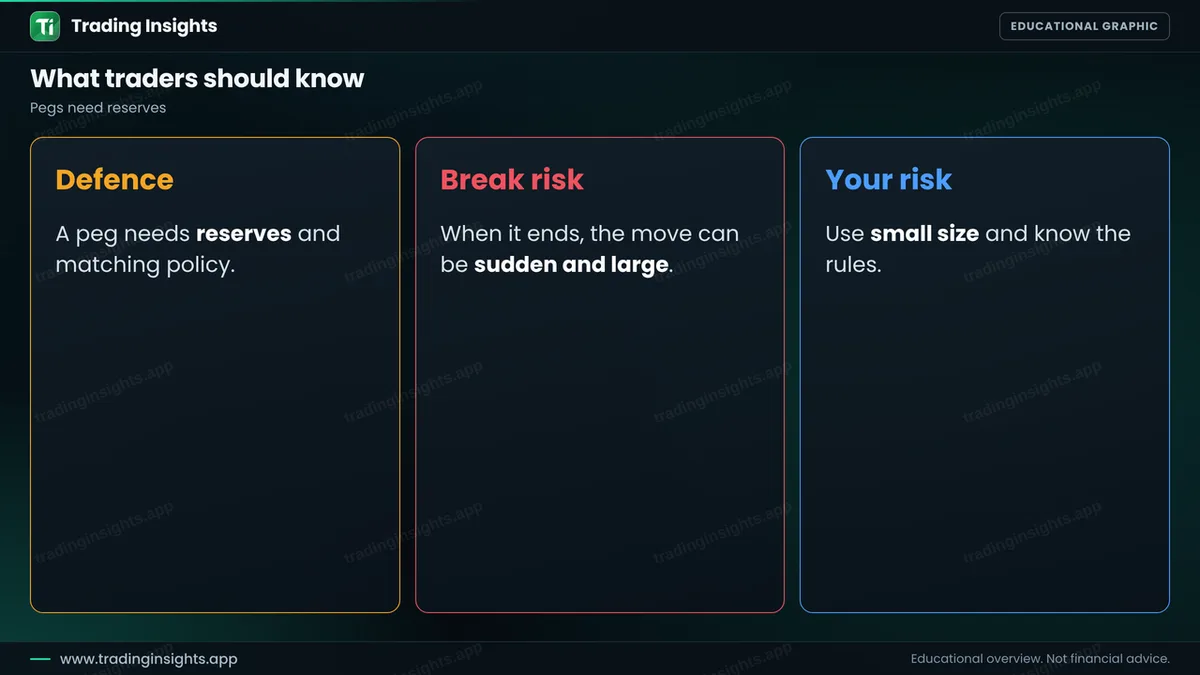
A peg is a promise, and a promise has to be backed by something. To hold a rate, the central bank keeps reserves of the anchor currency. If the home currency is under selling pressure, it sells reserves and buys its own currency to push the price back up.
Its interest rate policy also tends to follow the anchor. If the anchor country raises rates, the pegged country often has to follow, even when its own economy needs the opposite. That link is the real cost of a peg.
Pegged vs floating currencies compared
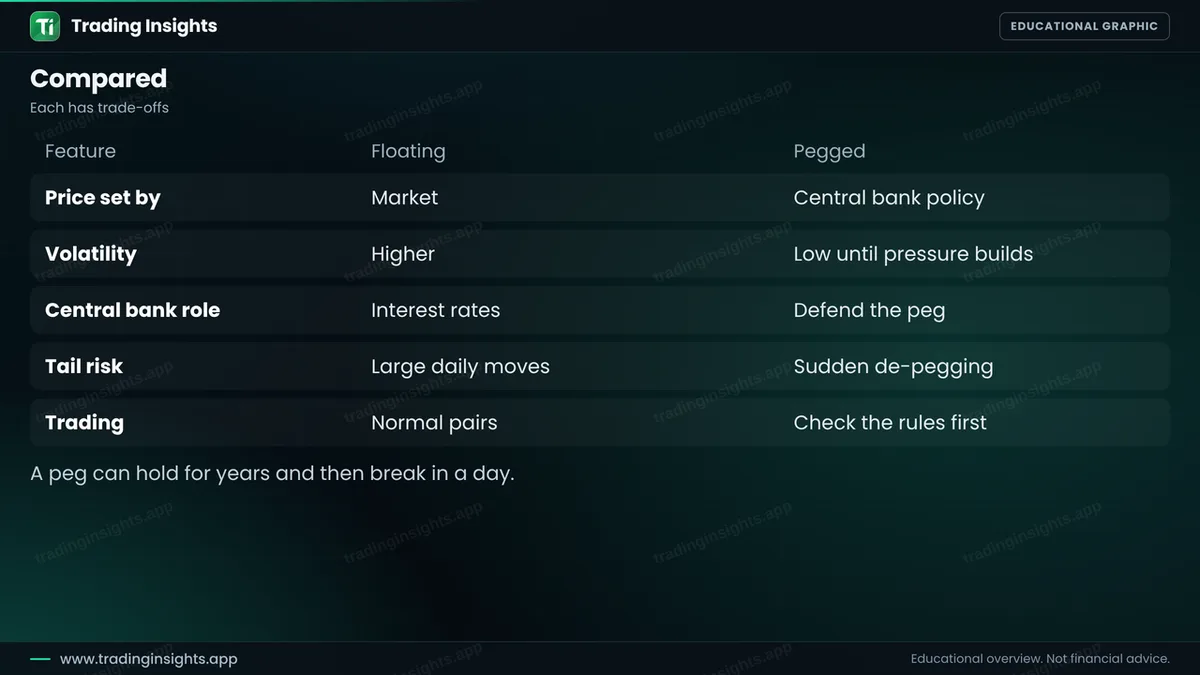
A peg gives stability, which helps trade and business planning. The cost is that the central bank must hold enough reserves to defend the rate, and its policy loses some freedom. If pressure becomes too strong, the peg can break.
A well-known case is January 2015, when the Swiss National Bank dropped its minimum EUR/CHF rate of 1.20, and the franc surged within minutes.
What traders should know about pegged currencies
A pegged pair can sit in a tiny range for years, which looks like low risk. It is not. The risk has not gone away, it has been stored up. When the regime changes, the move can be huge and can come as a gap, with no trading in between.
Before trading a pegged or managed pair, find out how the regime works and what the central bank has said. Costs can also be wider, and some brokers limit trading in these pairs. See exotic currency pairs. A stop may not fill at your price in a gap. See slippage.
Step-by-step: how to check a currency regime before you trade
- Find the regime. Is the currency floating, pegged or managed? The central bank's own website usually says.
- Check the anchor. What does the currency follow, and at what rate or band?
- Look at reserves and policy. Is the central bank able to defend the rate? See central banks and forex.
- Watch the news. Statements about the peg, reserves or a possible change in policy are warning signs.
- Decide on size and stop. Use small size, and accept that a stop may not protect you in a gap.
What signals a peg may be under stress
None of these predict a break, and a peg can survive all of them. But together they are a reason to cut size or stay out:
- The central bank is spending reserves heavily to defend the rate.
- Its policy rate is far from what the home economy needs.
- Officials are repeatedly asked about the peg and give mixed answers.
- The pair is pinned at the edge of its band.
- Spreads widen without a clear reason.
Why stops do not work the same on a peg
On a floating pair, a stop at 30 pips usually fills near 30 pips. On a pegged pair, price may not trade through the levels between your entry and the new rate. Your stop then fills at the first available price, which can be far worse.
That is why sizing the risk by the stop distance alone is not enough on a pegged pair. The real worst case is bigger than the stop suggests.
Illustrative example: floating pair vs pegged pair
A trader risks 1% of a $10,000 account, or $100, on a floating pair with a 30-pip stop. With a $10,000 account risking 1% ($100), the position size is $100 / (30 pips x $10 per pip per lot) = about 0.33 lot. A win pays about $200, and a loss costs about $100.
On a pegged pair, gaps are rare but huge. If the peg broke and price jumped 500 pips past the stop, the loss on that same 0.33-lot position could be many times the planned $100. For that reason, the trader would cut the size sharply or skip the pair.
Common mistakes
- Treating low volatility as low risk. Calm on a pegged pair is a feature of the peg, not safety. Size for the gap, not for the quiet.
- Ignoring the central bank's statements about the peg. Official comments are the main clue. Read them before you enter.
- Using normal size on a pegged pair. A normal stop does not cap the loss in a gap. Cut the size sharply.
- Assuming a stop will fill at the set price. In a gap it will not. Accept that the real loss can be larger.
Frequently asked questions
What is a currency peg?
A policy where a central bank keeps its currency at a fixed rate, or inside a band, against another currency or a basket of currencies. It does this by trading in the market and by matching interest rate policy.
Do major currencies float?
Yes. The US dollar, euro, yen and pound are floating, so the market sets their prices. Central banks still influence them through rates and statements, and may intervene in rare cases.
Why can a peg break?
If reserves run low or policy conflicts become too large, the central bank may be unable or unwilling to defend the rate. The break can then be sudden, with price moving to a new level in minutes.
Should beginners trade pegged currencies?
It is better to be careful. The risk of a sudden break is real, and costs can be higher. Learn to trade floating majors first, and use the position size calculator to keep risk small.
Your next step
Pick one pair you trade or watch and look up its regime. Write down whether it floats, is pegged or is managed, and what the central bank says about it. If it is pegged, decide in advance how much smaller your size will be.
This is education, not financial advice. Trading carries risk, and no method guarantees results. The charts are illustrative and not real market data.


