
Elections move currencies because they can change tax, spending and trade policy, and because the result itself is uncertain. When uncertainty rises, volatility usually rises with it, spreads widen and prices can gap. The practical answer for most traders is to treat an election as event risk: shrink the size, decide in advance whether to trade or stay flat, and never rely on a forecast. This article covers political risk in forex without taking any political side.
Why elections matter for forex
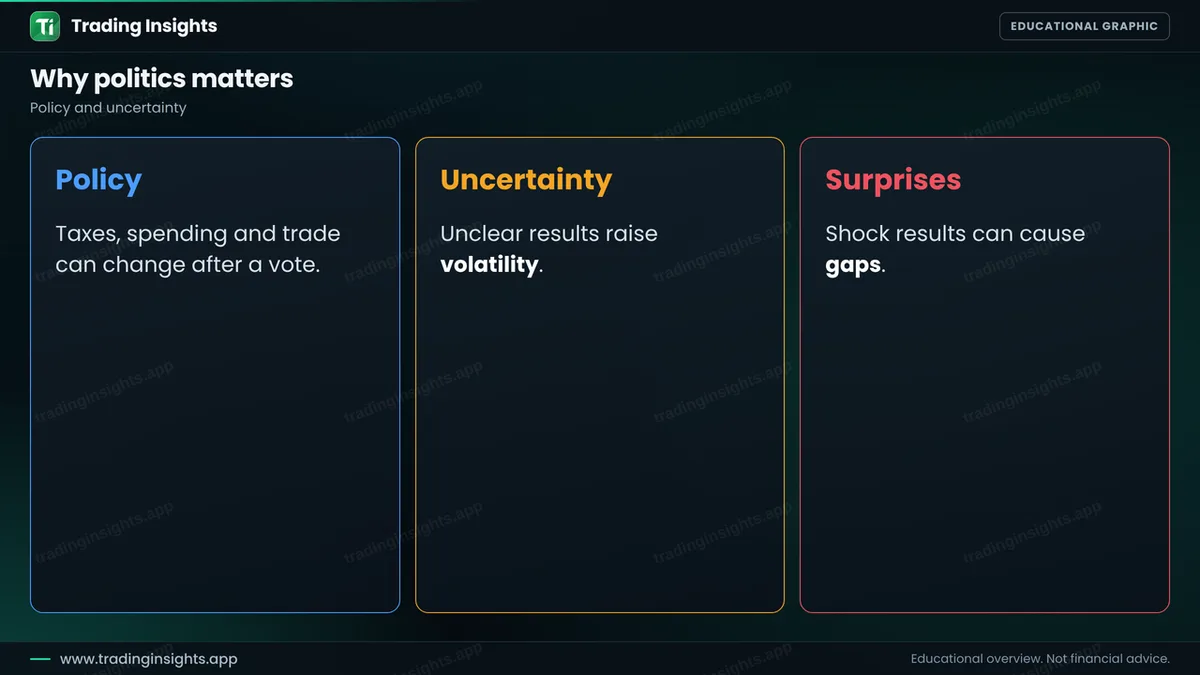
A new government may change policy on spending, taxes or trade, and those changes can affect growth, inflation and interest rate expectations. Currencies respond to those expectations, not only to the people involved. See government debt and fiscal policy for how budgets feed into a currency.
Before the vote, the market tries to price in the most likely outcome. That means the news is partly in the price already. A surprise forces a fast repricing, and fast repricing is what produces gaps, especially when it lands in thin trading hours. See low-liquidity periods.
What happens to price around a vote
You do not need to know who wins to see the pattern. The days before an election often bring cautious, uneven trading as participants wait. On the night, the first results can move price in seconds, and the move can change direction several times as more votes are counted.
Typical effects to expect:
- Wider spreads, because liquidity providers protect themselves.
- Slippage on market orders and on stops.
- Sharp moves in the first minutes, which may partly reverse.
- Gaps if the result arrives while your market is closed or quiet.
A close or unexpected result tends to cause the biggest reaction. A widely expected result may cause a small move or none at all.
A cautious plan for trading election risk
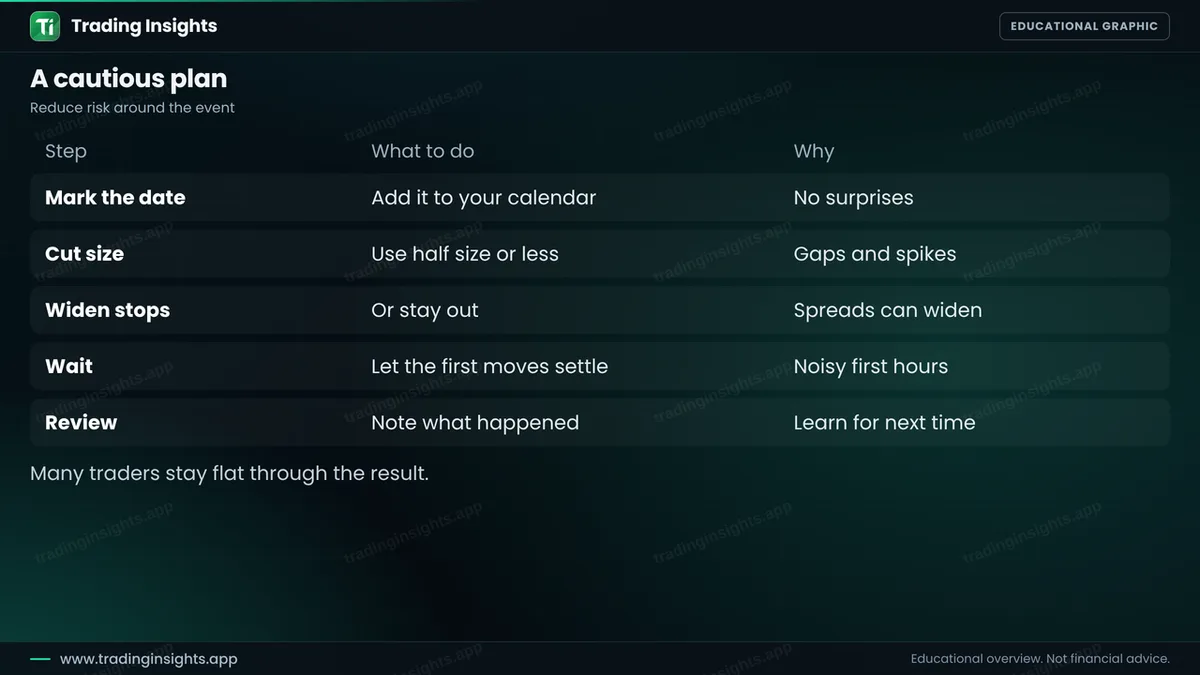
The goal is not to predict the result. It is to make sure one event cannot do real damage to your account. Mark the date in your calendar, cut the size to half or less, and decide in advance whether you will trade or stay flat.
Many traders choose to be flat through the result. If you trade afterwards, wait for the first moves to settle, since spreads and slippage can be large. See trading the news spike and slippage.
Step-by-step rules
- Add the election and the expected results time to your calendar, converted to your own time zone.
- Decide in advance: trade small, or stay flat. Write the decision down.
- Close or reduce open trades that could gap, and widen or remove any plan that needs a tight stop.
- Do not open new positions in the hours before the result.
- After the result, wait for the spread to return to normal and for price to settle at a level.
- Trade only if a clear setup forms, such as a pullback to a broken level, and use reduced size.
- Review what happened in your journal, including the spread and slippage you saw.
The main risks
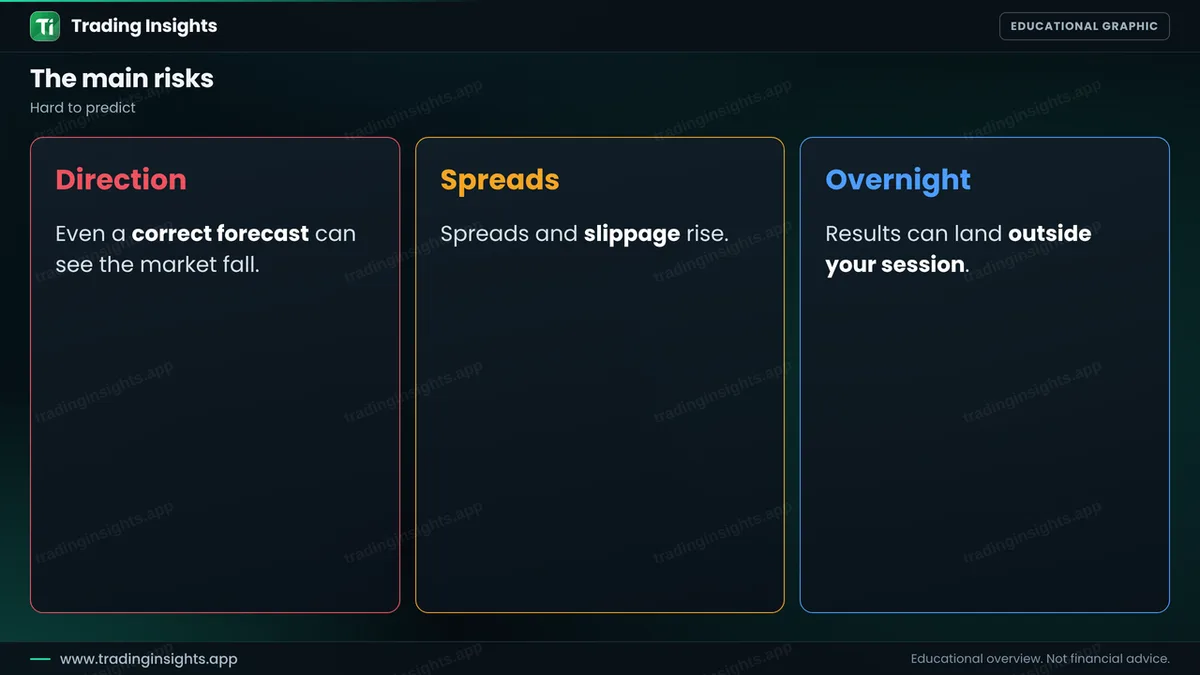
Even if you guess the result, the market may already have priced it in, and the move can go the opposite way. Spreads and slippage rise, and the result may arrive outside your trading session. A stop is an order to exit, not a promise of a price, so in a gap it can fill far from where you set it.
What invalidates a post-election trade
A plan to trade the settled move should be dropped if conditions are still disorderly. Skip the trade if:
- The spread is still much wider than normal.
- Price is still jumping several times the usual range without pausing.
- The result is disputed or unclear, so the next headline could reverse everything.
- Your stop would need to be so wide that the position size becomes too small to be worthwhile.
Waiting costs you nothing. Missing a move is cheaper than taking a full-size loss at a bad fill.
Election risk example: illustrative example with simple numbers
A trader normally risks 1% ($100) with a 30-pip stop on EUR/USD. With a $10,000 account risking 1% ($100), the position size is $100 / (30 pips x $10 per pip per lot) = about 0.33 lot. A win pays about $200, and a loss costs about $100.
Before a major election, the trader halves the risk to $50, or stays out, because the stop might fill far from the planned price. At half risk, the position size is $50 / (30 pips x $10 per pip per lot) = about 0.17 lot, so a 30-pip loss costs about $50. After the result, the trader waits for price to settle at a level and trades the pullback with the normal size once spreads are back to normal.
You can check your own numbers with the position size calculator.
Common mistakes
- Trading full size into the result. One gap can cost far more than the planned risk. Cut the size to half or less, or stay flat.
- Assuming a correct forecast means a profit. The market may have priced the result in already. Trade the reaction you see, not the outcome you expect.
- Placing tight stops in a thin market. Wide spreads can trigger a tight stop for no reason. Use a wider stop with a smaller size, or wait.
- Letting political views drive trades. Opinions bias your read of the risk. Plan for volatility and react to price, not to preference.
Frequently asked questions
Do elections always move currencies?
Not always. Moves are bigger when the result is close, surprising or likely to change policy. A widely expected outcome often produces a small reaction.
Should I trade through an election?
Many traders reduce size or stay flat, because spreads and gaps can be large. If you trade, decide the size and the exit before the event, not during it.
Can I predict the market reaction?
It is difficult. The market may have priced in the result, so even a correct forecast can lose money. Focus on managing risk rather than guessing.
How do I handle political views?
Keep them out of trading. Plan for risk and react to price, not opinion.
Your next step
Look at your economic calendar for the next major election in a currency you trade, and write down one line now: either "flat through the result" or "half size, wait for the spread to settle."
This is education, not financial advice. Trading carries risk, and no method guarantees results. The charts are illustrative and not real market data.


