
The best way to trade during a drawdown is to slow down and follow rules you wrote before the losses started. Cut your risk at set drawdown levels, pause and review at a deeper level, and step back up only after results recover. A drawdown is a fall from an account peak, and every trader has them. What turns a manageable one into a serious one is usually the reaction: bigger size, more trades, a new strategy. For the maths behind it, see drawdown and risk of ruin.
What happens to your head in a drawdown
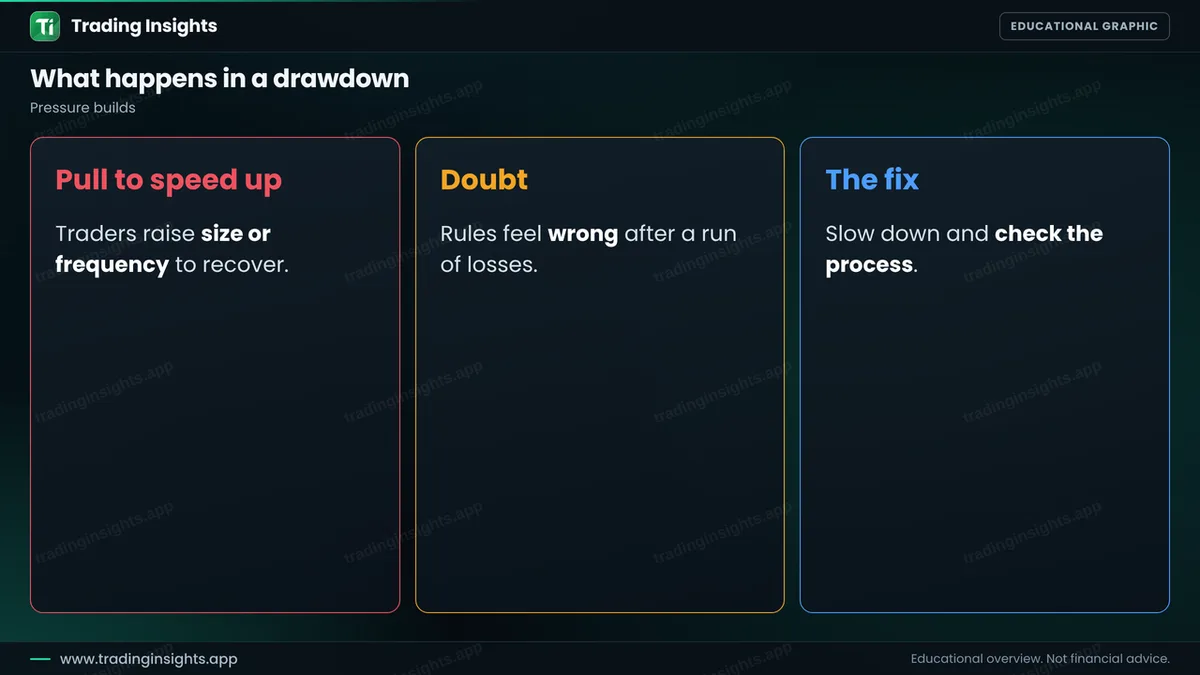
After a run of losses, two feelings arrive together. One is the urge to win the money back fast. The other is doubt: maybe the strategy has stopped working. Both push you to change something right now.
That pressure is the real danger, because it makes you break the rules that were protecting you. The better response is to slow down. Look at revenge trading and the martingale strategy to see where the opposite road ends.
Why recovering a loss takes more than you lost
Losses and gains are not symmetrical. If you lose 10%, you need about 11% to get back to even. If you lose 50%, you need a 100% gain to return to the start.
This is why protecting capital early matters so much. A small drawdown is easy to recover from. A deep one can take so long, and tempt you into so much risk, that it ends the account.
Drawdown rules: how to respond at each level
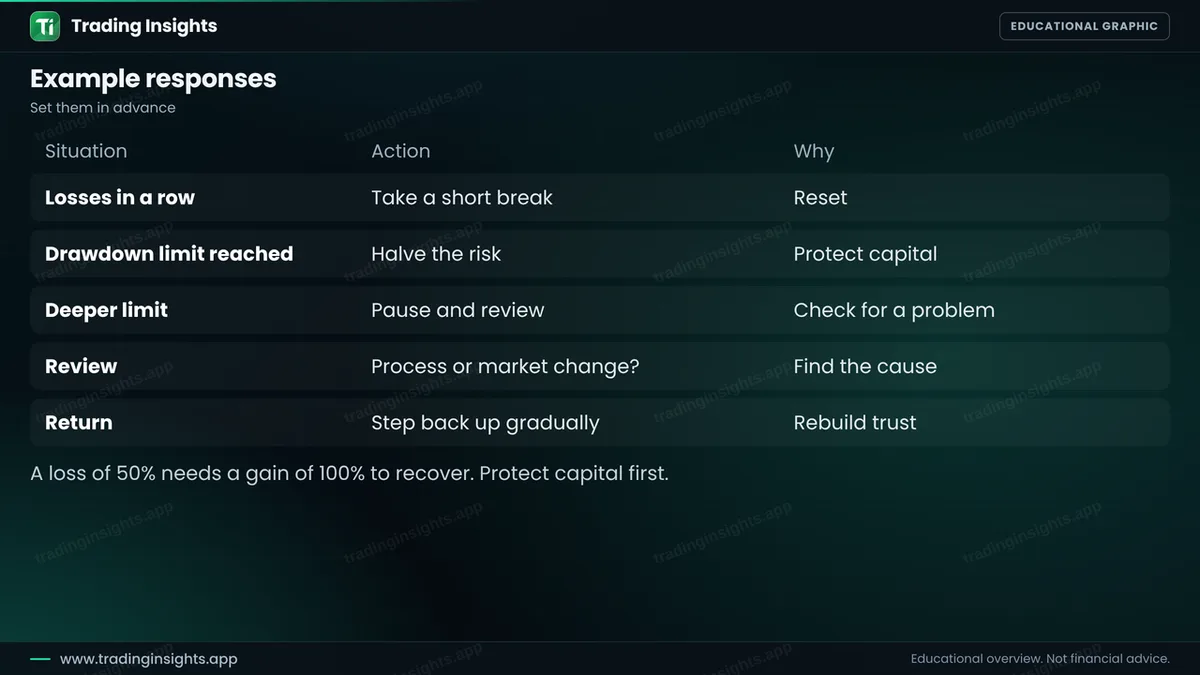
Decide your responses before you need them, because you will not think clearly in the middle of a losing run. Write them into your trading plan with numbers. A simple version looks like this:
| Situation | Response |
|---|---|
| A few losses in a row | Take a short break |
| Drawdown reaches 5% | Halve the risk per trade |
| Drawdown reaches 10% | Pause trading and review |
| Results recover | Step back up gradually |
At the review, ask one question: is the problem my process, or has the market changed? A daily loss limit works alongside these levels to cap the damage on any single day.
How to tell a rule break from normal losing
Not every loss is a signal that something is broken. A sound strategy loses in clusters. The useful check is whether you followed your rules on each losing trade.
Go through the recent trades one by one. Mark each as a clean loss, where you took the setup and managed it as planned, or a rule break, where you moved a stop, oversized or entered without a setup. A post-trade review and your journal make this fast. If most losses are clean, the strategy is probably in a normal rough patch. If many are rule breaks, the fix is discipline, not a new system.
What to avoid when trading a drawdown
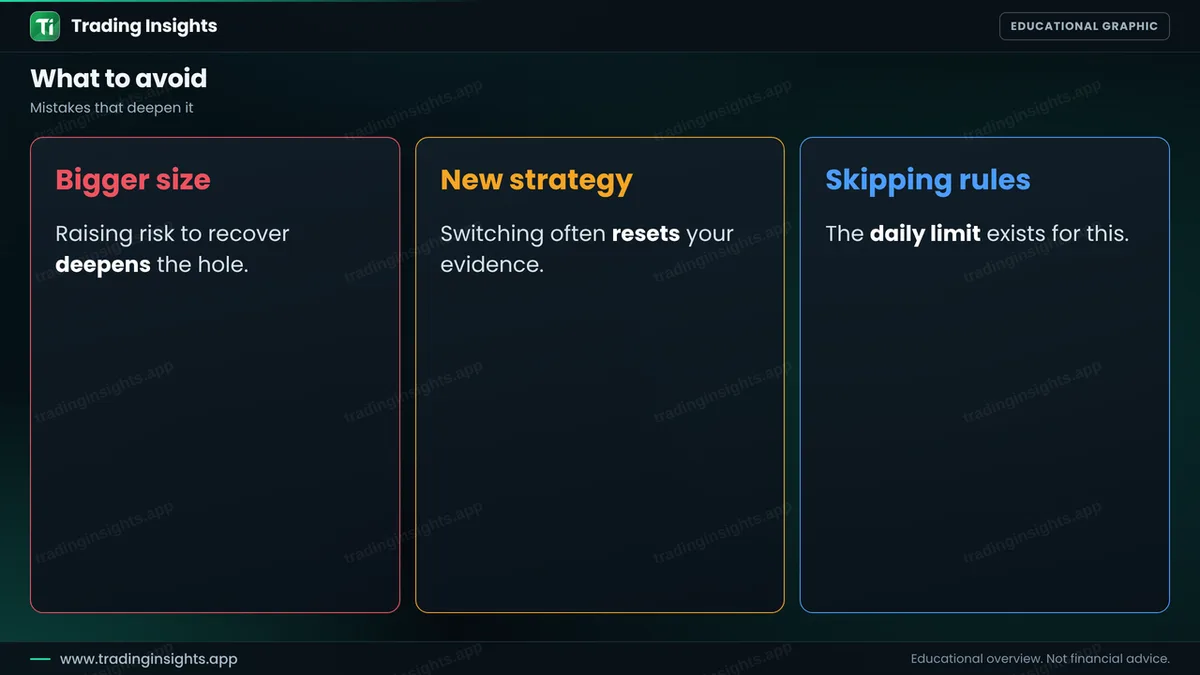
Do not raise size to recover. It feels logical, but it makes the next loss bigger and the hole deeper.
Do not switch strategy after every bad week. You never collect enough trades to judge any of them, so you keep resetting your evidence. And do not skip the rules that exist for exactly this moment, such as the daily limit.
An illustrative example of a drawdown plan
A trader risks 1% ($100) per trade on a $10,000 account with a 30-pip stop. With a $10,000 account risking 1% ($100), the position size is $100 / (30 pips x $10 per pip per lot) = about 0.33 lot. A win pays about $200, and a loss costs about $100.
After a 5% drawdown, the plan says to halve the risk to $50, or about 0.17 lot on the same stop. After a 10% drawdown, the trader pauses for a week and reviews 30 trades. The review shows that three of the losses broke the rules. The trader returns at half size and steps back up after two profitable weeks.
You can run your own numbers with the position size calculator.
Step-by-step: how to handle a drawdown
- Write your drawdown limits and responses in your trading plan before you need them.
- Cut the risk per trade when the first limit is reached.
- Pause and review at the deeper limit, and step away from the screen.
- Separate rule breaks from normal losses, trade by trade.
- Return gradually, at reduced size, and step up only after results recover.
What invalidates the plan
The plan only works if you follow it. It stops working the moment you override a limit "just this once", or when you stop recording trades and cannot see the drawdown any more. It is also invalid if you reduce risk but compensate by trading more often, because total exposure has not really fallen.
Common mistakes
- Raising size to get the money back. A bigger position makes the next loss larger. Keep size flat or lower until results recover.
- Changing strategies too often. Each switch resets your evidence. Judge a strategy over a meaningful number of trades.
- Trading longer hours to catch up. More screen time adds more low-quality trades. Stick to your normal session and setups.
- Hiding the drawdown by not keeping records. What you do not measure you cannot manage. Keep a journal with the balance after every trade.
Frequently asked questions
What should I do in a drawdown?
Slow down, cut the risk at the limits you set in advance, pause and review at the deeper limit, and avoid raising size to recover. The goal is to protect capital while you work out whether the problem is your process or the market.
How big a drawdown is normal?
It depends on the strategy and the risk per trade. Many traders plan for several percent and set their limits before they start, so a drawdown never arrives as a surprise.
Should I change my strategy during a drawdown?
Not right away. First check whether you followed your rules, and whether the market has changed. Changing a sound strategy because of a normal losing run usually makes things worse.
How do I return to full size?
Step up gradually after results recover, for example after a few profitable weeks. Moving back in stages lets you confirm that things are working before taking full risk again.
Your next step
Open your trading plan today and add three numbers: the drawdown at which you halve risk, the drawdown at which you pause, and what you will review during the pause.
This is education, not financial advice. Trading carries risk, and no method guarantees results. The charts are illustrative and not real market data.


