
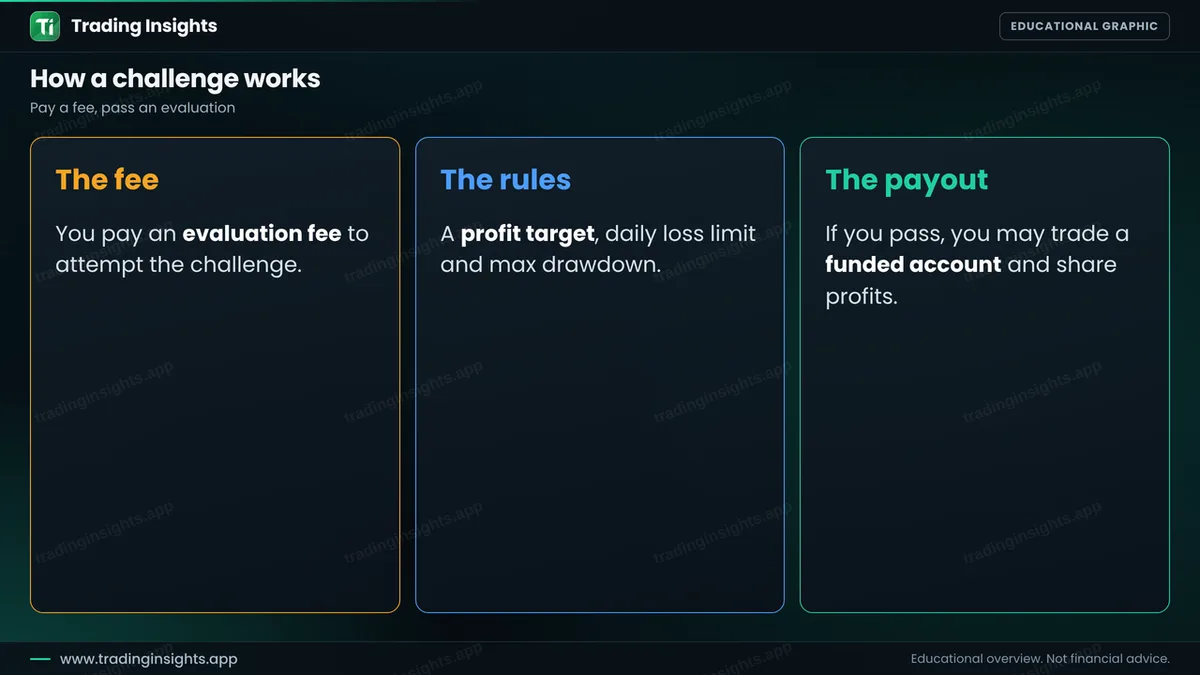
A prop firm challenge (also called an evaluation) is a paid test: you pay a fee, trade a simulated account under strict rules, and if you reach the profit target without breaking the limits, you may be offered a funded account and a share of the profits. Whether it is worth it depends on the exact terms and on how disciplined you are. Terms differ widely between firms, so read them carefully. This article is general education and not a recommendation of any firm.
How a prop firm challenge works
The firm gives you a set account size, such as $50,000, and a profit target, for example 8% to 10%. You must stay within a daily loss limit and a maximum drawdown. If you break a limit, the attempt ends and you usually pay a new fee to try again.
Many firms use more than one phase, and some set a minimum number of trading days or a time limit. These details vary by firm, so never assume the rules match another firm's.
Prop firm rules to read before you pay
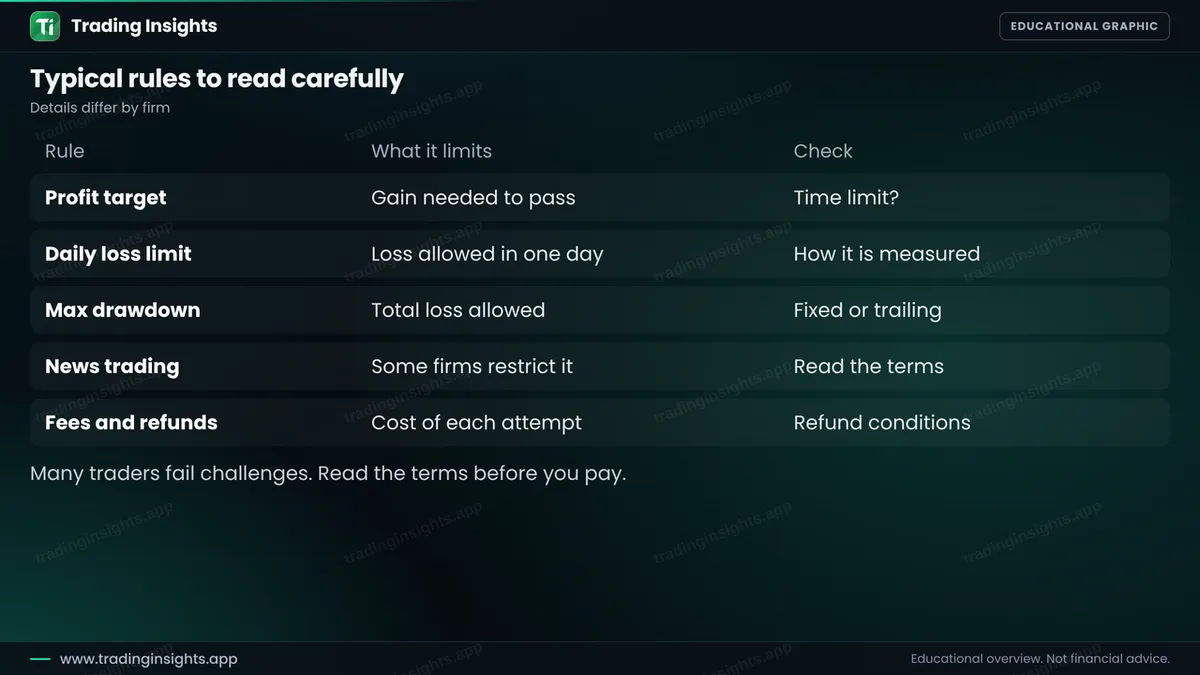
The details matter more than the headline account size. A few points decide whether a rule is easy or hard to live with:
- Daily loss limit. It may be measured from the start-of-day balance or from equity, which includes open trades.
- Maximum drawdown. It may be fixed, or trailing, meaning it moves up as your balance or equity rises.
- News and strategy limits. Some firms limit trading around news, and others restrict certain strategies or holding over the weekend.
- Fees and refunds. Check what happens to the fee if you pass, and whether it is refunded at all.
Compare the cost with what you would pay on a normal small live account. See trading with a small account.
The main risks of prop firm challenges
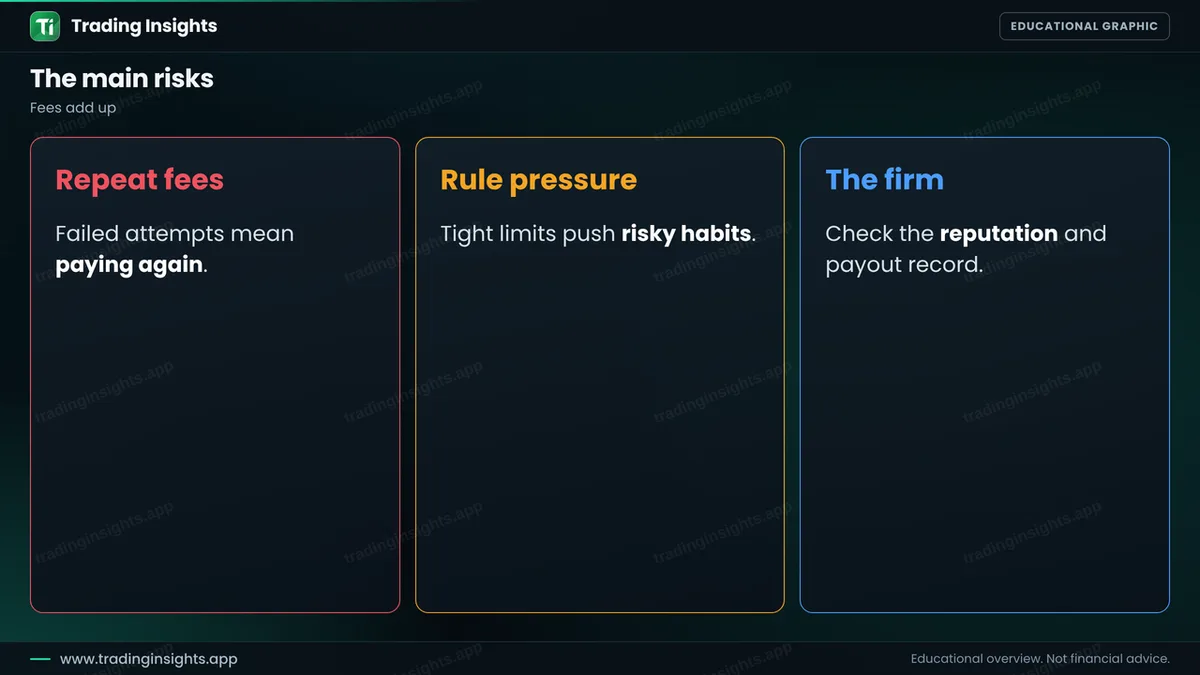
Many traders fail challenges, and repeated fees can exceed what a small live account would lose. Tight limits can also push you to overtrade or to risk more than you normally would, so use the same discipline as usual. See the daily loss limit and overtrading in forex.
Also check whether the firm is reputable and what its payout record looks like. Offers that sound too good are a warning sign. Read the terms slowly and check several independent sources.
How to approach a challenge
- Read every rule before you pay, and save a copy of the terms.
- Trade a plan you have tested. See how to backtest.
- Risk well below the limits. Many traders risk 0.5% to 1% per trade.
- Treat the fee as spent. Budget for failure, and decide in advance how many attempts you will pay for.
- Verify the firm and its payout record from several sources.
Illustrative example: risk on a $50,000 challenge
This is an illustrative example with made-up numbers. The challenge has a 5% daily loss limit ($2,500) and a 10% maximum drawdown ($5,000). The trader risks 0.5% ($250) per trade with a 30-pip stop on EUR/USD.
The position size is $250 / (30 pips x $10 per pip per lot) = about 0.83 lot. A loss costs about $250. Eight losses in a row would reach about $2,000, which is within the daily limit, but the margin is smaller than it looks. At 1% risk ($500 per trade), five losses would already reach $2,500 and end the attempt in a single day.
Now the cost side. Suppose the fee is $300 and a trader needs three attempts before passing. The total spent is $900 before any payout. If a funded account then pays nothing for weeks, the trader is still behind. That is why the fee should be treated as spent money.
Challenge or small live account?
A challenge gives access to larger capital, but you accept fees, strict limits and a simulated start. A small live account has no outside limits and no fee, but the dollar gains are small. Neither is better for everyone.
A useful test is to ask whether you already follow a tested plan with steady risk. If not, the challenge mostly tests your discipline under pressure, and failing it is an expensive way to find out. You can use the position size calculator to see what your plan means in dollars before you pay.
Common mistakes
- Skipping the rules and breaking a limit by accident. An equity-based daily limit counts open losses. Read how each limit is measured and keep a buffer.
- Over-risking to hit the target quickly. Large size ends the attempt on a short losing run. Keep risk small and accept a slower pace.
- Paying for repeated attempts without changing the plan. The same plan tends to fail the same way. Review your trades before each new attempt.
- Choosing a firm only by its low price. A cheap fee means little if payouts are unclear. Check the terms and the payout record.
Frequently asked questions
What is a prop firm challenge?
It is an evaluation where you pay a fee and trade under set rules to try to earn a funded account. The rules, targets and fees depend on the firm.
Is a challenge better than a small live account?
It depends. A challenge gives larger capital but has fees and strict limits. A small live account has no limits but small profits.
What is a trailing drawdown?
It is a limit that moves up as your balance or equity rises, so the room for losses can shrink. Check whether it stops trailing at some point, as this varies by firm.
How do I check a firm?
Read the terms, check the payout record and reviews from several sources, and be careful with unrealistic promises.
Your next step
Pick one firm you are curious about and write its rules in a table: target, daily limit, drawdown type, fee and refund terms. Then work out your lot size at 0.5% risk with the position size calculator and see how many losses the limits allow.
This is education, not financial advice. Trading carries risk, and challenge fees can be lost in full. No method guarantees results. The charts are illustrative and not real market data.


