
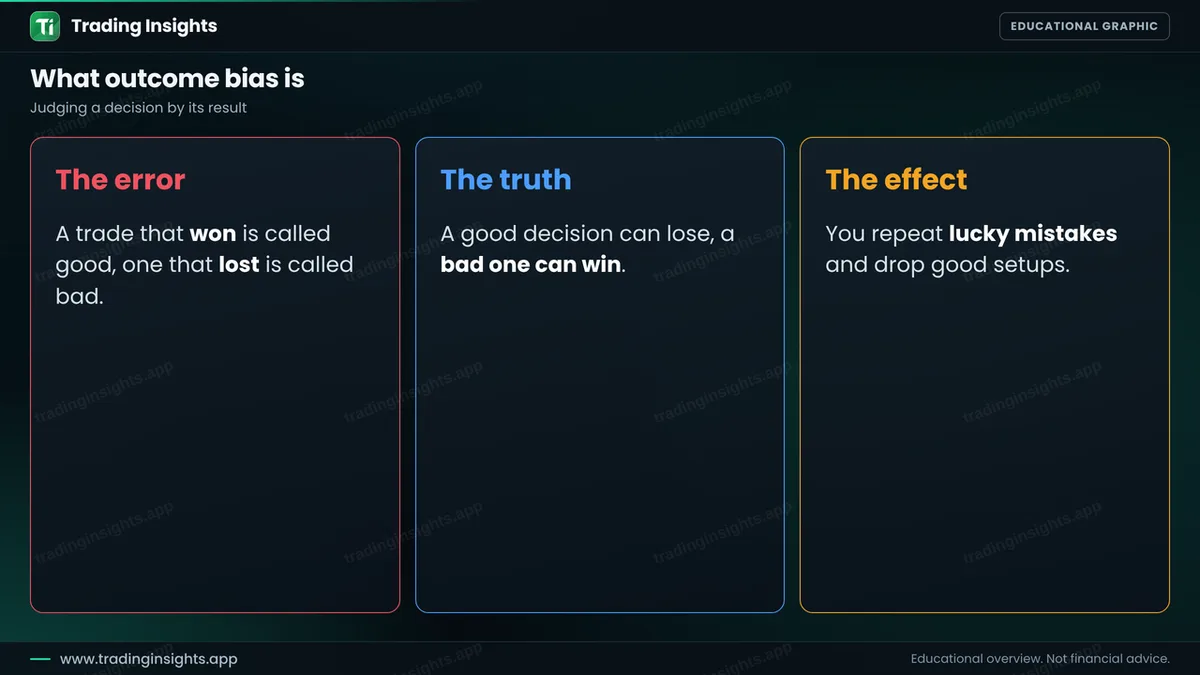
Outcome bias is judging a trade by its result instead of by the quality of the decision behind it. A trade that wins feels right and a trade that loses feels wrong, but when chance is involved the two are not the same. A good decision can lose and a bad decision can win, and mixing them up teaches traders to repeat lucky mistakes and drop sound plans. The fix is to grade your process, then look at results over many trades.
What outcome bias looks like in trading
Suppose you break your plan, take a trade with no stop, and it wins. If you call that a good trade, you will do it again. Suppose instead you follow your plan perfectly and lose. If you call that a bad trade, you may drop a plan that works over time. Both errors come from reading one result as proof.
It is like a dice game. If you bet well on the odds and lose one roll, the bet was still good. If you bet badly and win, the bet was still bad.
The four types of trade
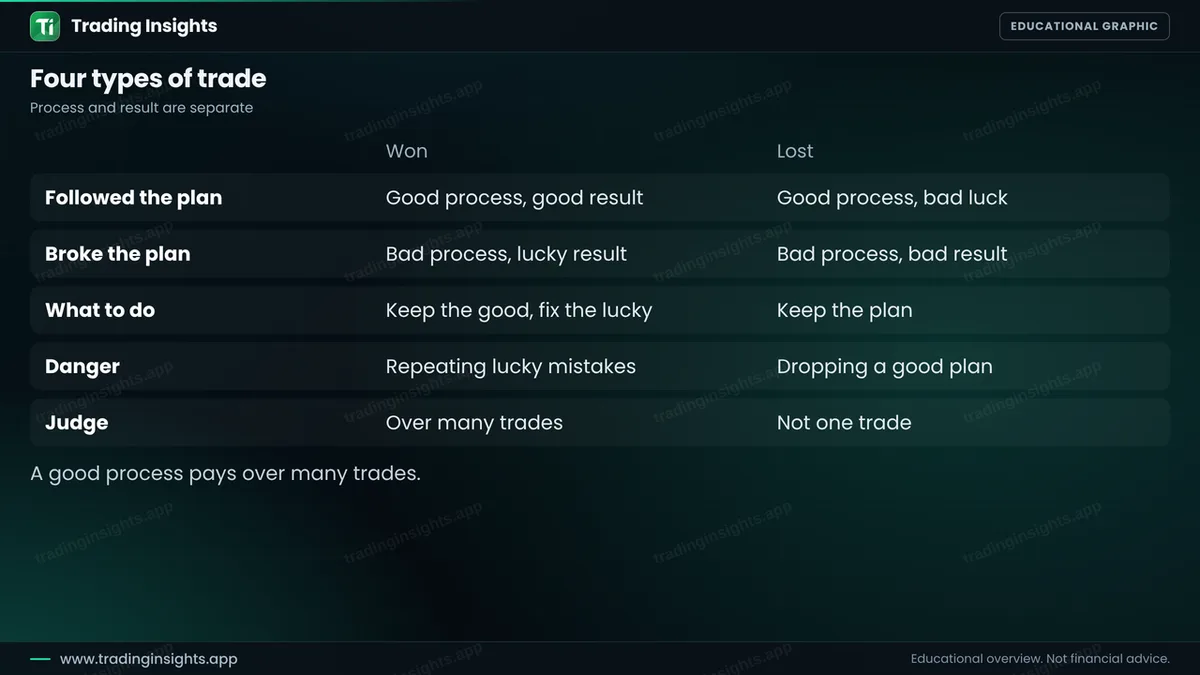
Process and result are separate. A planned loss is good process with bad luck, and the right response is to keep the plan. A winning trade that broke the rules is bad process with good luck, and the right response is to fix the habit, not celebrate. A single trade says little about your edge. Judge over many trades, as in trading journal metrics.
How to measure process instead of results
Process is easier to measure than it sounds. Pick four or five rules from your plan, for example: the setup was on my list, the stop was placed before entry, the risk was 1% or less, I did not move the stop, and I did not trade during my no-trade hours. Count how many you followed. That count is your process score.
How to fix outcome bias step by step
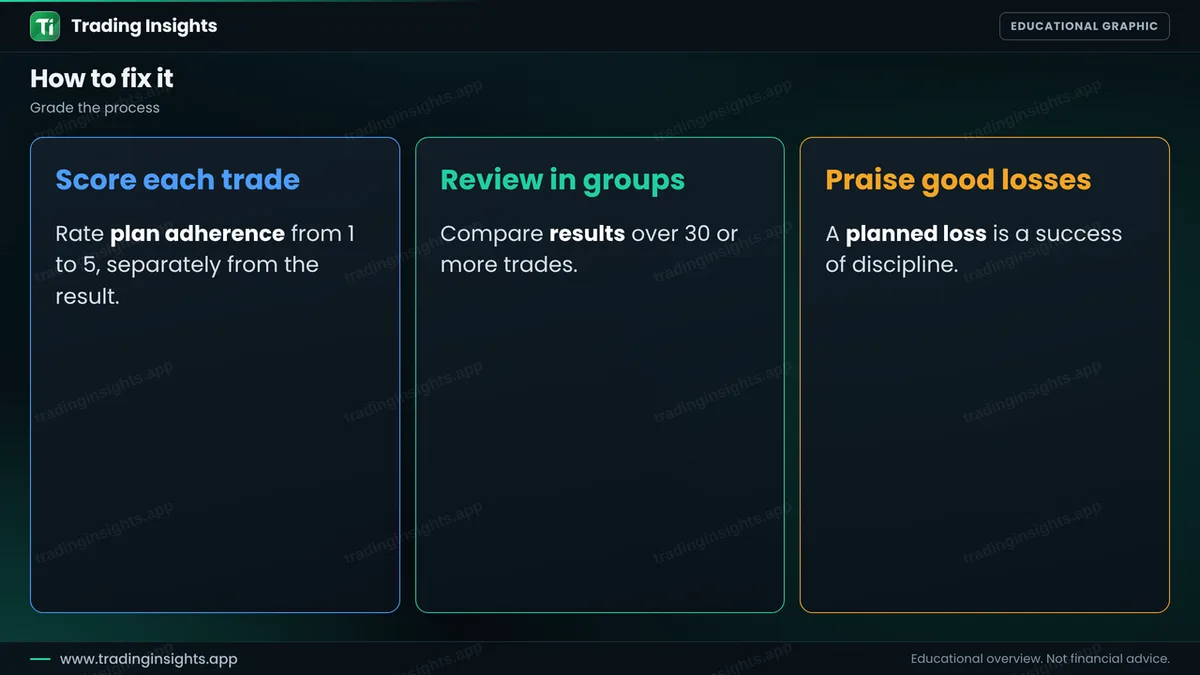
- Score every trade from 1 to 5 on how well you followed the plan, before you look at the profit.
- Use a checklist so that the process is clear. See pre-trade checklist.
- Review in groups of 30 or more trades.
- Praise planned losses. They show discipline.
- Fix lucky wins. Note what rule you broke and how to avoid it.
Illustrative example: scoring two trades
This is an illustrative example, not real trades. Trade A: a trader sells with a 30-pip stop and a 60-pip target, and the stop is hit. With a $10,000 account risking 1% ($100), the position size is $100 / (30 pips x $10 per pip per lot) = about 0.33 lot. A win pays about $200, and a loss costs about $100. The loss of about $100 is within the plan, so it scores 5 out of 5 for process.
Trade B: a later trade moves the stop further away, then wins $150. It scores 2 out of 5 because it broke the stop rule, even though the result was positive.
After 30 trades, the trader compares the average process score with the total result. If high-score trades are profitable over time and low-score trades lose, the plan is worth keeping. If not, the plan needs work, and the data shows where.
Why outcome bias is hard to see
Results are loud and process is quiet. A profit shows up as a number in your account, while a skipped rule leaves no trace unless you write it down. That is why a journal helps: it turns the invisible into something you can count. Even a one-line note, such as "moved stop, lucky", gives you data for the monthly review. Over time, you will see which rule breaks cost you the most, and you can focus on those first.
Also remember that a series of wins can hide a flawed process for a long time, which makes the later loss feel sudden. Grading the process protects you from that surprise.
Common mistakes
- Changing a plan after two or three losses. A short run says little. Wait for a larger sample. See trading patience.
- Celebrating wins that broke the rules. This trains the habit that will hurt you later. Note the rule you broke and treat the win as a warning.
- Judging a strategy before it has enough trades. Ten trades prove little. See how to backtest.
- Skipping the journal when you lose. Losses hold the best lessons. Record them while the details are fresh.
Frequently asked questions
What is outcome bias?
It is judging the quality of a decision by its result rather than by the reasoning and process behind it.
Can a good trade lose?
Yes. A trade that follows a sound plan can lose, because any single outcome involves chance.
How do I score my process?
Rate how well you followed your plan, from 1 to 5, before you look at the result.
How many trades do I need to judge a plan?
Many traders look at 30 or more, and more is better.
Your next step
Add a "process score" column to your journal, and fill it in before you record the profit on your next ten trades. After ten, compare the scores with the results.
This is education, not financial advice. Trading carries risk, and a good process does not guarantee a profit. The charts are illustrative and not real market data.


