
When you click buy on a forex platform, the price you pay is the end of a chain that starts among a few very large banks. Understanding that chain explains three things beginners often find confusing: why spreads change during the day, why two brokers show slightly different quotes, and why your real trading cost is more than the number on the broker's homepage.
What the interbank market is
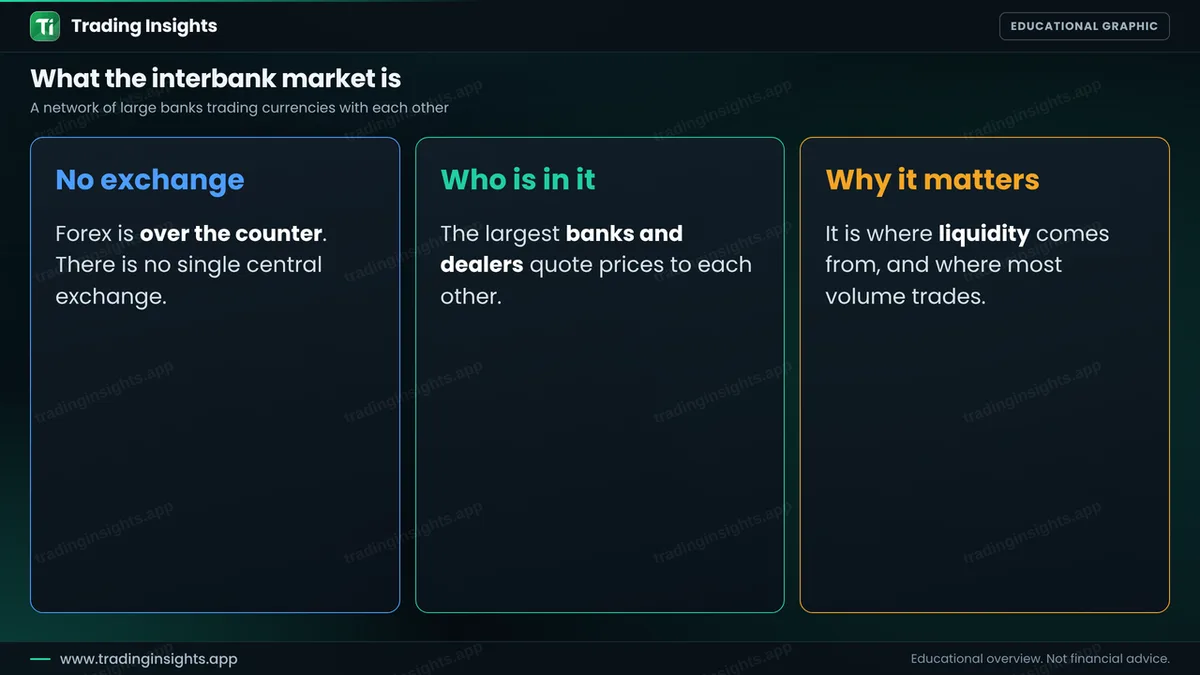
Forex has no central exchange. It is an over-the-counter market, which means two parties agree a price directly. The largest banks and dealers quote buy and sell prices to each other, mostly through electronic platforms, and they trade very large sizes. This network is called the interbank market.
Because the biggest participants compete, prices between them are extremely tight. That competition is where most of forex liquidity comes from. Funds, companies and retail traders all take prices that start from this layer.
How a price reaches your screen
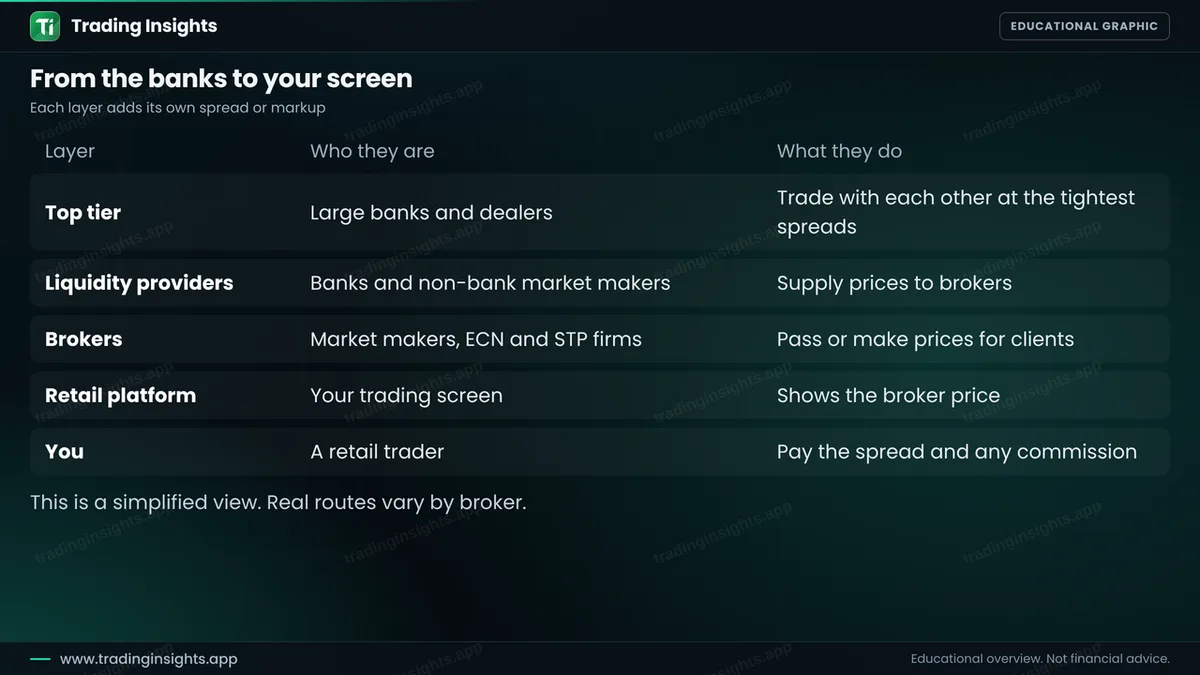
Retail traders do not trade directly with top-tier banks. Liquidity providers, which include banks and non-bank market makers, send streams of prices to brokers. The broker may add a markup or a commission, and then shows the result on its platform. Each layer has to earn something, so the further you are from the source, the wider the spread tends to be.
The exact route depends on the broker type. This is a simplified view, and real routes vary by firm, so read your broker's execution policy.
What this means for you
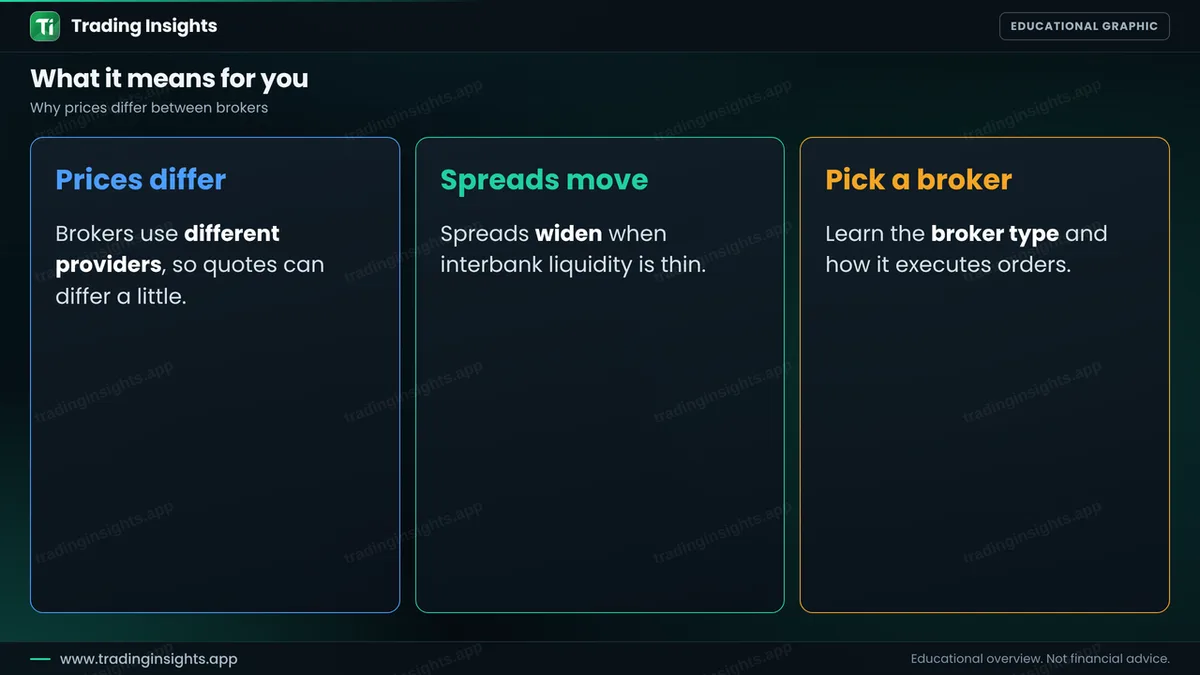
- Prices differ a little. Brokers connect to different providers, so quotes can differ by a fraction of a pip. For a swing trader this is noise. For a scalper aiming at a few pips it can decide the result.
- Spreads move. When liquidity thins, at rollover or around holidays, spreads widen. A strategy tested on calm-hour spreads may look much worse live.
- Execution matters. How your broker passes your order affects slippage and fills, especially during fast markets.
- Sessions matter. Liquidity follows the working hours of the big financial centres, so the same pair can be cheaper to trade in one session than another.
Why there is no single forex price
- With no central exchange, there is no single official price.
- Each dealer quotes its own prices based on its supply, demand and risk.
- Competition keeps the quotes very close together in normal conditions.
- In fast markets the differences grow, and quotes can be pulled or widened.
Where this knowledge does not help
Understanding the interbank layer will not give you an edge on direction. You cannot see the interbank flow from a retail platform, and it is not a signal. Its practical value is in costs and execution. It also matters less for a long-term position held for weeks, where a fraction of a pip is small compared with the stop. Terms such as bid, ask and spread are explained in the glossary.
How to turn this into rules
- Record your all-in cost. Write down the typical spread plus any commission for your main pair.
- Check cost at your trading time. Look at the live spread at the time of day you actually trade, not just at the quiet London morning.
- Keep a spread limit. Do not enter if the spread is more than a set multiple of normal, such as double.
- Place stops with the spread in mind. On a buy, the stop triggers on the bid price, so a wide spread effectively moves your stop closer. Add a few pips of room when spreads are unusually wide.
Illustrative example: comparing two brokers
This is an illustrative example with made-up numbers, not real quotes. Broker A offers a 0.2-pip spread and charges $7 round-turn commission per lot. Broker B shows a 1.0-pip spread with no commission. On EUR/USD at $10 per pip per lot, Broker A costs 0.2 x $10 + $7 = $9 per lot, and Broker B costs 1.0 x $10 = $10 per lot.
A trader with a $12,000 account risks 0.5%, which is $60, on a EUR/USD buy at 1.0742 with a 18-pip stop at 1.0724 and a 36-pip target at 1.0778. Lot size is $60 divided by (18 x $10), about 0.33 lot. Price reaches the target for about $119 before costs. Costs at Broker A are about $9 x 0.33 = $2.97 and at Broker B about $10 x 0.33 = $3.30. On such a tight stop, cost is a visible share of the risk.
Illustrative example: a wide spread at a bad moment
Another illustrative example. The same trader sells USD/CHF at 0.8875 on a $12,000 account, risking 0.5% ($60), with a 12-pip stop at 0.8887 and a 24-pip target at 0.8851. Pip value is assumed at about $11.27 per lot at that price, so lot size is about 0.44. The entry is just after a news release, when the spread has widened from 1 pip to 4 pips. The stop is hit and the loss is about $60, plus the extra spread paid on entry. A tight 12-pip stop leaves little room when the spread is four times normal. The fix is to wait, or use a wider stop and a smaller lot size.
Common mistakes
- Thinking retail traders trade directly with banks. Orders go through brokers and liquidity providers, and it affects fills. Learn your broker's model before you rely on tight fills.
- Comparing brokers only by the advertised spread. Commission, slippage and fast-market spreads all count. Add them together and compare the all-in number.
- Ignoring the difference between calm and fast spreads. Advertised spreads are usually the calm figure. Avoid entries during news and rollover, or widen the stop and cut size.
- Assuming every broker shows the same price. Providers differ. Backtest and trade on the same feed where you can.
- Overlooking regulation and execution policy. A low spread from an unregulated firm can cost more in the end. Check who regulates the broker.
Pre-trade checklist
- I know the current spread and it is close to normal for this pair.
- I am not entering within minutes of a major release or the daily rollover.
- My stop distance is wide enough to survive a normal spread.
- Lot size comes from my risk and stop distance, using the position size calculator.
- I am trading on the same broker and feed I tested on.
Frequently asked questions
What is the interbank forex market?
It is a network of large banks and dealers that trade currencies directly with each other. It is the source of most forex liquidity and the starting point of the prices retail traders see.
Do retail traders trade in the interbank market?
Not directly. Retail traders trade through brokers, who get prices from liquidity providers and add their own spread or commission.
Why do prices differ between brokers?
Brokers connect to different liquidity providers and add their own markups. The result is small differences in quotes, which matter more to short-term traders.
Why is there no central exchange in forex?
Forex developed as an over-the-counter market, where trades are made directly between parties. There is no single venue where all trades are matched.
Nothing here is financial advice; it is an explanation of how prices are formed. Spreads can widen sharply in fast markets, and trading leveraged products can lose more than you expect.


