

A forex bonus looks like free credit. In practice it is a contract, and the price of that contract is written in the terms, not on the banner. Before you accept any bonus, find out how many lots you must trade, what happens to your profits and what happens if you withdraw. In several regions, including parts of Europe, the UK and Australia, rules limit or ban these offers for retail clients, so an offer you see online may not be allowed where you live. This guide gives you a checklist, a worked cost calculation and a plain rule for deciding. Make sure the broker is real first, and keep your own limits in place whatever the offer says.
Common forex bonus offers
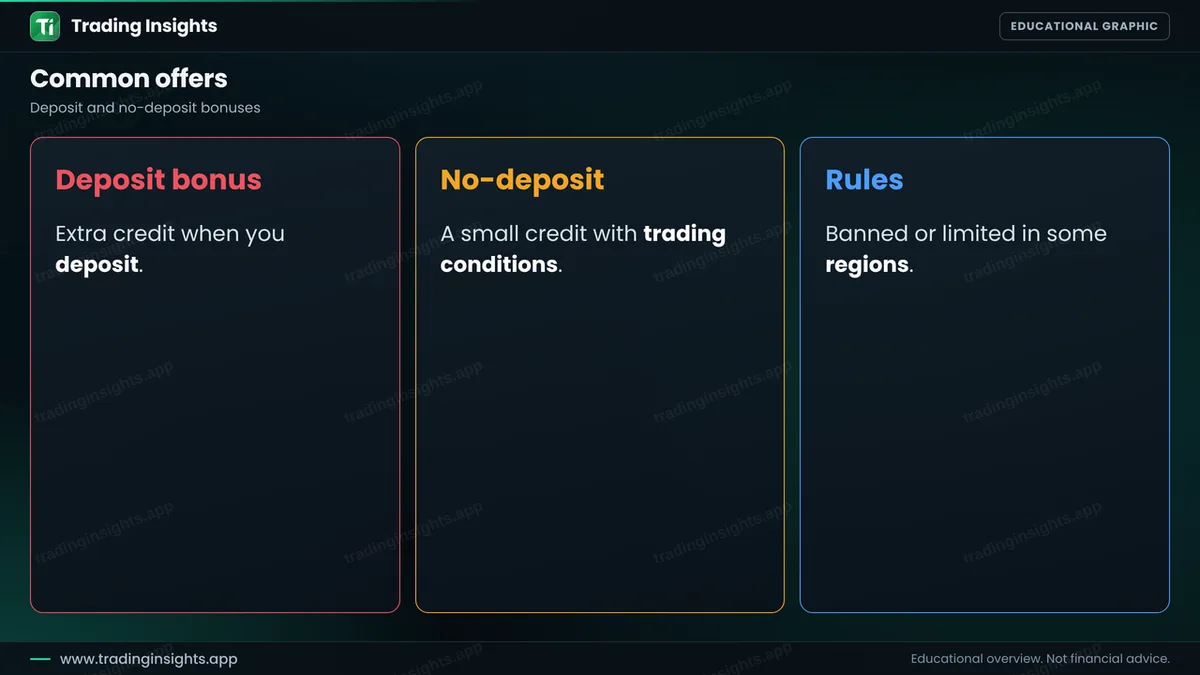
A deposit bonus adds credit when you fund the account, often as a percentage of the deposit, such as 20% or 25%. A no-deposit bonus is a small credit given for opening an account, usually with strict conditions. Brokers use both to attract new clients, and the credit often cannot be withdrawn directly. It may be treated as margin, as trading capital or as a reward unlocked by trading volume. The legal position differs by country, so check what applies to you before reading any further.
What to check before you accept a bonus
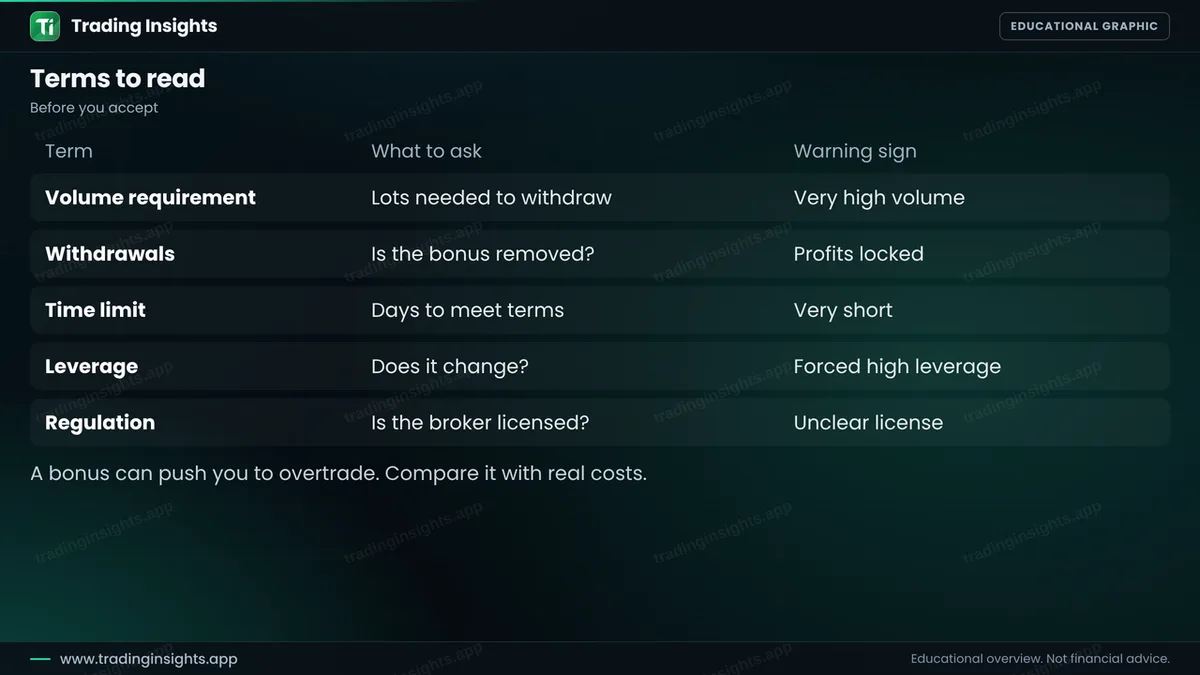
The terms decide whether a bonus is worth anything. Look for these items in the full terms, not the banner:
- Volume requirement. How many lots you must trade before you can withdraw.
- Profit rules. Whether profits made with the bonus are locked or limited.
- Withdrawal rules. Whether the bonus is removed if you withdraw any funds.
- Time limit. How long you have to meet the conditions.
- Leverage or instrument limits. Whether the bonus changes what you may trade.
Also confirm that the broker holds a licence from a regulator you can verify, and compare the bonus with your real trading costs, including spreads and commissions.
A cost calculation you can repeat
Suppose a broker offers a 25% bonus on an $800 deposit, which is $200, and requires 40 lots of trading volume before any withdrawal. Assume the average spread cost is about $6 per lot. Then 40 lots cost about 40 x $6 = $240 in spread, which is more than the $200 bonus. Before you place a single trade, the bonus is already underwater.
Now look at the volume from a risk angle. With the bonus, the account is $1,000. A trader who risks 1% per trade ($10) on a 20-pip stop trades 0.05 lot, since 10 / (20 x $10) = 0.05. Reaching 40 lots at 0.05 lot per trade would take 800 trades. To finish faster, the trader would need to raise the size, and that is exactly how bonuses push people to break their own risk rules.
What makes a bonus a bad deal
A bonus is a bad deal when the cost of unlocking it is larger than the credit, when the terms are vague or can change after you accept, or when withdrawals are delayed without a clear reason. It is also a warning sign when an offer is far bigger than anything else on the market and the broker has no clear regulator. If a broker will not show the terms in writing before you deposit, walk away.
The main risks
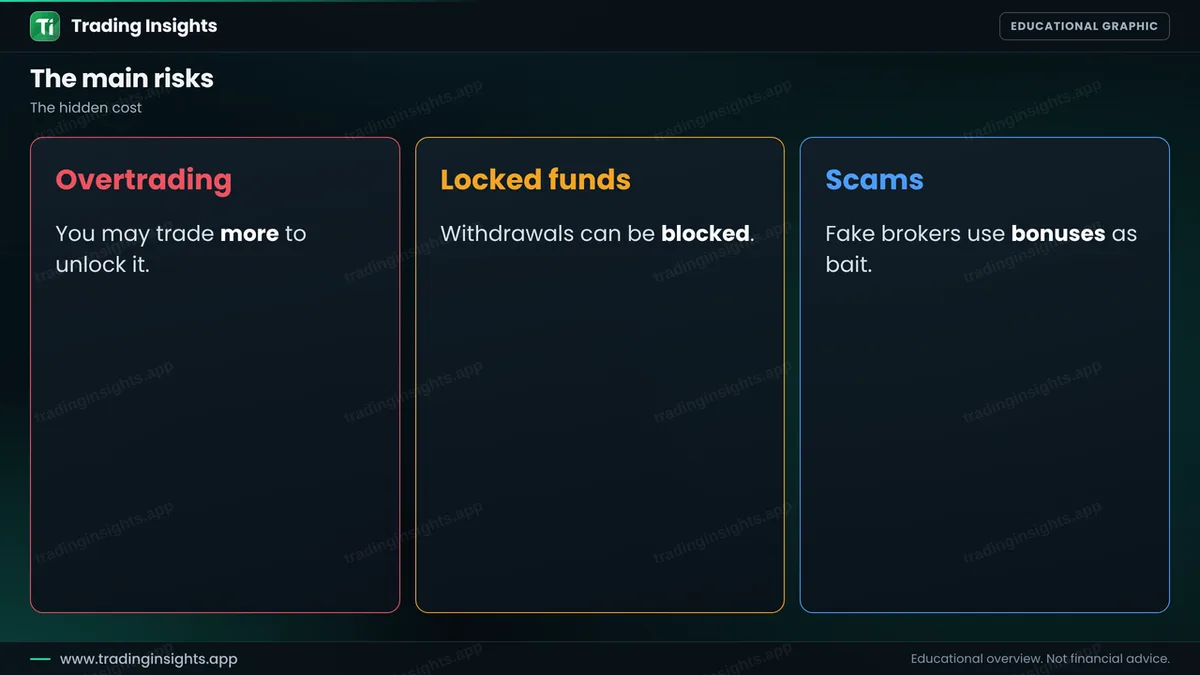
The largest risk is behavioural. A volume requirement can push you to overtrade, and overtrading raises costs and loses discipline. Withdrawals can be blocked until the terms are met. And fake brokers often use large bonuses as bait to attract deposits.
Rules for evaluating an offer
- Confirm the broker is regulated and that bonuses are allowed where you live.
- Read the full terms, including volume, profit and withdrawal rules.
- Calculate the cost of the required volume, using real spread and commission figures.
- Compare that cost with the bonus. If the cost is close to the credit or above it, decline.
- Keep your own risk rules unchanged, including the size of each trade.
- Check any size with the position size calculator before you trade.
- Keep a record of the terms in case of a dispute.
Two illustrative examples
The figures are invented for the exercise and are not real accounts.
Illustrative example 1 (win, rules unchanged). The trader above keeps the usual risk. The account is $1,000, the risk is 1%, or $10, and the EUR/USD trade has a 20-pip stop and a 40-pip target. The size is 10 / (20 x 10) = 0.05 lot. The target is reached, and the trade makes 0.05 x 40 x 10 = $20. It is a small gain, and it shows how slowly 40 lots would be built up.
Illustrative example 2 (loss, chasing volume). Another trader decides to hurry and trades 0.50 lot, ten times the planned size, on the same 20-pip stop. The risk is 0.50 x 20 x 10 = $100, which is 10% of the $1,000 account. The stop is hit, and the trade loses $100. The loss is large against the bonus, and the volume requirement has barely moved.
Common mistakes
- Accepting without reading the terms. The headline number hides the conditions. Read every line first.
- Raising risk to meet a volume target. This breaks your risk rules to chase credit. Keep risk per trade fixed.
- Trusting unlicensed brokers with big offers. Large bonuses are a common lure. Check the regulator first.
- Forgetting that withdrawals may remove the bonus. One withdrawal can cancel the credit and any profits tied to it. Ask before you withdraw.
- Ignoring regional rules. An offer may not be legal where you live. Check your local regulator's guidance.
Pre-trade checklist for accepting a bonus
- Is the broker licensed, and have I verified it myself?
- Are bonuses allowed in my region?
- What is the volume requirement, and what does it cost in spread?
- What happens to the bonus and profits if I withdraw?
- Does the offer change my usual trade size or leverage?
- Do I have the terms in writing?
Frequently asked questions
What is a forex deposit bonus?
It is extra credit added to your account when you deposit, usually with volume or time conditions. The credit often cannot be withdrawn directly.
Are forex bonuses allowed everywhere?
No. Several regulators restrict or ban them for retail clients, so check your region. A broker offering them anyway may be operating outside local rules.
What should I check first?
The broker's licence, then the volume requirement, withdrawal rules and time limit. Work out what the required volume will cost you in spread.
Should I accept a bonus?
Only if the terms are clear and it does not change your risk rules. Many traders decline them to keep their account simple.
Your next step
Pick any bonus offer you have seen and write down its volume requirement. Multiply the lots by the broker's spread cost per lot and compare the result with the bonus. If you meet an unfamiliar term, look it up in the glossary.
The material on broker bonuses is for learning purposes and is not financial advice. Currency trading carries a high risk of losing money, and bonuses can lead to extra costs and larger losses.


