
A price such as 1.10253 on EUR/USD ends in a pipette, the fifth decimal and one tenth of a pip. Most brokers now quote prices this way, and some platforms also use the word point. Mixing these units is a quiet source of costly mistakes, especially when you type a stop, because 30 pips and 30 points can be very different distances.
Pip, pipette and point
For most pairs, a pip is 0.0001. For pairs involving the Japanese yen, a pip is 0.01. A pipette is a tenth of a pip, so 0.00001 on EUR/USD and 0.001 on USD/JPY. A point is a platform term. On many platforms it equals a pipette, but definitions differ, so check yours before relying on it.
| Unit | EUR/USD | USD/JPY |
|---|---|---|
| Pip | 0.0001 | 0.01 |
| Pipette | 0.00001 | 0.001 |
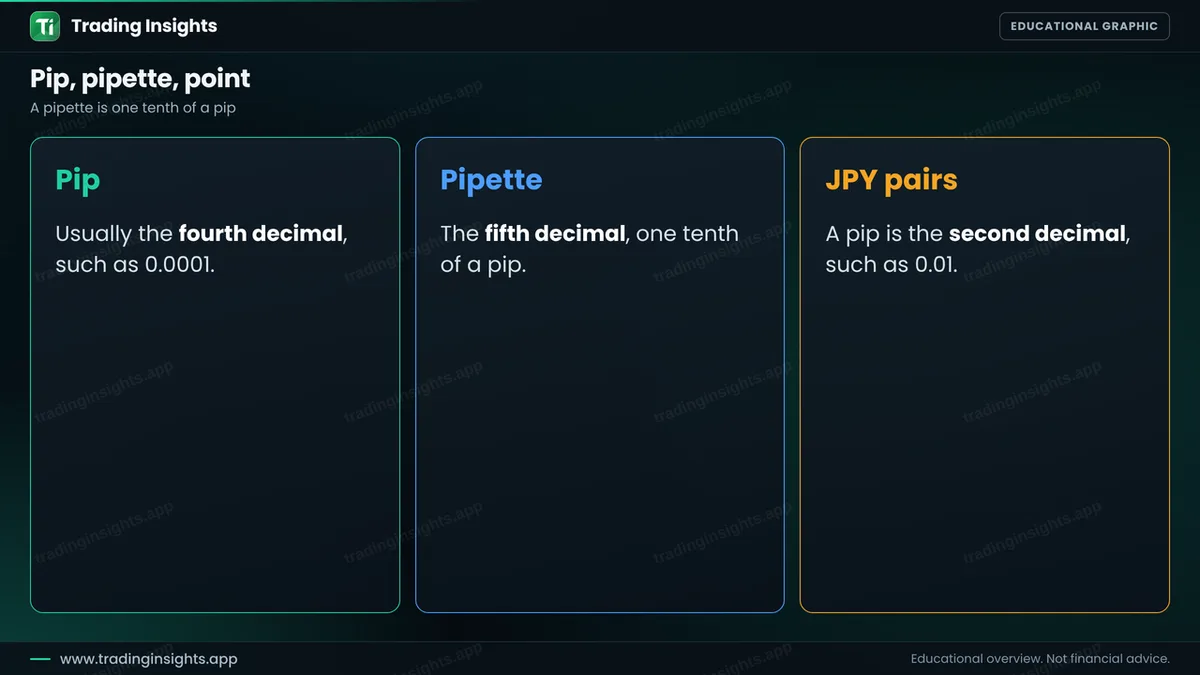
Ten pipettes in a pip
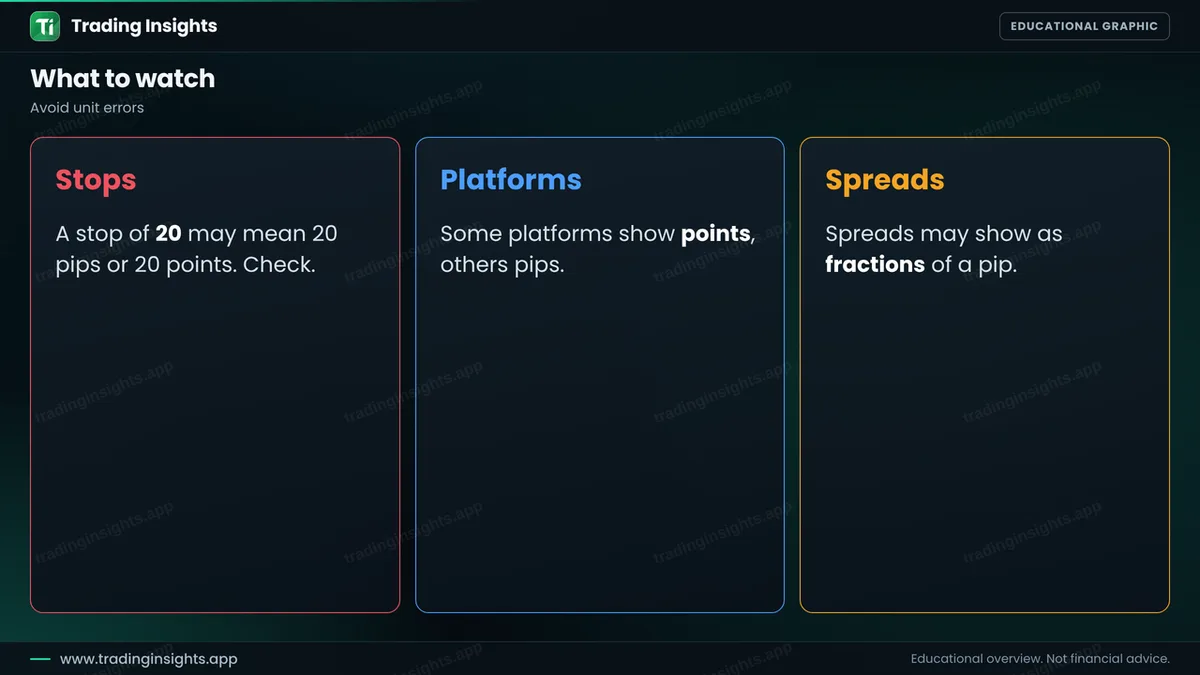
If EUR/USD moves from 1.10000 to 1.10010, that is 10 pipettes, which is 1 pip. When a broker shows a spread of 8 points on a fractional-pip platform, it is usually 0.8 of a pip. Reading the spread in the right unit matters, because a spread of 8 pips and one of 0.8 pips are very different costs. For the money value of a pip on different lot sizes, the pip calculator gives the figure instantly.
Counting a move
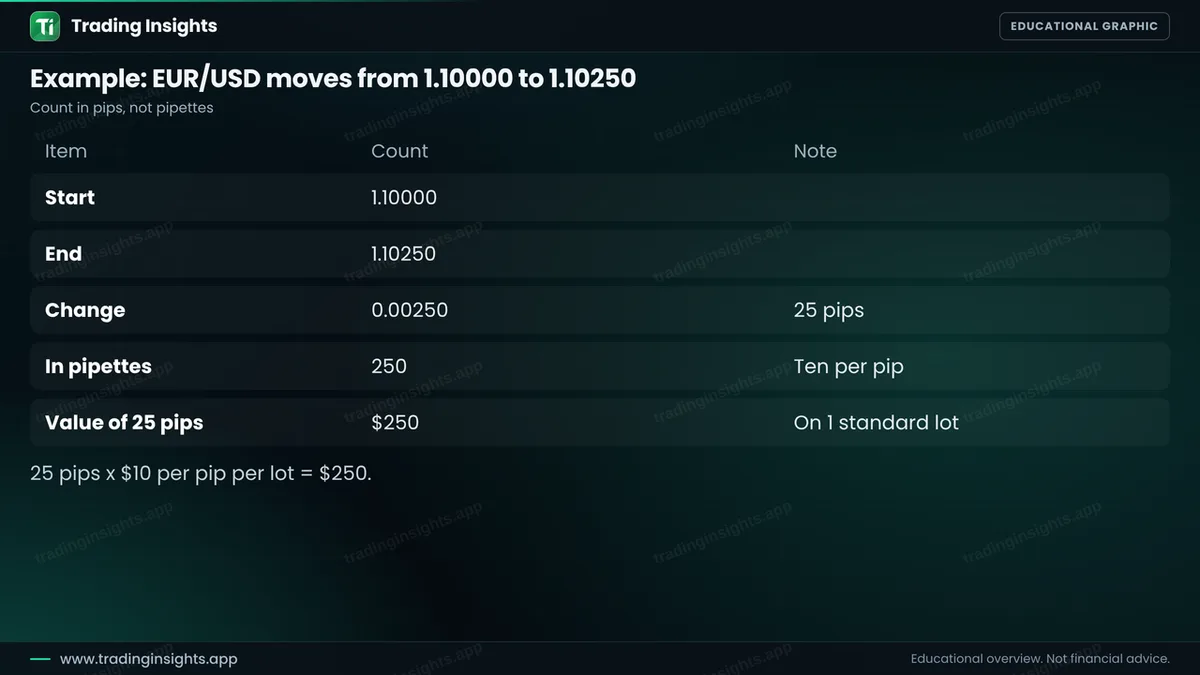
If EUR/USD moves from 1.10000 to 1.10250, the change is 0.00250. That is 25 pips, or 250 pipettes. At $10 per pip per standard lot, the move is worth $250 on one lot. Always convert to pips before using any position size formula, since the formulas assume pips.
Step-by-step rules to avoid unit errors
- Learn your platform's units. Find out whether its stop field uses price, pips or points, and what each is worth.
- Convert the stop to pips before sizing. Divide the price distance by 0.0001, or by 0.01 for yen pairs.
- Size the trade from pips. The position size calculator takes the stop in pips.
- Read the spread in pips, converting if the platform shows points.
- After entering, look at the stop on the chart in price terms and confirm it sits where you planned.
- Set the take-profit the same way, and check the reward-to-risk ratio.
Illustrative example: a unit error in the stop
A trader with a $7,000 account plans to buy GBP/USD at 1.27400 with a 20-pip stop at 1.27200, and sizes the trade for 1% risk, or $70.
Position size: $70 / (20 pips x $10 per pip per lot) = 0.35 lot.
Used to a platform where 200 points means 20 pips, the trader types 200 in the stop field of a new platform that counts in pips, so the stop lands 200 pips away at 1.25400. If that stop is hit, the loss is 0.35 lot x 200 pips x $10 = $700, or 10% of the account, instead of the $70 planned. The size was right, and the unit was wrong.
Illustrative example: reading the units correctly
A trader with a $9,000 account wants to buy USD/JPY at 149.250 with a stop at 148.850 and a target at 150.050. The stop is 0.400 away, which is 40 pips, or 400 pipettes, since a yen pip is 0.01. The target is 0.800 away, which is 80 pips. Risk is 0.5%, or $45. One pip on one lot is about $6.70, because it is 1,000 yen converted at 149.25.
Position size: $45 / (40 pips x $6.70 per pip per lot) = 0.16 lot.
Price reaches the target. Result: 0.16 lot x 80 pips x $6.70 = $85.76. Counting in pips from the start, and checking the levels on the chart, kept the trade exactly as planned.
Why the extra digit exists
Brokers quote an extra decimal to show finer price changes and tighter spreads. It does not change how you count profit and loss in pips. It only means the price has more precision. When you think in pips, you can ignore the last digit, and doing so avoids most of the confusion. Some platforms label the extra digit as a point, and some show spreads in points even when the chart shows pips, so a quick test on a demo account, placing a trade with a known stop and reading the result, removes any doubt. Terms such as pip, lot and spread are also defined in the glossary.
Common mistakes
- Confusing points with pips. On many platforms a point is a tenth of a pip. Look up your platform's definition.
- Entering a stop in the wrong unit. A stop ten times too small is hit by noise, and one ten times too large risks more than planned. Check the price on the chart.
- Forgetting that yen pairs use the second decimal. A pip on USD/JPY is 0.01, not 0.0001. Use the right pip when sizing.
- Calculating the lot size from pipettes. The formula needs pips. Convert first.
- Reading the spread in the wrong unit. A spread of 8 points is not 8 pips. Convert before judging the cost.
Pre-trade checklist
- Do I know whether my platform uses pips, points or price?
- Is the stop converted to pips for sizing?
- Does the stop on the chart sit where I planned?
- Is the spread read in pips?
- Is the take-profit the right distance?
- Is the lot size taken from the stop distance?
Frequently asked questions
What is a pipette?
One tenth of a pip, shown as the fifth decimal on most pairs and the third decimal on yen pairs.
How many pipettes are in a pip?
Ten.
Is a point the same as a pip?
Not always. On many platforms a point equals a pipette, so check how your platform defines it.
How do I avoid unit mistakes?
Check the stop on the chart after entering it, and know whether your platform uses pips or points.
This pipette article is for education only and is not financial advice. Trading carries risk, and a unit error can make a loss many times larger than planned. The pipette examples are illustrative and not real market data.


