
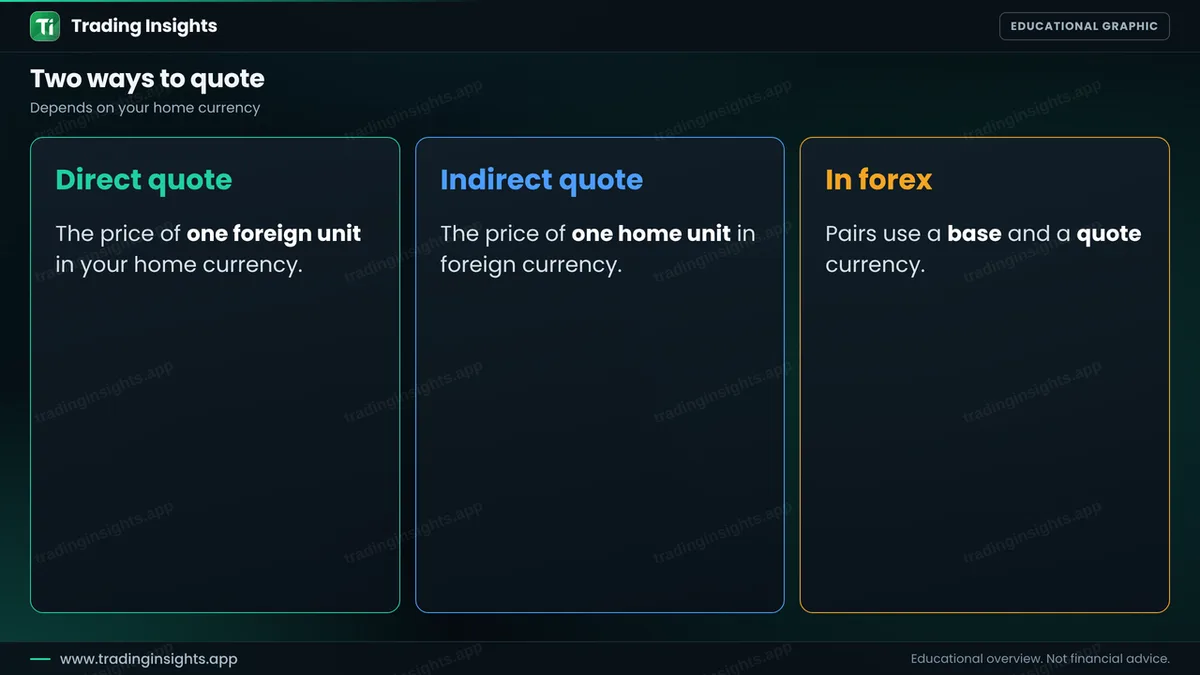
An exchange rate says how many units of one currency you pay for one unit of another. A direct quote expresses the price of one unit of foreign currency in your home currency. An indirect quote expresses the price of one unit of your home currency in foreign currency. Which label applies depends on where you live, so traders rely on a fixed convention instead: every pair is written BASE/QUOTE, and the rate is the amount of the quote currency needed to buy one unit of the base currency.
Direct versus indirect quotes
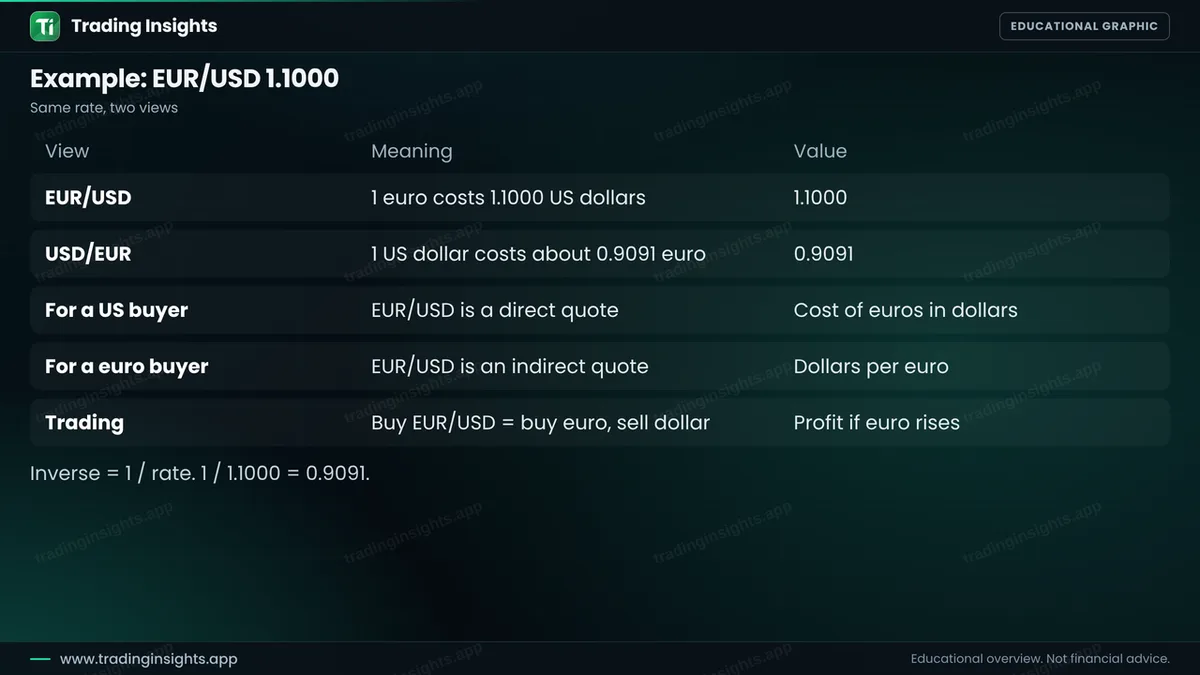
Take EUR/USD at 1.1000. For someone who thinks in US dollars, one euro (foreign) costs 1.1000 dollars (home). That is a direct quote. For someone who thinks in euros, the same rate is awkward: they would rather know that one dollar costs about 0.9091 euro. That is an indirect quote.
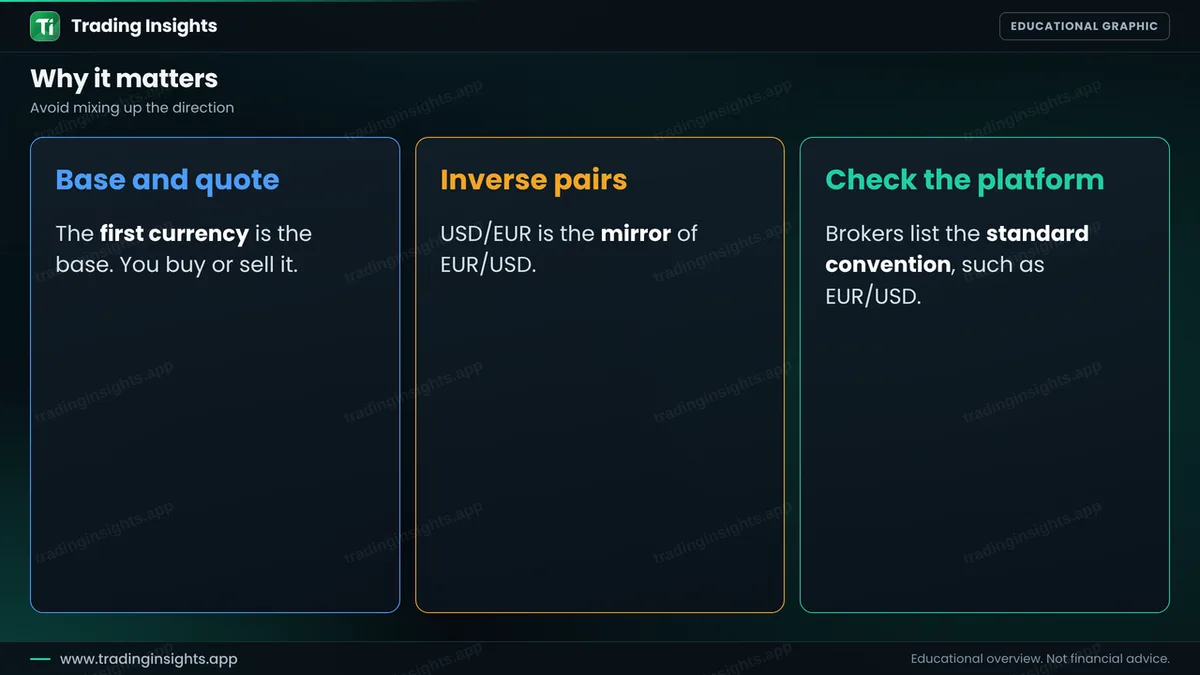
The two views are inverses of each other. Nothing about the market differs; only the viewpoint does. Retail forex platforms avoid the confusion by listing standard pairs, such as EUR/USD, GBP/USD and USD/JPY, in the same direction for everyone.
Base currency and quote currency
In EUR/USD, EUR is the base and USD is the quote. This has direct consequences for your order.
- Buying EUR/USD means buying euros and selling dollars. You gain if the euro rises against the dollar.
- Selling EUR/USD means selling euros and buying dollars. You gain if the euro falls.
- The quote currency sets the pip value. On pairs that end in USD, one pip on one standard lot is about $10. On pairs such as USD/JPY the pip is paid in yen, so the dollar value changes with the rate. The pip calculator handles this.
A rate going up means the base currency is gaining against the quote currency. It does not say the base is strong in general, only against that one partner.
Worked conversion: EUR/USD at 1.1000
EUR/USD at 1.1000 means 1 euro = 1.1000 dollars. To flip the rate, divide 1 by it: 1 / 1.1000 = 0.9091. So 1 dollar = about 0.9091 euro, and a USD/EUR quote would read 0.9091.
Use the rate to convert amounts. 5,000 euros are worth 5,000 x 1.1000 = 5,500 dollars. To go the other way, 5,500 dollars are worth 5,500 / 1.1000 = 5,000 euros. The rule of thumb is simple: multiply when you go from the base currency to the quote currency, and divide when you go from quote to base.
How to flip a rate safely
Flipping is just division, but errors creep in when people mix the two directions.
- Decide what you want. Do you want the price of the base in quote terms, or the reverse?
- Check the pair name. If you want the price of one yen in dollars and the screen shows USD/JPY at 150.00, you need the inverse.
- Divide once. 1 / 150.00 = about 0.00667 dollar per yen.
- Stay consistent. Never combine a rate and its inverse in one calculation.
The same logic gives cross rates. If EUR/USD is 1.1000 and USD/JPY is 150.00, then EUR/JPY is about 1.1000 x 150.00 = 165.00. Quote currencies cancel when you multiply a chain of rates so that the middle currency appears once as quote and once as base.
Where the direct/indirect label confuses people
- Switching between brokers. Some platforms list USD/CAD, others CAD/USD. Always read the pair name before clicking.
- Reading news in a different convention. A report may say "the dollar rose against the yen" while your chart shows USD/JPY. Convert the sentence into base and quote terms.
- Using a home-currency view. A trader in Europe who sees EUR/USD as indirect may reverse their reasoning. Stick to base and quote instead.
- Pip calculations. The pip value depends on the quote currency and your account currency.
Step-by-step: reading any pair before you trade
- Name the base and the quote. The first currency is the base.
- Say what a rise means. A higher rate means the base is gaining on the quote.
- Pick the direction. Buy if you expect the base to rise, sell if you expect it to fall.
- Check the pip value for your account currency.
- Set the stop and target in pips from the entry price on the same pair.
- Size the position with the position size calculator.
For other terms such as lot and spread, see the glossary.
Two illustrative examples
Both examples use a $6,000 account risking 0.75% ($45) per trade. The prices are invented.
Illustrative example 1: reading the pair correctly (a win)
A trader expects the pound to fall against the dollar. They know that in GBP/USD the pound is the base, so a fall in the pound means a fall in the rate, and they sell. The entry is 1.2840, the stop is at 1.2885, 45 pips above, and the target is at 1.2750, 90 pips below. With a $6,000 account risking 0.75% ($45), the position size is $45 / (45 pips x $10 per pip per lot) = about 0.10 lot. A win of 90 pips pays about $90; a loss costs about $45. Price falls to the target, a gain of 1.5% of the account.
Illustrative example 2: misreading the direction (a loss)
Another trader expects the Australian dollar to weaken against the US dollar and sells AUD/USD at 0.6520. Selling is the correct order for that view. The stop is set at 0.6550, 30 pips above, and the rate rises on a surprise data release. With a $6,000 account risking 0.75% ($45), the position size is $45 / (30 pips x $10 per pip per lot) = about 0.15 lot. A win of 60 pips would pay about $90; a loss costs about $45. The stop is hit and the trade loses about $45. The point of this example is the sizing: the loss stayed at the planned 0.75%, even though the view was wrong. A trader who had misread the base currency and bought instead would have had the opposite exposure to the one intended.
Common mistakes
- Thinking a higher number means the first currency is strong in general. It means strength only against the second currency. Compare each currency against more than one partner.
- Buying the wrong direction on a flipped pair. If a pair is listed as USD/CAD and you wanted to bet on the Canadian dollar rising, you must sell it. Read the pair name before you click.
- Ignoring the quote currency in pip value. A pip on USD/JPY is not worth $10. Use a calculator.
- Mixing a rate and its inverse in one calculation. This gives wrong prices. Flip once and stay consistent.
- Forgetting the spread. You buy at the ask and sell at the bid, so the price you see is not the price you get.
Quote-reading checklist
- Which currency is the base, and which is the quote?
- Does a higher rate mean my base currency rises?
- Is my order direction (buy or sell) the one that matches my view?
- Do I know the pip value for my account currency?
- Have I calculated the stop and size from the same price format?
- Have I checked that my platform shows the pair I intended?
Frequently asked questions
What is a direct quote?
It is the price of one unit of foreign currency in your home currency. For a US-based person, EUR/USD at 1.1000 is a direct quote.
What is an indirect quote?
It is the price of one unit of your home currency in foreign currency. The same EUR/USD rate, read as 0.9091 euro per dollar, is indirect for a US-based person.
How do I invert a rate?
Divide 1 by the rate. For EUR/USD at 1.1000, the inverse is about 0.9091.
Which currency is the base?
The first currency in the pair. EUR is the base in EUR/USD, so a buy order means buying euros.
This is educational only, not financial advice. The prices and results are illustrative and not real market data. Trading carries risk of loss, and a wrong direction or position size can lose money quickly.


