

Your trading platform shows five numbers that are easy to confuse. Balance is your deposits plus the results of closed trades. Equity is balance plus the floating profit or loss on open trades. Used margin is the deposit your broker holds against open positions. Free margin is equity minus used margin. Margin level is equity divided by used margin, shown as a percentage. Of the five, equity and margin level matter most, because they show where you stand right now and how far you are from a margin call.
What each number means
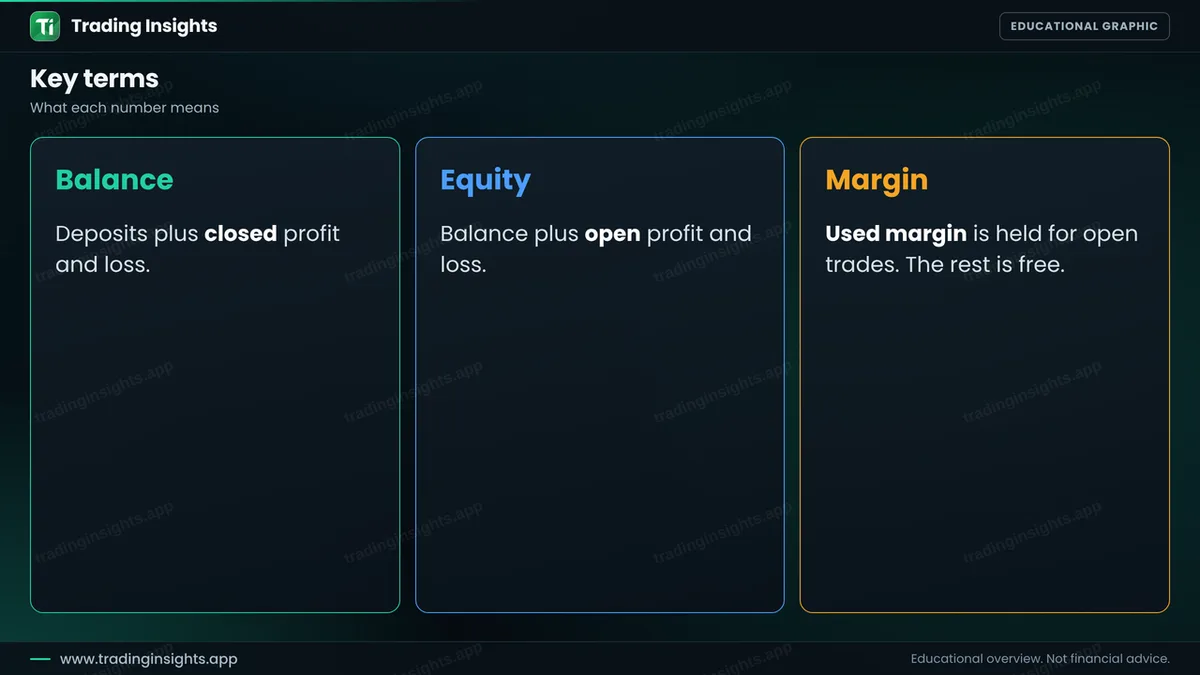
Balance changes only when a trade closes or when you deposit or withdraw. An open trade that is down 400 dollars does not change it, which is why it can give a false sense of safety.
Equity is the live value of the account. If you closed everything this second, equity is what you would hold, before any final spread cost. It moves with every tick.
Used margin is the part of your equity that the broker sets aside as a good-faith deposit for the positions you hold. It is not a fee and it is not lost. It is released when the position closes.
Free margin is what remains after used margin. It limits how many new positions the platform will let you open, but it is not a recommendation for how many you should open.
Margin level is equity divided by used margin, multiplied by 100. A high figure means plenty of room; a low figure means a margin call may be near.
A worked example
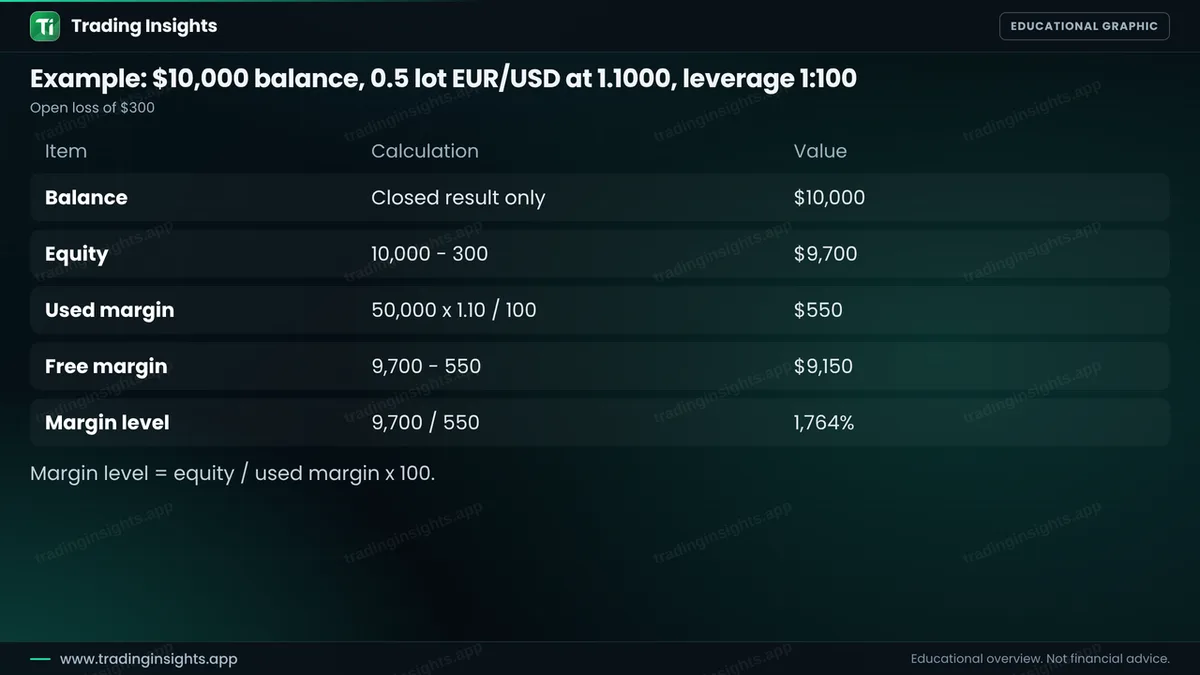
A trader has a $10,000 balance and opens 0.5 lot of EUR/USD at 1.1000 with leverage of 1:100. The position is 50,000 euros, worth 50,000 x 1.10 = $55,000, and the margin is 1% of that, about $550.
The trade is $300 down. Equity is $10,000 - $300 = $9,700. Free margin is $9,700 - $550 = $9,150. Margin level is $9,700 / $550 x 100 = about 1,764%.
Brokers set their own margin call level and stop-out level, so check yours. For the effect of leverage on both gains and losses, remember that the margin rate in this example, 1%, is what makes a $55,000 position possible with a $10,000 account.
Why margin level falls
Margin level falls in two ways: equity drops because open trades lose, or used margin rises because you open more positions. Both can happen together. As an illustration, suppose the loss in the example above grew to $9,500 with used margin unchanged. Equity would be $500 and margin level would be $500 / $550 x 100 = about 91%. That is far below the starting level, and it shows how quickly a large position can use up an account.
Margin is not the same as risk. The margin on a trade says how much the broker holds, while the stop distance and lot size say how much you can lose. A small margin requirement can sit beside a large possible loss, which is the reason to size from risk and not from margin.
How to use these numbers
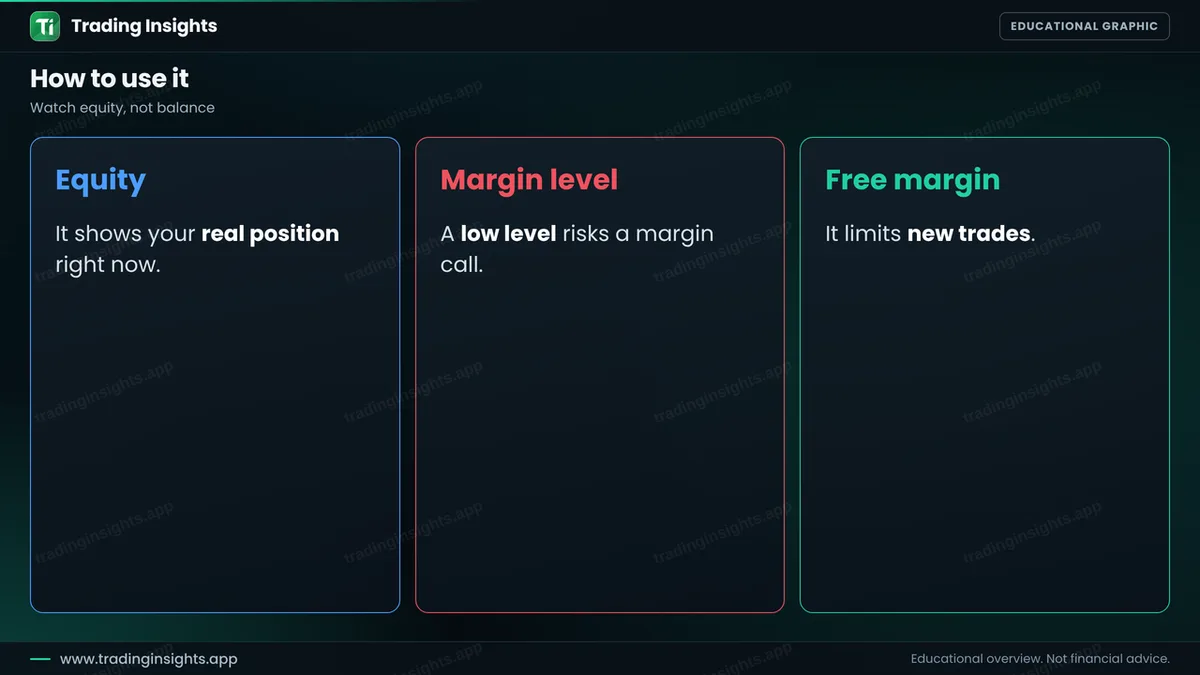
- Watch equity, not balance. Equity includes open losses.
- Keep the margin level high. Treat a falling level as a signal to cut size, not to add.
- Check free margin before adding trades, but size from your risk rule.
- Know your broker's margin call and stop-out levels. They differ between brokers and account types.
- Account for correlated trades. Two positions in similar pairs raise used margin and risk together. See correlation-adjusted position sizing.
Illustrative example: sizing from risk (a win)
This is an illustrative example. A trader with a $10,000 account risks 1.5% ($150) on a long in EUR/USD with a 27-pip stop and a 54-pip target. With a $10,000 account risking 1.5% ($150), the position size is $150 / (27 pips x $10 per pip per lot) = about 0.56 lot. A win of 54 pips pays about $302; a loss costs about $150. The price reaches the target. Throughout the trade, used margin stays modest and the margin level stays far above any warning zone, because the position was sized from the stop.
Illustrative example: sizing from margin (a loss)
This is another illustrative example. A second trader looks at free margin, sees room for several lots, and opens 3 lots of GBP/USD with the same kind of stop, 46 pips wide. A 46-pip loss on 3 lots costs about 3 x 46 x $10 = $1,380, nearly 14% of the account, and the used margin is also far higher. The risk-based rule for the same account is: With a $10,000 account risking 1.5% ($150), the position size is $150 / (46 pips x $10 per pip per lot) = about 0.33 lot. At that size the same stop loses about $150. One trader sized from risk; the other sized from what the broker allowed.
What to check on your own platform
Platforms label these numbers a little differently. Some show margin level as a percentage; others show only free margin. Open your account panel with no trades and write down what you see. Then open one small demo trade and watch each number change: used margin rises, free margin falls, and equity moves with the floating result. A few minutes on a demo account teaches the panel better than any definition.
Also check how your broker treats pending orders, hedged positions and weekend gaps, since each can affect the margin used. For a sense of how losses compound against an account, see drawdown recovery math, and use the position size calculator to turn a stop and a risk percentage into lots.
Common mistakes
- Looking at balance and ignoring equity. Open losses are real. Make equity the number you watch.
- Using all the free margin because it is there. Free margin is a limit, not a target. Size from your risk rule.
- Not knowing the stop-out level. If you do not know it, you cannot judge how close you are. Look it up with your broker.
- Adding to a losing trade as the margin level falls. This raises used margin while equity shrinks. Reduce risk instead.
- Confusing margin with risk. A small margin requirement does not mean a small possible loss.
Account-panel checklist
- Write down balance, equity, used margin, free margin and margin level for your open trades.
- Compare equity with balance to see your floating result.
- Look up your broker's margin call and stop-out levels.
- Calculate the loss if each open trade hits its stop, and compare the total with your risk limit.
- Check whether open trades are correlated.
- Decide in advance at what margin level you will reduce size.
Frequently asked questions
What is the difference between balance and equity?
Balance counts closed trades only. Equity adds the profit or loss on open trades, so it shows the current value of the account.
What is free margin?
It is equity minus used margin, and it is what the platform lets you use for new trades. It is a limit, not a guide to how much to trade.
What is margin level?
It is equity divided by used margin, shown as a percentage. A low value means a margin call may be close.
Which number should I watch most?
Equity and margin level. They show your current position and how close you are to a margin call.
This is educational only, not financial advice. Trading carries risk of loss, and leverage can magnify losses beyond your deposit in some cases. The examples use made-up numbers and are not real market data.


