
Much of trading is waiting. The best setups are rare, and the market spends long periods doing very little. For many people that is the hardest part. They open the platform, nothing is happening, and a trade that is not quite right starts to look acceptable, just to feel involved. This article looks at boredom and the need for excitement, and shows how to turn waiting into part of the plan.
The problem
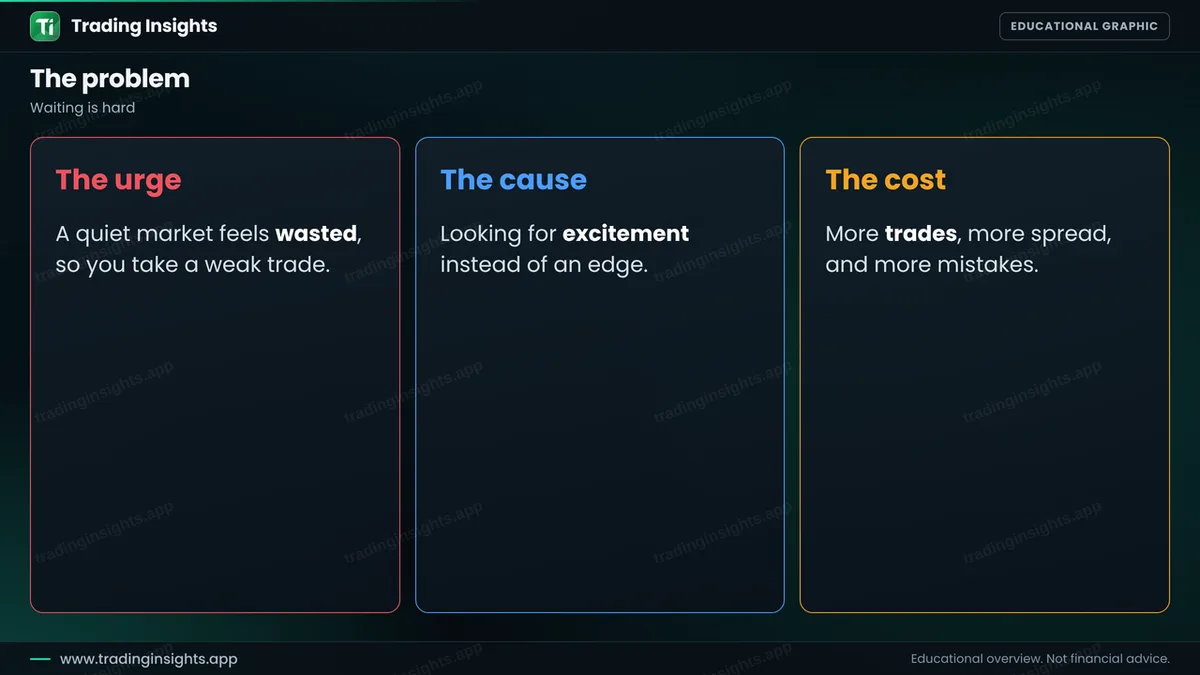
The urge feels natural. A quiet market seems like wasted time, and a trade makes the screen come alive. Some traders also seek the thrill of risk: the uncertainty, the quick result and the sense of action. That is close to gambling behaviour. The cost is real: weaker setups, more spread paid and larger losses as discipline erodes.
Why waiting is built into the job
A tested setup does not appear every hour. If your method produces a good trade a few times a week, then most of your screen time will be spent without a trade. That is not a flaw in the method, it is the shape of the work. A trader who takes ten trades a day with a method that offers two is paying for eight trades with no edge.
Habits that help
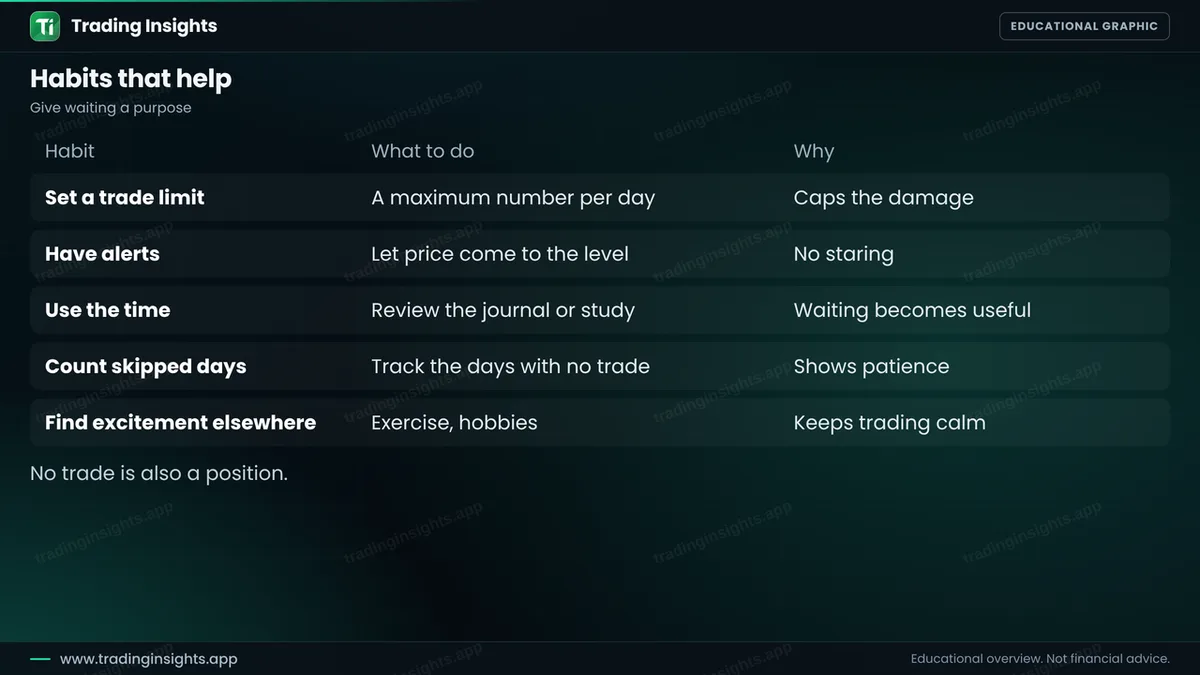
- Set a trade limit. A maximum number of trades per day caps the damage from a restless session.
- Use alerts. Set price alerts at the levels in your plan, and let the price come to you. You do not need to stare at the chart.
- Use the time. Review the journal, study a pattern, or update your levels. Waiting becomes work that improves your edge.
- Count the skipped days. Note days with no trade as a success when the plan offered nothing.
- Find excitement elsewhere. Exercise, sport or a hobby can give you the stimulation that trading should not have to provide.
How to stay on plan
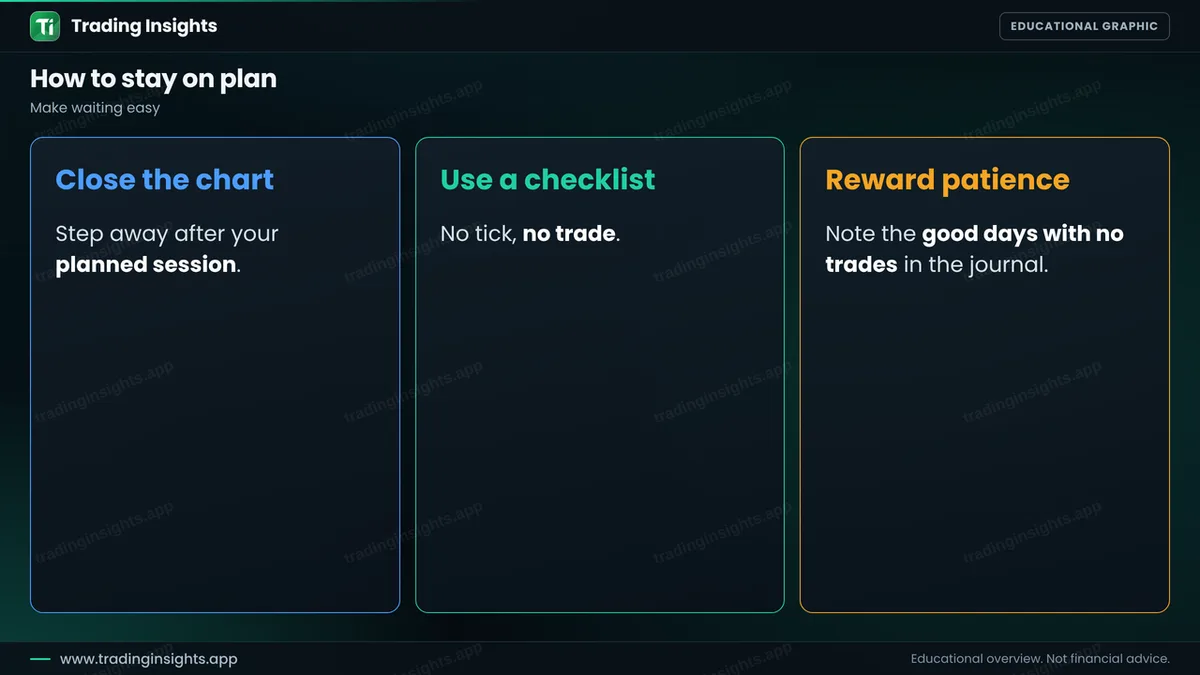
Close the chart once your planned session ends, because fewer hours on the screen means fewer chances to force a trade. Use a checklist so that no tick means no trade. In the journal, mark days when you saw no valid setup and did nothing as "good days".
When it may be more than boredom
If you feel a strong need to trade, cannot stop even after large losses, hide your trading from others or borrow money to continue, it may be a sign of a gambling problem. It is worth talking to a doctor, a counsellor or a support service. Trading should be a planned activity with a budget you can afford to lose, and no plan replaces getting help when it is needed.
Where the advice does not apply
Some styles, such as scalping or high-frequency day trading, have more setups by design, and for them a trade limit might be higher. The idea is not "trade less" for everyone, but "trade only what the plan offers". If your plan offers many setups, then waiting is shorter.
What to do, in order
- Write the number of trades per day you will allow, and the setups that qualify.
- Set alerts at your levels and close the chart in between.
- Define a stop and target before you enter, with a reward of at least twice the risk.
- Size from the stop using the position size calculator, with a fixed small risk. If a term in the planned setup is new, look it up in the glossary.
- Log every day, including the days with no trades.
- Review weekly how many trades followed the plan and how many were taken out of boredom.
Illustrative example: waiting for the alert
This is an illustrative example, not a real trade. A trader with a $25,000 account sets an alert at a resistance level on EUR/USD and spends the morning reviewing the journal. When the alert fires, the trader waits for a bearish trigger candle and sells at 1.0688, with a stop 27 pips higher at 1.0715 and a target 54 pips lower at 1.0634. Risk is 0.5%, or $125, so lot size is about 0.46. Price falls to the target for about $248, or 0.99%. The trader took one trade in a whole session, and it was the one that fitted the plan.
Illustrative example: a trade "to do something"
Another illustrative case. On a slow day the same trader gets restless and buys GBP/USD at 1.2612 in the middle of a range, with no level behind it. A stop 39 pips lower at 1.2573 and a target 78 pips higher at 1.2690 are placed, but only because the platform asks for them. Risk is 1% ($250), and lot size is about 0.64. Price drifts down and the stop is hit for a loss of about $250, or 1.00%, plus the spread. The market was identical on both days. The difference was whether the trade came from the plan or from the need to act.
Common mistakes
- Watching the chart for hours with nothing to do. Staring invites action. Use alerts and step away.
- Taking a trade because "it has been a while". Time since the last trade is not a signal. Check the setup against the plan.
- Increasing the size to make a trade more exciting. That is gambling behaviour. Keep risk fixed.
- Feeling guilty about days with no trades. A day without a valid setup is a day the plan worked. Record it as a good day.
- Ignoring signs of compulsive behaviour. If you cannot stop, get support. Do not rely on willpower alone.
Pre-trade checklist
- The setup is one of the ones written in my plan.
- It is at a level, and the trigger candle has closed.
- I know the stop and the target before I enter.
- I am within my trade limit for the day.
- I am not trading just to feel involved.
- Money at risk stays within my fixed per-trade limit.
Frequently asked questions
Why do I take trades when I am bored?
A quiet market feels like wasted time, and a trade offers action and excitement even without an edge. It is a common human reaction.
How can I stop forcing trades?
Set a trade limit, use alerts, spend waiting time on review, and use a checklist so that no tick means no trade. None of these needs willpower in the moment, because you set them when calm. Start with the trade limit, since it is the easiest to enforce.
Is a day with no trade a bad day?
No. If you saw no valid setup and did nothing, you followed your plan.
When should I seek help?
If you cannot stop trading after large losses, hide it from others or borrow money to trade, talk to a professional or a support service. A gambling problem is a health issue and not a lack of discipline. Support services and doctors deal with it regularly, and asking early is easier than asking late.
Educational only, and not financial advice. Trade only money you can afford to lose, and if trading feels compulsive, speak to a professional or a support service.


