
Social media can hurt your trading because the feed shows winning trades and hides the losses, which pushes you to compare yourself and take more risk than your plan allows. Open any trading feed and you will see big wins, new cars and perfect entries. What you will not see are the losing trades, the blown accounts and the paid promotions behind some posts. This does not mean every poster is dishonest, but the feed is a highlight reel, built by an algorithm that favours exciting content over honest content.
How social media and trading go wrong
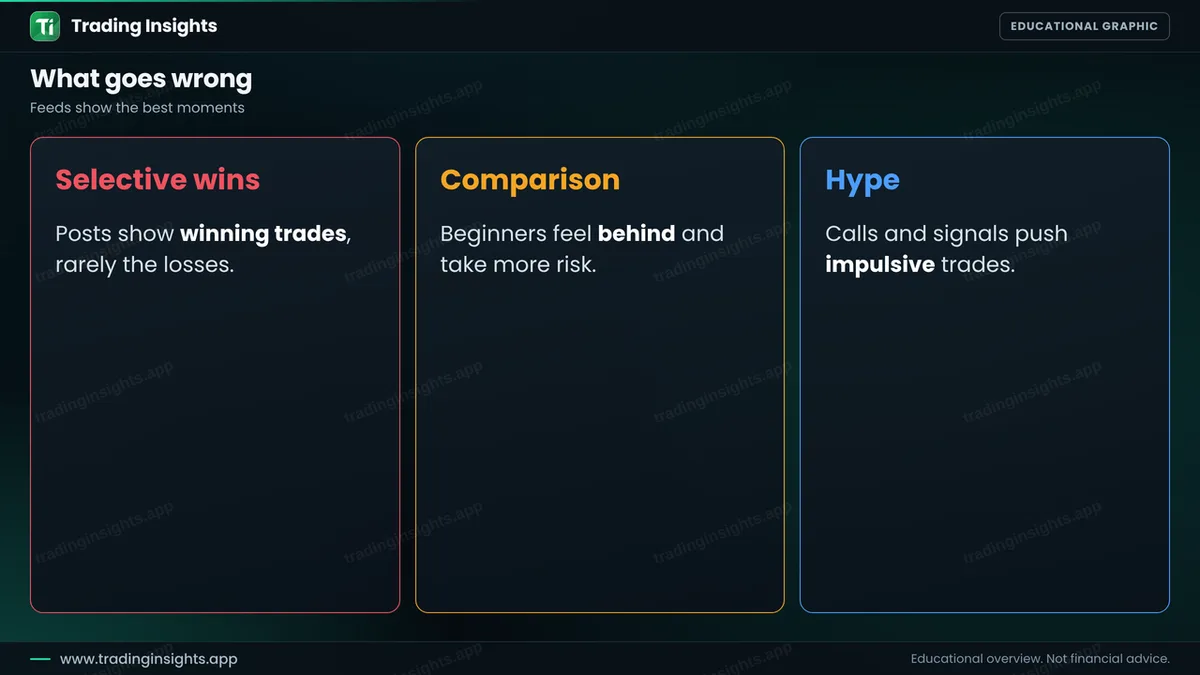
Selective posting is the first problem: one winning screenshot is not a track record, and a feed built from thousands of such screenshots looks like a world where everyone wins constantly. The second problem is comparison, which can push a trader to raise size or trade more often just to catch up to an image that was never representative in the first place. The third is hype — calls and signals that arrive loudly right when a price is already moving, which is the worst possible time to enter on someone else's word rather than your own analysis.
Each of these pulls a trader away from their plan differently: selective posting distorts your sense of normal results, comparison distorts your risk sizing, and hype distorts your timing. None requires the poster to be lying outright — an honest trader sharing only their best week still misleads anyone who does not see the rest of the story.
Why comparison is dangerous for risk management
A new trader sees someone turn a small account into a large one in a few weeks and feels slow by comparison. The natural reaction is to risk more per trade to close the gap. But the post shows only the survivor of that approach, not the much larger number of people who used similar oversized risk and lost their accounts — those accounts do not post follow-up screenshots.
Bigger size does not fix a feeling of being behind, and it does not improve a strategy's actual edge. What it reliably does is raise the chance that an ordinary losing streak, the kind every strategy eventually produces, causes serious and sometimes unrecoverable damage. Risk sizing should come from your account size and your tested strategy, never from a feeling produced by scrolling.
How to read a trading post before giving it any weight
Ask a few simple questions before a post changes how you trade:
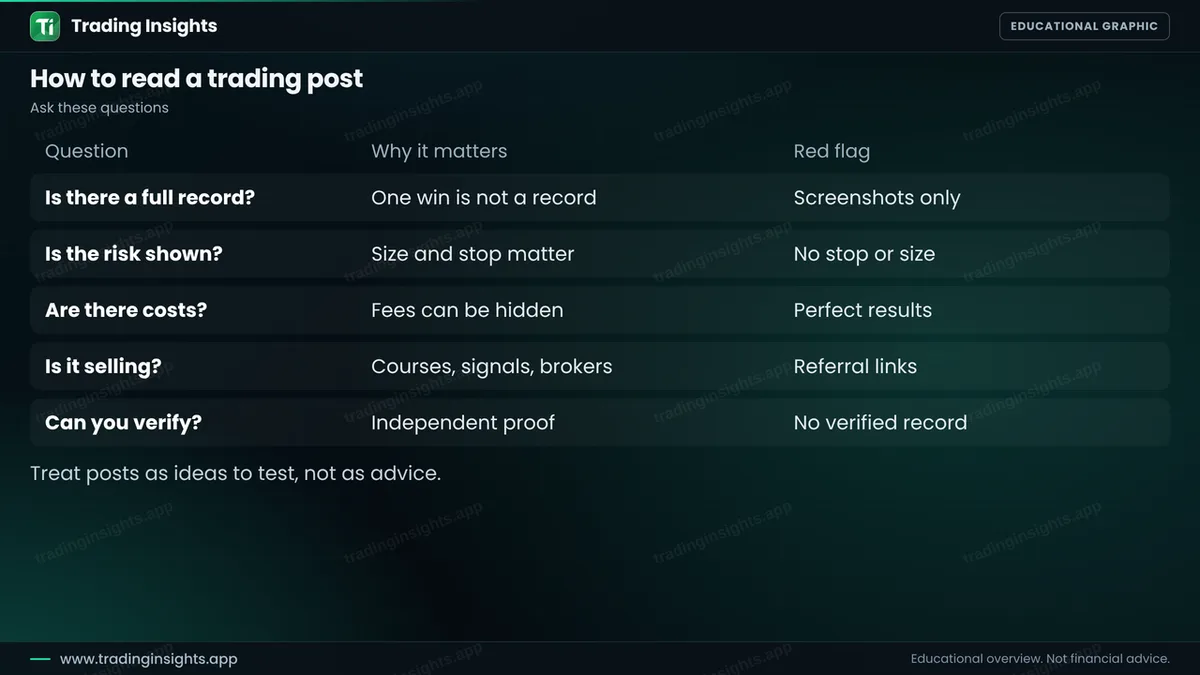
- Is there a full, time-stamped record, or only one screenshot?
- Is the position size and the stop-loss shown, not just the profit?
- Does the poster sell courses, signals or broker referrals?
- Are costs such as spread and commission included in the result?
- Can the results be verified by a third party, rather than taken on trust?
Be especially careful with perfect-looking results and with promises of guaranteed income; treat any post as an idea to test independently, never as advice to act on directly.
Healthier habits for using trading feeds
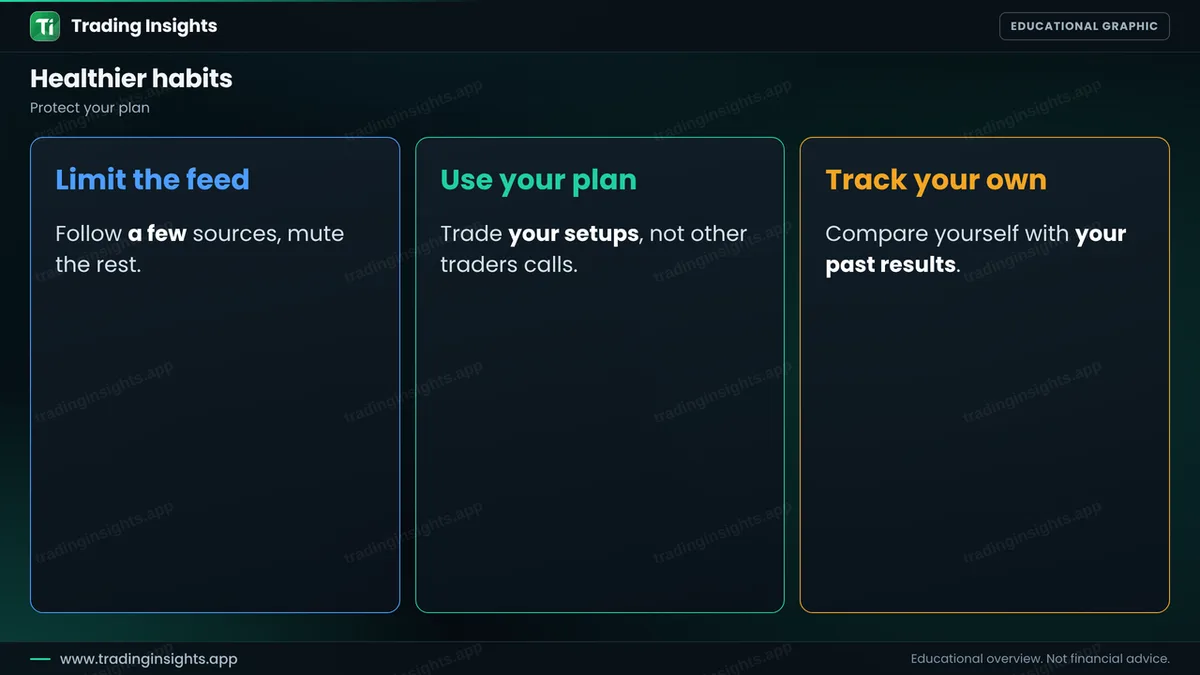
- Limit the feed. Follow a small number of sources you can actually verify, and mute everything else during your trading hours.
- Use your own plan. Trade the setups you have tested and defined yourself, not a shape you saw in someone's post.
- Track your own results. Your journal is the only honest record of your trading; someone else's screenshot tells you nothing about your account.
- Keep risk fixed. Comparison is never a valid reason to change position size; check sizing with the position size calculator instead of adjusting by feel.
- Take breaks from feeds after a loss, when the urge to chase a win and "catch up" is strongest.
Signals that a post is pulling you off plan
Watch for these feelings, which are more reliable warning signs than anything in the post itself: feeling behind right after scrolling, wanting to trade a pair you do not normally follow, wanting to copy a call without knowing its stop, or wanting to raise size right after seeing someone's big win. Any one of these is a cue to close the app and return to your checklist before touching an order ticket.
Illustrative examples: two reactions to the same post
Example 1 (plan followed, win). A trader with a $10,000 account sees a post claiming a 300-pip win and feels the pull to double size. Their plan risks 1% ($100) with a 30-pip stop on EUR/USD, a 1:2 setup checked on the risk-reward calculator, sizing to about 0.33 standard lot. They ignore the post, enter at 1.0850 with a stop at 1.0820 and a target at 1.0910, and the trade reaches target for a gain of roughly $200.
Example 2 (plan broken, loss). A different trader sees the same kind of post and doubles their usual size on an unrelated GBP/USD idea, risking about $200 instead of $100 on a 25-pip stop, buying at 1.2650 with a stop at 1.2625. Price reverses on a data release and hits the stop. The loss is roughly $200 — double a normal, planned loss — for a trade sized by a feeling of being behind rather than by the account's own risk rules.
Common mistakes
- Taking a trade because someone else posted it. You do not know their risk or exit plan, so trade only setups from your own tested plan.
- Raising size to match a feed of big wins. This turns an ordinary losing streak into real, sometimes permanent, damage, so keep risk fixed regardless of what you just saw.
- Trusting results without a full record. A single screenshot proves nothing about overall performance; ask for a verified, continuous history.
- Paying for signals or courses on the strength of a few screenshots. Selling is often the poster's real business model; check the record and the real costs first.
- Checking feeds right after a loss. This is exactly when the urge to chase a comparison trade is strongest, so build in a short break instead.
Pre-trade checklist
- Is this entry from my own tested plan, not something I just saw on a feed?
- Have I checked my normal position size, rather than sizing by feel?
- Is my risk-reward ratio in line with my plan, not adjusted to "catch up"?
- Have I confirmed the stop-loss and target levels before entering?
- Did a post today make me feel behind, and if so, have I let that pass?
- Am I about to trade a pair or setup I do not normally follow?
- Would I still take this trade if I had seen no social media today?
Frequently asked questions
Is social media bad for trading? It can be useful for ideas and learning, but it shows mostly wins and can push comparison and impulsive trades. Used with a plan and a time limit, it does far less harm.
How can I tell if a trading post is reliable? Look for a verifiable record, the risk shown alongside the profit, and no sales pitch attached. Be cautious with perfect results and promises of guaranteed income.
Should I follow trade calls I see online? Be careful. Calls often arrive late, and you rarely know the poster's real risk or exit plan. Test any idea on a demo account first.
What is a healthy way to use trading communities? Use them for learning and feedback, and keep your own plan and risk rules firmly in place. Communities that share losses honestly, not just wins, are more useful.
Can comparison ever be useful? Comparing your current results with your own past performance is useful. Comparing your account with a stranger's edited highlight reel is not.
Your next step
Write one rule into your trading plan today, such as "no feeds during trading hours and no size changes because of a post," and follow it for the next twenty trades before reviewing whether it changed your results.
This is general education, not financial advice. Trading carries risk of loss, the figures above are illustrative and not real market data, and no method or habit guarantees a result.


