
There is no single correct amount of money to start forex trading. Brokers will let you open an account with very little, but a low minimum deposit does not make a small account a good idea. The better questions are how much you can afford to lose, and whether the account is large enough for your risk rules to work. This guide gives you a way to answer both with arithmetic instead of guesswork.
Why small accounts are tricky
A properly sized trade risks a small percentage of the account, often 1% or less. On a small balance that percentage is a tiny amount of money, so even a good winning trade produces a result too small to feel meaningful. That tempts many beginners to risk more than they should, because they want the effort to feel worthwhile. Risking more is the fastest way to lose a small account.
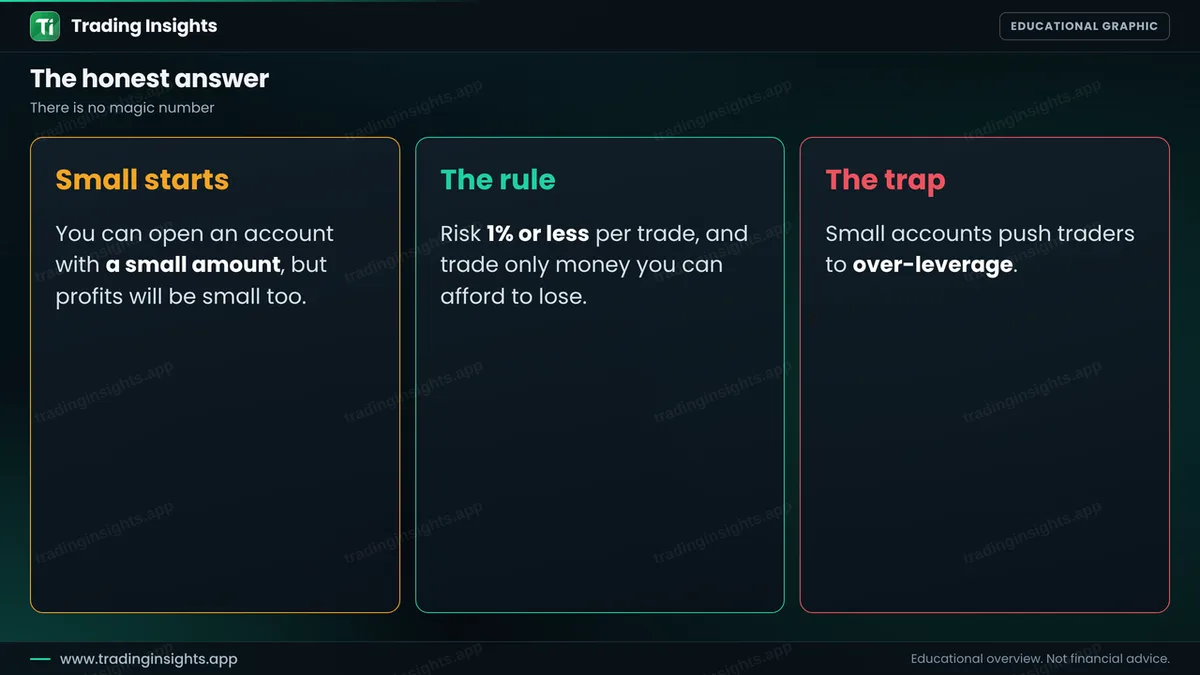
Starting capital is therefore about two things: how much you can lose without damaging your rent, bills or emergency savings, and how much you need so that a sensible stop and lot size fit inside the account.
The smallest account that fits your stop
Most brokers have a minimum trade size of 0.01 lot, a micro lot. On a USD-quoted pair like EUR/USD, one pip on 0.01 lot is worth about $0.10. So the risk of the smallest possible trade is 0.01 x stop in pips x $10. A 30-pip stop risks 0.01 x 30 x $10 = $3. To keep that at 1% of the account, the account must be at least $300. The general rule for these pairs is: minimum account = stop in pips x $10, if you want 1% risk at the smallest size.
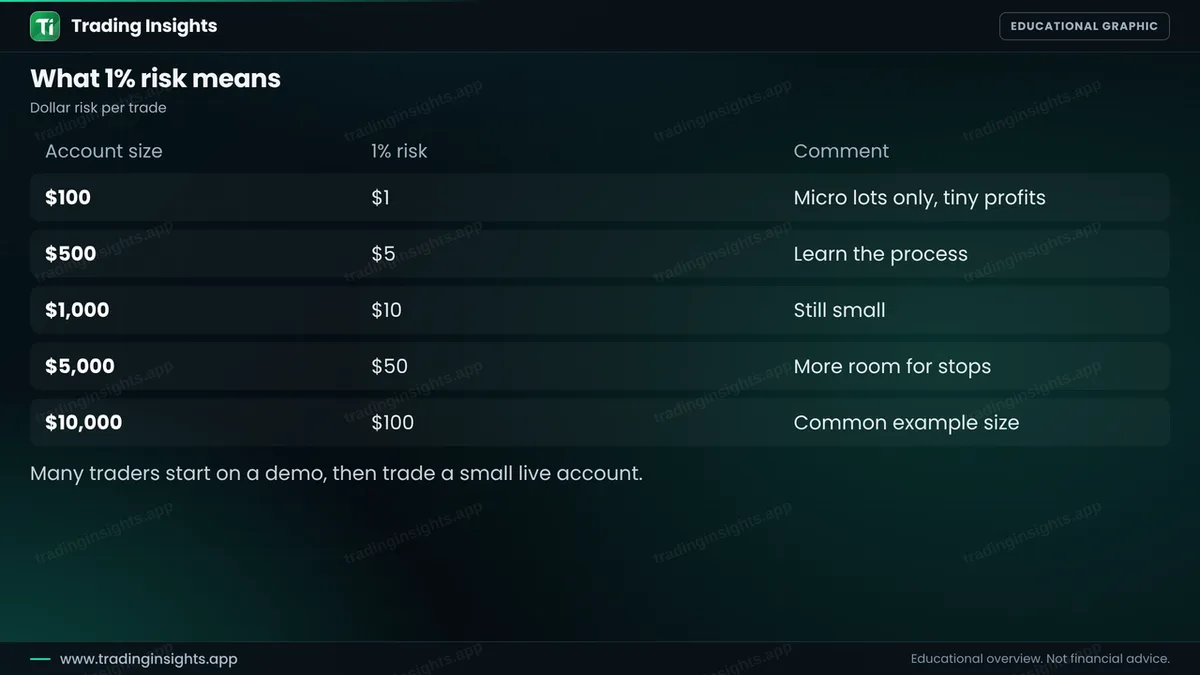
That gives a quick table. A 20-pip stop needs about $200, a 50-pip stop needs $500, and a 100-pip stop needs $1,000. If you start with $100 and use a 30-pip stop, your smallest trade risks 3% of the account, which breaks the 1% rule before you begin. You can use the position size calculator to check your own numbers.
Costs do not shrink with the account
Spreads and commissions are the same in dollars per lot no matter how small your balance. A 1-pip spread on a 20-pip stop is 5% of your planned risk on any account. On a small account, the proportion that goes to costs is therefore a larger share of your small profits. This is another reason to trade fewer, better setups and to compare brokers on total cost.
How to decide how much to start with
- Use spare money only. Never use rent money, loans or emergency savings.
- Start on a demo account until you can follow your plan for several weeks.
- Go live small. Pick a balance whose 1% fits your usual stop at the broker's minimum lot size.
- Keep risk at 1% or less per trade and write the dollar figure down.
- Avoid leverage as a substitute for size. High leverage lets you open trades your balance cannot safely carry. The glossary explains margin and leverage.
Two illustrative examples
The examples use invented prices and a $2,500 account with a 1% risk budget of $25, at $10 per pip per standard lot.
Illustrative example 1 (win). EUR/USD holds a support level and a bullish candle closes. The trader buys at 1.0925 with a stop at 1.0900 (25 pips) and a target at 1.0975 (50 pips). Size: $25 / (25 x $10) = 0.10 lot. The target is reached and the trade makes 0.10 x 50 x $10 = $50. That is a 2% gain on the account, which is a good result and still only $50.
Illustrative example 2 (loss). AUD/USD rejects resistance and the trader sells at 0.6485 with a stop at 0.6506 (21 pips) and a target at 0.6443 (42 pips). Size: $25 / (21 x $10) = about 0.11 lot (rounded down). The stop is hit for a loss of about 0.11 x 21 x $10 = $23.10. The loss is within the plan, and the account is down about 0.9%.
Compare this with a $500 account on the first trade: 1% is $5, so a 25-pip stop would need 0.02 lot. A trader who cannot trade less than 0.05 lot is risking $12.50, or 2.5% of the account. The plan is the same, but the account is too small for it.
Common mistakes
- Opening a tiny account and risking 10% a trade. It feels like a way to grow fast, but a short losing run can wipe it out. Keep risk small even if profits look small.
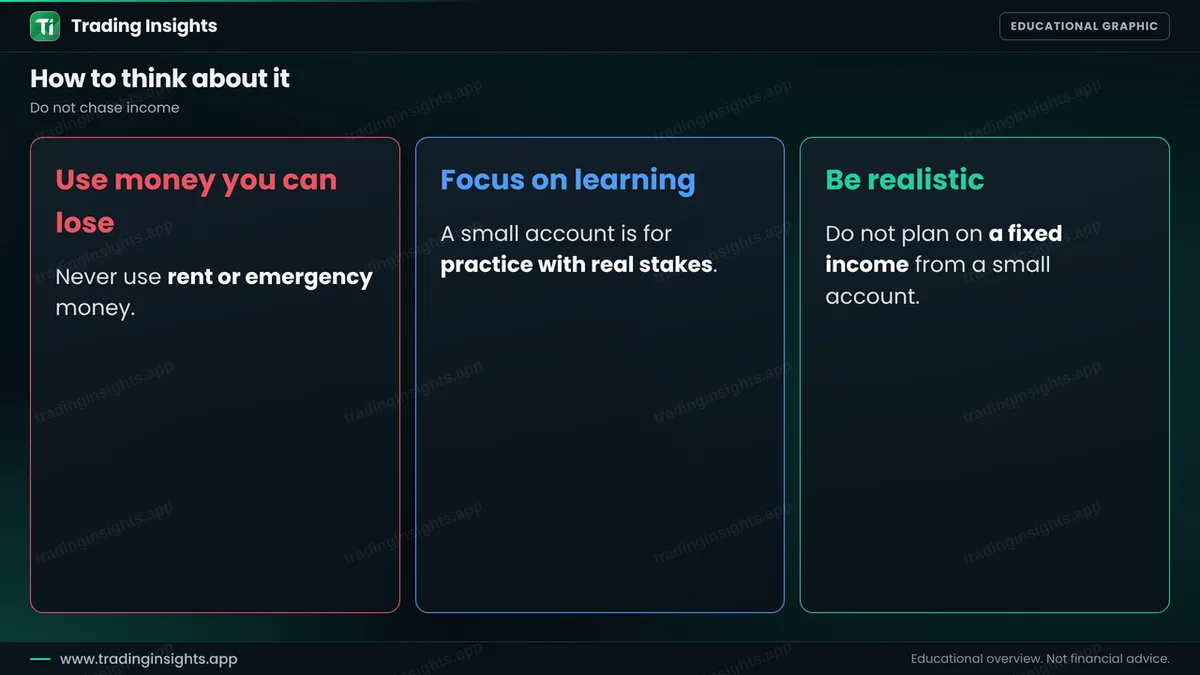
- Expecting a living from a small account. Percentage returns on a small balance cannot cover real expenses. Treat it as training and build skill first.
- Borrowing money to trade. Debt adds pressure, and pressure damages decisions. Trade only money you can afford to lose.
- Ignoring minimum lot sizes. If the smallest trade breaks your risk rule, the account is too small for that stop. Check the broker's minimum before depositing.
Pre-deposit checklist
- Can I lose this entire amount without affecting my essential expenses?
- Does 1% of the account fit my usual stop at the broker's minimum lot?
- Have I practised my plan on a demo account?
- Do I know the broker's costs per lot?
- Have I written down my maximum loss per trade, per day and per week?
- Am I clear that this is for learning first, income later?
Frequently asked questions
What is the minimum to start forex?
It depends on the broker, and some allow very small deposits. A low minimum does not make it a good starting size, because your risk rules still have to fit.
Can I trade forex with $100?
Technically yes, with micro lots, but 1% risk is about $1 per trade, which a 30-pip stop on the smallest lot would exceed. It is better used for practice than income.
How much should I risk per trade?
Many traders risk 1% or less of the account. Pick a number, write it down and keep to it.
Should I start with a demo account?
Yes. Practise the plan on a demo, then go live with a small amount so that real money does not teach you your first lessons.
This article is educational and is not financial advice. You can lose some or all of the money you deposit, and the examples use invented prices. Only trade with money you can afford to lose.


